
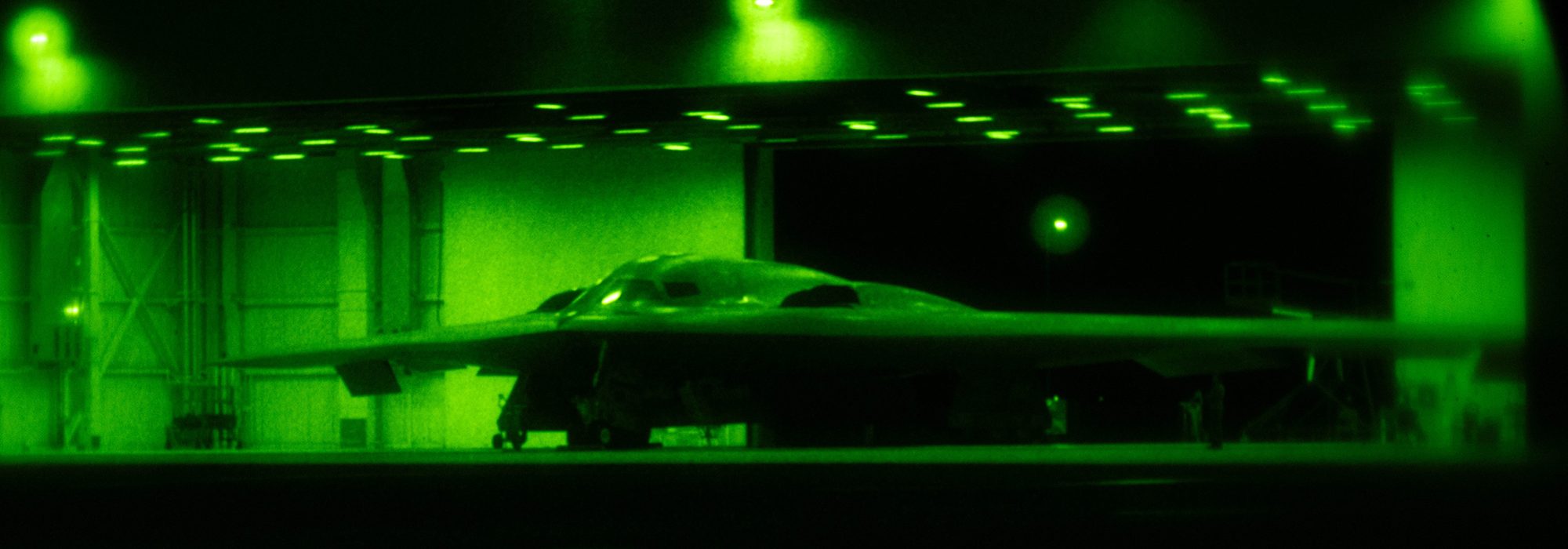
In a period of seven months, the United States executed two extremely different, yet equally devastating military operations on two sides of the world.
In June’s Operation Midnight Thunder, seven U.S. B-2 bombers destroyed most of Iran’s nuclear production capacity in an overwhelming demonstration of the U.S. Air Force’s unique ability to execute both global reach and global power. Then in January, the U.S. applied its unique stealth, cyber, special operations, and space assets to execute a joint mission to capture Venezuelan dictator Nicolás Maduro and his wife, plucking them from the presidential palace in a flawlessly executed midnight raid.
As President Donald Trump rightly stated, no other country on Earth could have pulled off these missions. Each demonstrated the exceptional capabilities the U.S. military has honed over the past 50 years. And yet these successes also shine a bright light on what our military lacks today and what must be done to fix that.
This is no time to rest on past laurels.
America’s ability to execute complex military operations may be second to none, but our capacity to fight a prolonged war is in doubt. Our unique technological advantages are eroding, as rivals strive to counter them and catch up. Worse, our defense in depth—that is, the forces we have at our disposal—is shrinking. China already has a larger Navy than the United States and it is on pace to overtake the size and scale of our Air Force, as well.
Size alone does not guarantee competence, of course. For that, we need look no further than Russia, which squandered its size advantage in Ukraine. But force structure enables deterrence, strengthens resilience, and makes it possible to reconstitute and repeat an action when necessary.
In Midnight Hammer, the Air Force employed more than half of its 19 B-2 bombers, sending seven jets forward and using three in an elaborate deception. More than 125 aircraft took part in the operation, including stealthy F-35A fighters that led the way in and out of Iran. Tankers and other assets also contributed.
The mission may have been flawless, but could USAF have repeated the mission a day or week later? The B-2s are 30 years old, and the Eisenhower-era tankers that refueled them are twice that age. Older planes, like older people, require more recovery time. Operation Absolute Resolve, the code name for the Maduro extraction, was also highly taxing. This time, some 150 aircraft took part, including about 20 percent of the entire U.S. F-22 force, along with Air Force and Marine Corps F-35s, Navy F/A-18s and E/A-18s, plenty of tankers, and a variety of unmanned aircraft.
If a single eight-hour mission against a crumbling South American dictatorship requires a fifth of its air superiority fighters, one has to wonder if our Air Force lacks the material depth to execute a sustained campaign against a peer adversary.
These two missions were effectively one-offs, like prize fights for which a champion has months to prepare. By contrast, a peer fight with a competitor is more like an Olympic relay race, in which each successive runner must hand off the baton to a teammate with the talent and energy to achieve victory. If any one of them drops the baton, the whole team loses. Successful relay teams have depth.
Operation Desert Storm, fought some 35 years ago, offers a clear and valuable lesson for planners today. That war, fought by generals who spent their formative years fighting in Southeast Asia and their entire careers in the context of the Cold War, was premised on a commitment to apply overwhelming force to ensure overwhelming victory.
Having once fought a war in which their hands were tied by policymakers, those generals had no intention of letting that happen again. Using forces built and trained to counter and defeat a larger Soviet peer in an existential contest, they went to war against Iraq with a disproportionate advantage, and they intended to use it to the fullest.
When Saddam Hussein invaded Kuwait in August 1990, it was only months after communist regimes in the former Soviet bloc collapsed like dominoes in the fall of 1989. One by one, Poland, Hungary, East Germany, Czechoslovakia, Bulgaria, and Romania fell. Indeed, unthinkably, the Soviet Union itself would cease to exist in December 1991.
Freed from the threat of a Soviet invasion in Europe, U.S. military planners threw everything they had against Saddam’s Iraqi army, then the fourth largest in the world: more than half a million troops, some 1,300 aircraft, and a sizable naval armada.
Planners had the luxury to draw from ample capacity, building strike packages on a scale not seen since World War II and not repeated since. Aircraft carriers crowded into the Persian Gulf. And when air ops slowed, Navy Tomahawk cruise missiles kept the pressure on the enemy.
Today, however, the U.S. Air Force lacks the aircraft, the weapons reserves, and the training they had in 1990. We can execute bespoke operations like Midnight Hammer and Absolute Resolve, but can USAF sustain a multiday attack plan?
President Trump appears to understand the problem and the necessary fix. In early January, he announced his intent to invest $1.5 trillion in defense in fiscal 2027, the first volley in what will surely be a hotly debated 2027 budget. If approved, that would be a 50 percent budget increase, a percentage not seen since 1951. In pure dollar terms (not adjusting for inflation) that increase alone is about what the entire Department of Defense spent in all of 2011.
Whether that $1.5T is a negotiating starting point or a serious figure is hard to know right now. But either way, it seems likely that the 2027 budget will be larger than today’s nearly $1 trillion, opening the possibility that, for the first time in decades, the Air Force and Space Force could gain the kind of investment that would begin to fix long-festering shortfalls in people, planes, parts, and training.
The prospect of buying dozens more F-35 and F-15EX jets each year, accelerating and increasing orders for B-21 bombers, completing the purchase of new E-7s, and accelerating development of the F-47, Collaborative Combat Aircraft, and perhaps a new mobility aircraft is highly motivating. So is finally solving the chronic pilot shortage and rebuilding morale in the fighting forces.
Few doubt that America still has the best military capabilities in the world. The question is whether we have enough capability and capacity—including trained and ready personnel—to deter a peer from risking a protracted fight with us. Experience shows it is better to invest now in deterrence than to pay the price in blood and treasure for an all-out war later.
Tell your representatives in Washington: Increasing defense spending is not just a “nice to have.” It’s an imperative to secure America in the future.