
AURORA, Colo.—Air Mobility Command’s interim boss said the Air Force is behind on modernizing its airlift fleet, to include selecting a Next-Generation Airlifter to replace the service’s fleet of C-5 and C-17 workhorses—a project that faces stiff competition for resources in the service’s modernization portfolio.
During a Feb. 24 panel on readiness at AFA’s Warfare Symposium, Lt. Gen. Rebecca J. Sonkiss said finding a solution for the NGAL program will be one of her top priorities, after taking over for her former boss, Gen. John D. Lamontagne, who recently became the Air Force Vice Chief of Staff. To Sonkiss, NGAL often gets overlooked alongside high-profile programs such as the B-21 Raider and Next-Generation Air Refueling System.
“I have to modernize the mobility fleet. And if you want to judge me 10-15 years from now, look at whether I was actually able to gain traction on Next-Generation Airlifter because that’s the next big problem that we have that we’re behind on,” Sonkiss said. “We must figure out what the pathway for [successors to the] C-5 and C-17, that strategic airlift fleet that doesn’t often gain traction in the narrative of what we need to modernize. We must come up with what the Next-Generation Airlifter is, because it is key to the readiness for the joint force.”
An Air Force plan, released in November, calls for the service to start fielding a new aircraft that will serve as the NGAL by 2038 but expects to have to keep the C-5 Super Galaxy and C-17 Globemaster in service until 2045 and 2075, respectively. NGAL would replace the two existing airlifters on a one-for-one basis, meaning the Air Force plans to buy about 274 new large cargo jets over the next five decades. NGAL is scheduled to have initial operating capability by 2041.
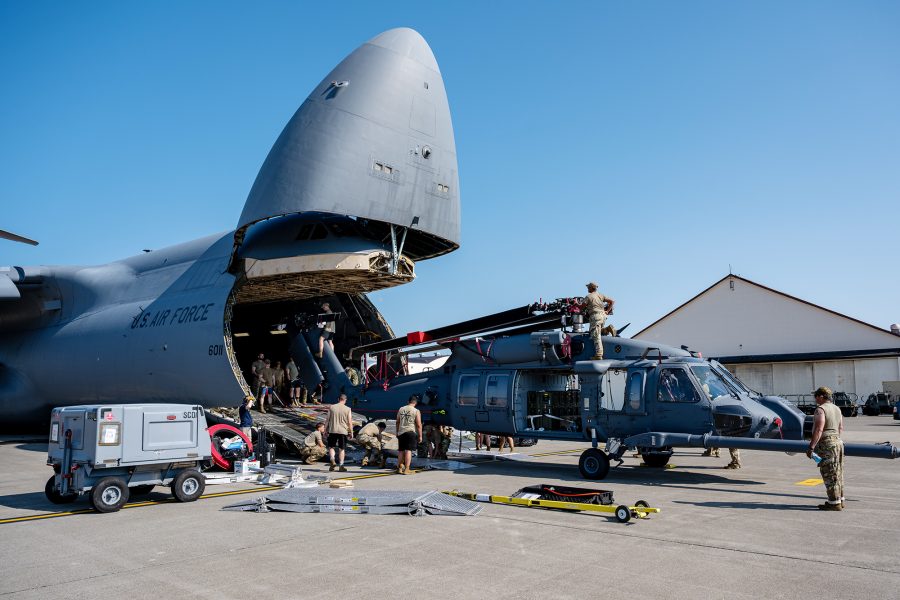
The C-5, which reached initial operating capability in 1970, is still a “critical tool” in AMC’s airlift toolkit, Sonkiss said during a Feb. 24 media roundtable.
“There is no other aircraft that can provide the capacity that the C-5 does, and we’ve shown time and time again that when that aircraft is asked to perform, it does,” she said. “[But] it is an old airplane. We have to get after what ‘next’ looks like, and we can’t wait until we’re shoveling [C-5s] into the boneyard before we get to that discussion.”
Sonkiss, a C-17 pilot, has a similar view of the Globemaster. “The C-17 is the most amazing airplane ever made,” she said. “I have a lot of time in it, so I can say that we have asked it to do a lot of things, and it’s done more than we ever planned for when we bought that airplane. It has performed flawlessly.”
The C-17 fleet, however, now averages about 25 years in service—high-tempo, hard operations.
“It’s getting old too. I cannot have a gap in my strategic airlift forces, and we’re working forward on the NGAL to combine the view of the C-5 and the C-17 fleet and figure out what the next strategic airlift needs to be. That conversation, in my book, can’t happen enough or can’t happen fast enough,” Sonkiss said.
In the near-term, Sonkiss said her main worry is the lack of digital connectivity for C-5 and C-17 crews flying in today’s challenging operational environment. “Your mobility forces are not connected,” she said. “We are on a pathway to try and get there, but I do not have battle space awareness.”
In a roundtable with reporters, Sonkiss said the Air Force has “been woefully negligent … way too long” by failing to invest in connectivity for the air mobility fleet.
As recently as 2024, then-AMC Commander Gen. Mike Minihan acknowledged to the House Armed Services Committee that his command would not meet his goal of equipping a quarter of its fleet with modern connectivity and situational awareness gear by fiscal 2025. Stressing that it remained an urgent need, he said the upgrades would cost $500 million but failed to make that year’s Air Force unfunded priorities list because the service was trying to crack down on unbudgeted requests; then-Chief of Staff Gen. David W. Allvin saw spare parts to boost readiness as a higher priority, said Lt. Gen. David H. Tabor, who was director of programs at the time.
Pushing that priority into the out years has left the fleet vulnerable, Sonkiss said. “I do not have battle space awareness in my strategic airlifter when my C-17 goes into the tactical environment—Unsat!” Sonkiss said. “We have to do better for our crews, it’s linked to survivability,” she added. “Our C-5s can be more effective if they know what’s going on, and they can remission in real time to get after work, the needs of the theater. Connectivity has to happen.”