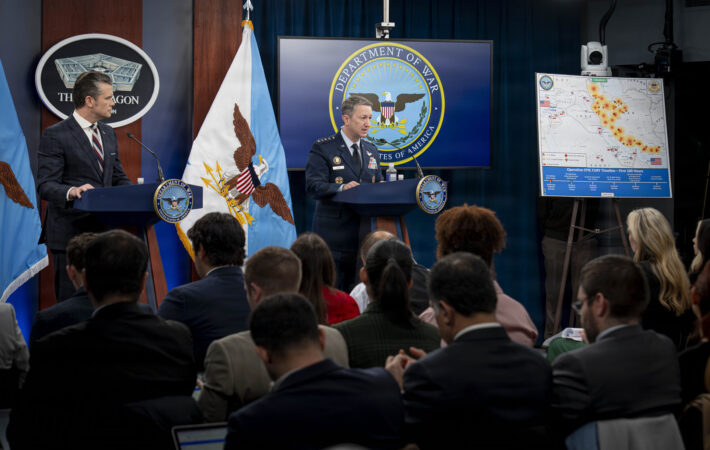
Control of the skies in Operation Epic Fury is enabling the Pentagon to rely more on satellite- and laser-guided bombs, throttle back on expensive long-range standoff munitions, and move to a new phase of air war, defense officials said March 4.
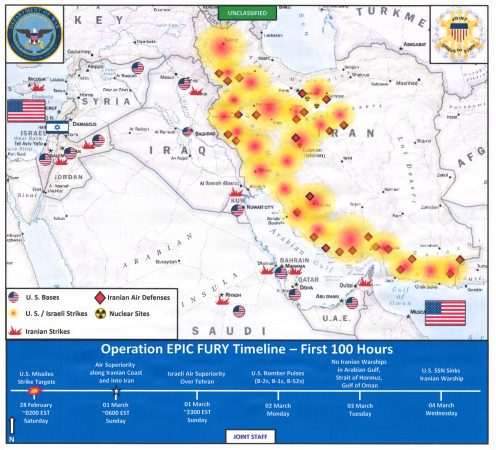
Chairman of the Joint Chiefs of Staff Gen. Dan Caine said the degradation of Iran’s air defenses had enabled the U.S. to achieve air superiority in the southern part of the country, enabling strikes deeper inland.
“This progress has allowed CENTCOM to establish localized air superiority across the southern flank of the Iranian coast and penetrate their defenses with overwhelming precision and firepower,” Caine said. “We will now begin to expand inland, striking progressively deeper into Iranian territory and creating additional freedom of maneuver for U.S. forces.”
As observers expressed concern about the rate of high-end munitions expended in the conflict, the Pentagon says they have become less reliant on those weapons as Epic Fury has progressed. “We used more exquisite standoff munitions at the start, but no longer need to,” Defense Secretary Pete Hegseth told reporters at the Pentagon.
To buttress its claims, the U.S. released extensive footage, apparently from MQ-9 Reapers or other overhead drones, which showed them either destroying Iranian targets or recording strikes launched from other platforms.
CENTCOM confirmed the uncrewed, relatively vulnerable MQ-9s are now participating in the campaign. B-1, B-2, and B-52 bombers are also launching strikes and are likely to increase in tempo now that the U.K. has allowed the U.S. to use its bomber bases in England and on the Indian Ocean island of Diego Garcia for strikes against Iranian targets. Nearly every type of fighter in service with the U.S. military is involved in Epic Fury.
“You’ve got to keep bombing them,” one former well-placed defense official said. “We’ve got tools that we can apply, and we’ve never been in a better place to apply them.”
Days after President Donald Trump said the campaign could take four to five weeks, Hegseth said March 4 that it could last as many as eight weeks.
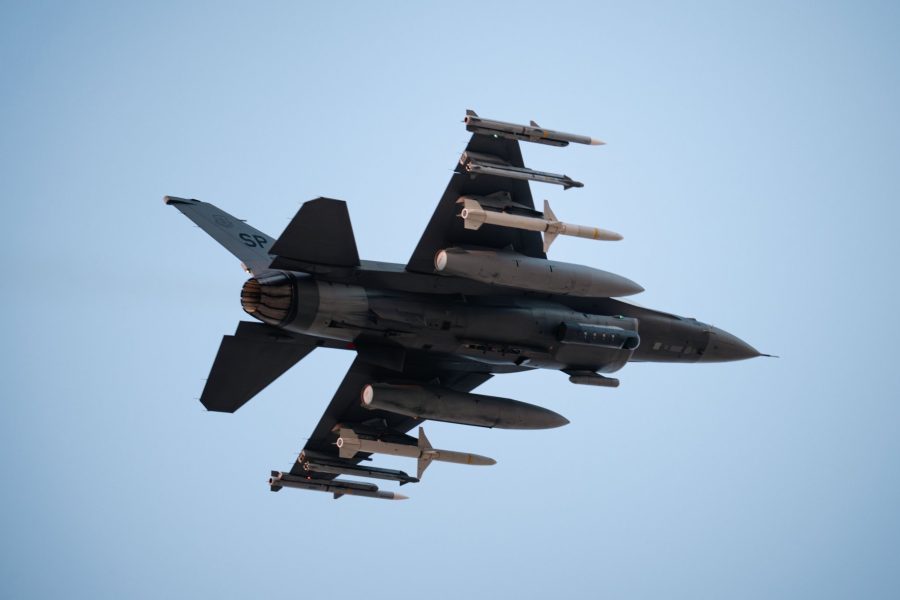
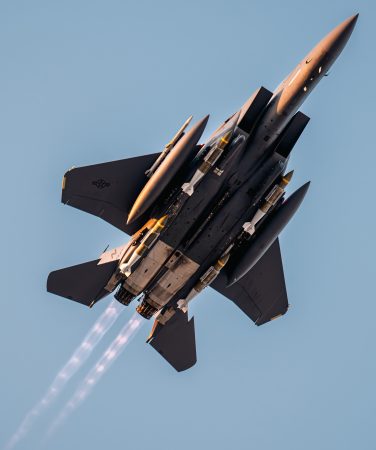
CENTCOM released images March 4 of U.S. Air Force aircraft that are participating in Operation Epic Fury, including non-stealthy fourth-generation F-15E Strike Eagles and F-16 Fighting Falcons. One F-15E, which carries a tailcode from RAF Lakenheath, U.K., is armed with four JDAM guided bombs, while carrying just one air-to-air missile for self-protection.
An F-16 from Spangdahlem Air Base, Germany’s 480th Fighter Squadron—a so-called “Wild Weasel” air-defense-hunting unit—is armed, along with other weapons, with two AGM-88 High-Speed Anti-Radiation missiles for knocking out radar-guided air defenses, indicating the U.S. likely now has its fourth-generation fighters in the thick of the combat.
“CENTCOM is now shifting in day four already from large deliberate strike packages using stand-off munitions at range outside an enemy’s ability to shoot at us now into stand-in precision strikes overhead Iran,” Caine said. “This is a point of munitions transition, from stand-off munitions to stand-in munitions like Joint Direct Attack Munitions, which are GPS-aided free-fall weapons, and other things like Hellfires, etc.”
The Pentagon has provided little detail on strikes against the Iranian leadership. Those appear to be carried out mainly by the Israeli Air Force, including the strike that killed Iran’s Supreme Leader, Ayatollah Ali Khamenei, which kicked off the war.
Elbridge Colby, the Pentagon’s top policy official, said in an appearance at the Council on Foreign Relations March 4 that U.S. and Israel’s military objectives overlap but are not identical.
Iran has retaliated by launching drone and missile attacks across the Gulf and at Israel. Six Americans were killed in Kuwait on March 1 when their tactical operations center was hit by an Iranian attack drone. That incident appears to have contributed to Kuwaiti forces being on edge the following day when at least one Kuwaiti Air Force F/A-18 shot down three U.S. Air Force F-15Es in a friendly fire incident, Air & Space Forces Magazine previously reported.
The Pentagon expressed confidence the missile threat will diminish in the days ahead.
“Iran’s theater ballistic missile shots fired are down 86 percent from the first day of fighting, with a 23 percent decrease just in the last 24 hours,” Caine said. “And their one-way attack drone shots are down 73 percent from the opening days.”