
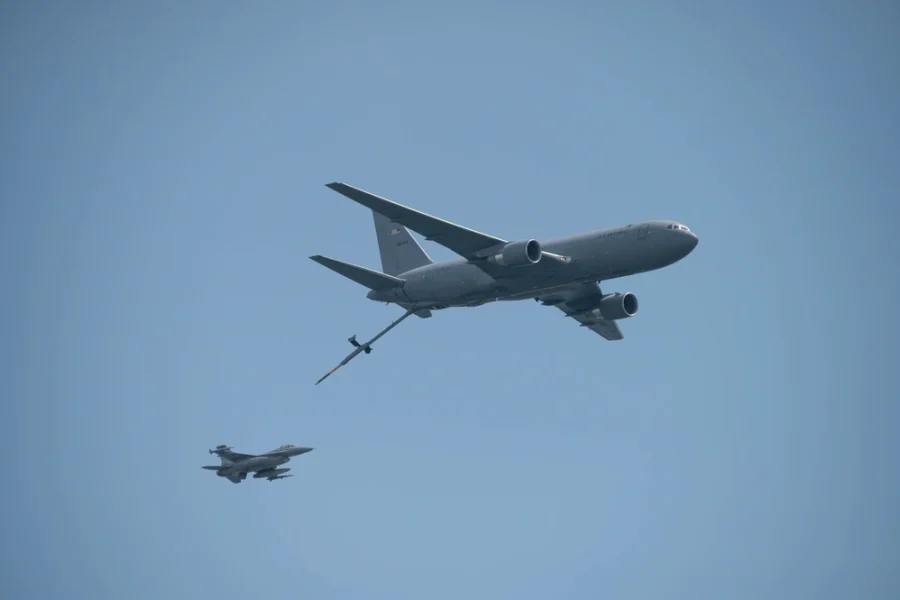
The Air Force won’t finalize a new deal with Boeing for another 75 KC-46 tankers until some of the “deficiencies” with the refueler are resolved, new Vice Chief of Staff Gen. John D. Lamontagne told lawmakers March 4.
The service announced in July 2025 it would purchase another 75 KC-46 Pegasus refuelers on top of the current program of record for 188 while the Air Force explores plans for a Next-Generation Air Refueling System. The additional KC-46s are intended to serve as a short-term measure to keep production on a modern tanker going while the Air Force considers a long-term plan to replace its aging fleet of about 375 KC-135 Stratotankers.
The decision to buy more KC-46s, instead of holding a competition for a new tanker, comes despite years of struggles for the Pegasus and its maker, Boeing. The Air Force and Boeing are still working to revise the aircraft’s Remote Vision System for boom operators after the initial version had visibility issues, and the boom telescoping actuator is still being redesigned after it was found to cause the boom to become “stiff” and prevent it from refueling certain aircraft, such as the A-10 Thunderbolt II, that cannot produce enough thrust to keep the boom in place during refueling.
While providing a program update to Sen. Dan Sullivan (R-Alaska), Lamontagne said the service is working “our way from 183 to 188 by the end of that initial contract” by next year. But Lamontagne, the former boss of Air Mobility Command, offered assurances that the plan for 75 more aircraft won’t be implemented without the plane’s issues being addressed.
“We are working through a couple of issues with the contractor, and we’re not going to get a new contract for another 75 KC-46s until we work through some of those deficiencies,” he said, adding that the new contract won’t likely come for another “couple of years.”
That timeline tracks with the current agreement, which states that the KC-46A production extension contract is planned from fiscal 2028 to fiscal 2036, according to a Justification and Approval document released by the service last fall. But it does put pressure on Boeing to ensure the program doesn’t suffer any delays as it has in the past n the past and that planned upgrades are completed.
In addition to the RVS and boom, the KC-46 has had issues with leaks in its fuel system, cracks on some airframes, and quality issues with its auxiliary power unit’s drain mast. Deliveries have been paused multiple times.
The RVS—the camera and video system boom operators use to refuel other aircraft—has been by far the most prominent problem, though. In certain lighting conditions, the boom operator is unable to see the receptacle clearly, resulting in damage to the receiving plane if the boom scrapes against that aircraft.
Last year, the Air Force and Boeing projected a new Remote Vision System 2.0 for the KC-46 will be fielded by summer 2027. The new date is nearly two years longer than previously anticipated, and four years later than originally expected.
The problems with the stiffness of the KC-46 refueling boom comes from the boom actuator which drives the boom out in the telescope direction to properly connect with a receiving aircraft. Rather than redesign the entire boom, Boeing and the Air Force chose to redesign the actuator, but developing a compliant actuator has proven to be difficult, then-Col. Leigh Ottati, chief of the KC-46 program office, said in 2023.
Boeing CEO Kelly Ortberg said recently that the company has now lost more than $7 billion on the fixed-price contract for the KC-46, describing the original deal has been a “bad contract for the last decade.” Boeing officials are hoping to underwrite the new contract for the additional 75 KC-46s “to ensure it’s a fair contract and we can make money on that,” Ortberg said.
Lamontagne said the Air Force is “confident that a good plan is in place” to complete the current program next year, “and then in subsequent years, we’ll intend to pursue another 75 KC-46s to deliver to the fleet.”