
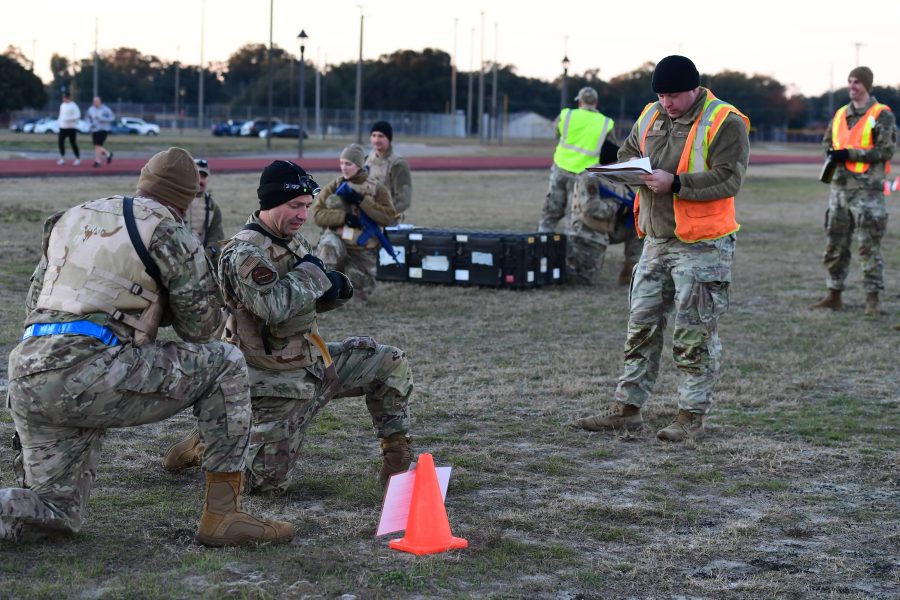
AURORA, Colo.—Still in the midst of transforming Basic Military Training to emphasize a shared “airminded” identity over job specialties, the Air Force training leaders are making similar changes at the next stop in an enlisted Airman’s career: tech school.
Every two weeks now at tech school, service members will have a small exercise “that brings you back to touching the roots of being an Airman,” 2nd Air Force Commander Maj. Gen. Matthew Wolfe Davidson told an audience Feb. 24 at AFA’s Warfare Symposium.
The initiative is called BRACER FORGE, a callback to PACER FORGE, the capstone agile combat employment exercise Airmen face at the end of Basic Military Training. And like PACER FORGE, BRACER FORGE will challenge Airmen to accomplish tasks outside of the specialties they may spend the rest of their career doing—specifically tasks to “defend, operate, generate and sustain airpower,” Davidson said.
For example, “if you’re a if you’re an antenna specialist … you’re going to get three personnel as air traffic controllers, and your job is to lead them in the establishment of an antenna,” Davidson said. “So now we’re going back to, I’m leading others. … It gets back to this basic sense of I’m an Airman first, or whatever you need me to do, I’ll do it—whether it’s setting up tents or fixing airplanes or putting gas in them.”
The BRACER FORGE concept dates back to 2024, but officials are revamping and expanding it. The effort is in “various states of implementation” across the five training wings that conduct tech training, Davidson said, and each of the different tech training schools are figuring out the best way “to achieve those outcomes as they do these reinforcement exercises.”
The end goal of the concept is to instill a “deep understanding and connection” in Airmen that regardless of specialty, they are responsible for mission accomplishment, Chief Master Sgt. Colin Fleck, command chief of the 2nd Air Force, said.
“You may not have all the specialties you need, but mission still has to get done,” he said.
It’s the same mindset Davidson and Fleck are seeking to instill at Basic Military Training. To that end, they launched BMT 2.0 last October, putting more emphasis on physical fitness training and trainees operating in small teams to defend, operate, generate and sustain airpower. The next phase of the effort, BMT 3.0, will begin in April and include a mock airfield with a C-130 cargo aircraft and F-16 fighter jets The airbase training range, scheduled to be operational in September, will give trainees a place to practice basic airfield support skills such as arming and refueling aircraft, repairing bomb-damaged runways, and loading casualties into a cargo aircraft for evacuation.
After receiving a mission brief, Fleck noted, “they have to run through their own risk management to decide what the top risks are, and they have to brief that back to the [military training instructor] to make sure that they’ve got it nailed down. They assign roles and execute the task.”
Fleck said the main idea of the airbase training range is to force Airmen to work as a team with discipline and attention to detail while executing airpower-related tasks.
Instilling that mindset—what leaders have dubbed airmindedness—is a massive shift; Davidson claimed this is the “most significant transformation of basic military training since 1950 … when we made the transition from an Army-based BMT into an Air Force-based BMT,” he said.
Now that the changes are trickling into tech school too, “this is the most transformational thing going on in the Air Force because this is not just about Basic Military Training,” Davidson said. “This is about changing the identity of Airmen.”