

Three weeks after being sworn in as the new Chief of Staff of the Air Force, Gen. Kenneth S. Wilsbach climbed into the cockpit of an F-22 fighter on Nov. 24 and prepared to take off from Langley Air Force Base, Va.
Now he wants the rest of the Air Force’s top leaders to likewise return to the skies.
Wilsbach is “encouraging commanders and leaders of all flying units to maintain or regain active flying status,” the Air Force said in a Dec. 2 release. The CSAF’s directive, an Air Force spokesperson told Air & Space Forces Magazine, is aimed at career aviators now commanding at the wing or higher levels. Such commanders typically have 1,000 or more flight hours to their credit, but as they ascend the ranks, they increasingly spend more time on staffs and less on the flight line. Wilsbach wants them to live the operational side of their duties.
“It allows one to connect with the rank and file who are accomplishing the mission,” said retired Lt. Gen. David A. Deptula, dean of AFA’s Mitchell Institute for Aerospace Studies. “And they appreciate someone who shares their risks and frustrations and conditions, and that’s what happens when you go down and fly as a senior officer with a unit.”
Leaders can have regular contact with Airmen without flying, but Deptula argued the nature of flying—from the time preparing on the flightline to the post-flight debriefs—creates unique bonds.
“Senior officers tend to get isolated from what’s going on in the rank and file—not necessarily because they want to, but because their staffs insulate them in some cases, and simply because of the nature of the job,” Deptula said. “But if you go down and fly, what you find out is you get attuned to what the challenges are at the squadron level.”
Deptula, who remained fully combat-mission-qualified in the F-15 at every rank throughout his three-star career, said that connection flows both ways.
“The captains and the majors and the lieutenant colonels will go, ‘You know, this really is a pain in the ass, why are we doing this?’ And you have an opportunity to explain, ‘OK, look at it from this perspective.’ In terms of communication, it provides a venue to exchange information that simply isn’t there otherwise,” he said.
Retired Col. John Venable, a fellow at the Mitchell Institute and a former F-16 pilot and Thunderbirds commander, said that without spending time in aircraft, leaders can become disconnected from the challenges of executing operations.
“There’s so much to [flying] and so many things that you can actually trip over and get yourself or someone else in big trouble,” Venable said. “Flying regularly is something that everyone needs to do, and if you don’t do that as a commander, if that’s not one of your priorities, then it’s not something that you recognize.”
Another former senior leader, a fighter pilot who oversaw combat operations, said understanding the nitty-gritty of ops is vital.
“You want to get a sense of whether the direction you’re giving A, makes sense, and B, is being followed,” he said. “ … There’s no better way of assessing how that’s going than being in the air and having to follow the rules that I put in place.”
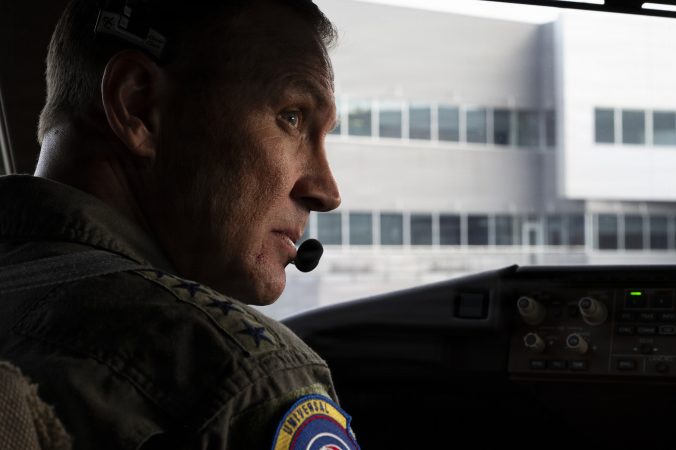
In the context of the entire joint force, commanders who fly can speak with greater authority when discussing operations with leaders from other services, the former senior leader added.
“The unique part about the Air Force is that we’ve always been a service technologically, operationally, that puts our officers up front when it comes to the flying part of the business,” he said. “So having senior officers in the flying business is absolutely appropriate. Always has been.”
Even outside of combat, flying can give senior leaders better insight into training and readiness challenges, Deptula said: “They’re going to be able to actually experience the same kind of frustrations as the captains and the majors that are flying.”
As an example, Deptula cited a time when he had to switch F-15s multiple times before taking off due to maintenance issues. A discussion about low availability rates is abstract in a PowerPoint briefing, but clear as day when experienced firsthand.
That said, all three former officers also noted that flying time comes with a cost. “It’s a value versus cost assessment,” the former senior leader said. “Because the cost is there. Every hour we put in a senior leader is an hour we don’t put in a young person.”
Deptula and Venable cited their concerns about the state of current Air Force readiness and the Air Force’s inability to get pilots enough flying time in recent years. Getting flying hours for senior commanders means finding the funds to do that without undermining readiness of fighting forces. “In this particular timeframe, where readiness is really low, you have to deal with this,” Deptula said. The way he dealt with the issue while he was a senior officer often meant flying with Guard units, which avoided draining Active-duty resources.
Venable recalled experiences as a young officer, when he and his fellow junior operators came up against what he called “sortie-sucking colonels,” who did the bare minimum to stay qualified and then otherwise spent minimal time in their aircraft.
“The one thing I would say that’s got to be a commitment from everybody that jumps into an airplane is they’ve got to be credible,” the former senior leader said. No faking allowed. “The worst-case scenario is that everybody in the squadron is looking at the senior officer who’s got to come in for that flight, and they’re just not credible, safe, or capable. They’re not putting the time in to maintain that credibility. That becomes a big negative.”
How much time it takes to build real credibility varies depending on the aircraft and the aviator, the former officers said. In some cases, it might mean flying once a week, while in others once a month would be enough.
Air Force policy authorizes officers in senior leadership positions to fly for either operational or indoctrination. An Air Force spokesperson told Air & Space Forces Magazine that Wilsbach wants leaders to maintain “operational flying status.”
At the base level, Basic Aircraft Qualification requires a certain number of flying hours, simulator time, check rides, and instrument qualification. But an aviator also can be certified as “Basic Mission Capable” or “Combat Mission Capable,” depending on additional training. Mission Qualification Training is developed at the unit level with specific requirements depending on the aircraft.
For officers with only Basic Aircraft Qualification, an instructor pilot must also be along for the ride, according to Air Force policy. If deemed basic mission capable or combat mission capable, however, they can fly solo.
“Specific status, identifiers (or codes), and requirements will depend on the individual positions and aircraft,” the Air Force spokesperson said.