
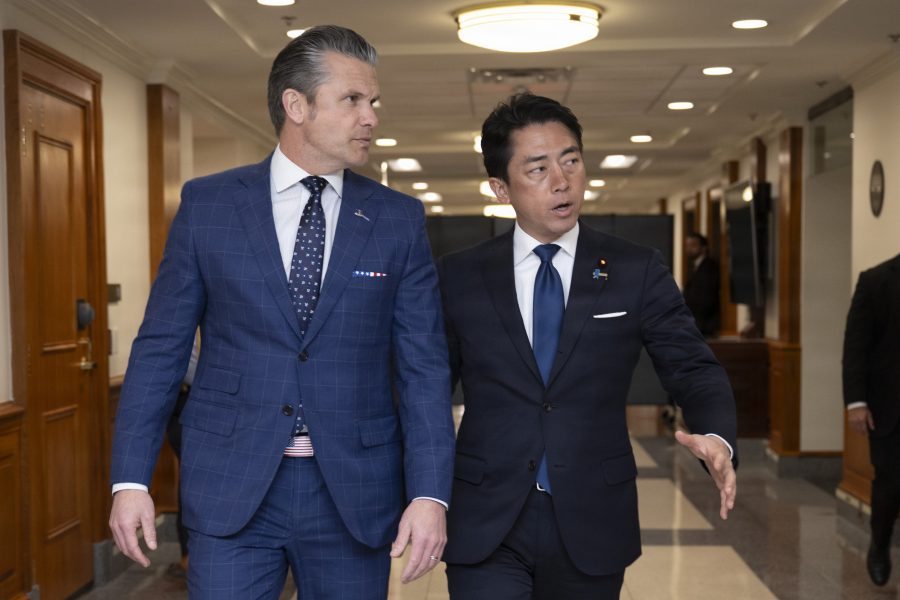
Japanese Defense Minister Shinjiro Koizumi met U.S. Secretary of Defense Pete Hegseth on Jan. 15 as the two nations look to further solidify their ties in the face of growing Chinese and North Korean threats.
“Our job and our goal here is to continue that, to strengthen that in every way possible,” Hegseth said at Pentagon. “It’s going to be hard-nosed realism, practical, common-sense approach that puts both of our vital national interests together and keeps the peace.”
One of the central efforts to deepen those ties is the transformation of U.S. Forces Japan into a joint forces headquarters that can coordinate military operations with the Japanese, plan joint exercises, and help defend the country if hostilities break out.
Japanese officials, eager to bolster the partnership under the Trump administration, have strongly supported the new command, announced by the Biden administration during then-Defense Secretary Lloyd Austin’s visit to Tokyo in July 2024. And the Trump administration appears to be moving forward with those plans.
A precise timeline for the transition and the final form of the new U.S. military headquarters is not yet clear. A Pentagon spokesperson did not immediately respond to questions about the status of the transition of U.S. Forces Japan.
In a readout of the meeting issued Jan. 16, Pentagon spokesman Sean Parnell said Hegseth and Koizumi “agreed to continue upgrading alliance command-and-control architectures, make bilateral training and exercises more realistic, improve alliance force posture and presence—including in Japan’s Southwest Islands.”
The moves are already underway, officials have previously said. And the Trump administration made moves to further it in December when it submitted nominations to separate out the dual-hat command structure of U.S. Forces Japan and the Fifth Air Force.
The White House has nominated Lt. Gen. Stephen F. Jost to remain as commander of U.S. Forces Japan, with Maj. Gen. Joel L. Carey, the Chief of Staff of Indo-Pacific Command and a close aide to INDOPACOM boss Adm. Samuel J. Paparo, set to become the head of the Fifth Air Force.
For more than 60 years, USFJ and the Fifth Air Force have shared a commander. The move to separate the commands opens up the USFJ job to officers from other services in the future. Jost is a year and a half into what is traditionally a three-year assignment.
The Senate has yet to act on either nomination.
In conjunction with the changes to USFJ, Japan is also standing up its Joint Operations Command, which commands branches of the Japan Self-Defense Forces and works with foreign militaries. Hegseth visited Tokyo last March, shortly after the command was established, and offered support for the effort and said at the time that more personnel and a larger staff would be coming to U.S. Forces Japan.
In an op-ed in a Japanese newspaper last summer, Jost wrote that “these shifts in command and control are occurring against the backdrop of intensifying regional concerns, including a rise in coercive and unprofessional military maneuvers in all domains of operations.”
Later that summer, command and control “augmentees” arrived at the U.S. Forces Japan’s headquarters, in what the command said at the time was the start of a “multi-phase effort in which more staff and resources will arrive in the coming months as USFJ transitions into a warfighting headquarters.”
“The transformation into a warfighting headquarters will streamline decision-making and create more agile and lethal forces, embodying peace through strength through credible deterrence in the Indo-Pacific,” a spokesperson for U.S. Forces Japan told Air & Space Forces Magazine last month. “Ultimately, this transition will enhance unilateral and bilateral readiness to respond to any contingency, support to U.S. operations, and enable our Japan and U.S. Forces to protect the security, prosperity, freedom, and well-being of the U.S. and our allies and partners in the region.”
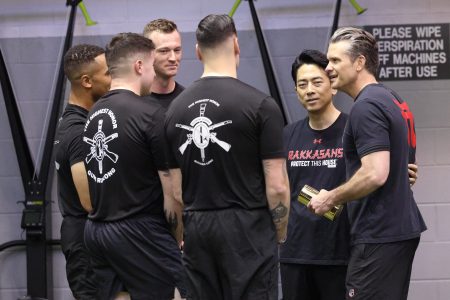
Underscoring Japan’s effort to maintain warm relations with Washington, Koizumi did not start his day at the Pentagon. Instead, he met Hegseth at Fort Myer, Va., for an early-morning physical training session with Hegseth and members of the Army’s Old Guard, during which the two men were cordial and appeared to share some laughs throughout the workout session.
Hegseth, wearing a 187th Infantry Regiment “Rakkasans” t-shirt, gifted Koizumi a matching shirt. The parachute unit earned the nickname, which loosely translates to “falling umbrella” in Japanese, during their occupation of Japan after World War II. Koizumi comes from a prominent political family. His father served as Japan’s prime minister while his grandfather was the director general of the defense agency that later evolved into the Ministry of Defense.



“The Japan-U.S. alliance is becoming even more solid and unwavering,” Koizumi said in brief comments at the Pentagon.
In November, Japan’s Prime Minister, Sanae Takaichi, angered Beijing by suggesting that Japan could become involved militarily if China attacked Taiwan. China lashed out at Japan and cut back on exports of rare earth minerals and rare earth magnets.
Tensions in the region also increased in December after Chinese forces conducted an air and sea exercise near Taiwan that U.S. officials said appeared to be a rehearsal for a potential quarantine of the self-governing island.
Speaking at the Honolulu Defense Forum on Jan. 13, Koizumi stressed the need for “like-minded” Pacific nations to strengthen their defense ties. “Right now, we can see tensions that are on the brink of war across the globe,” said Koizumi, who did not mention China by name.
Koizumi added Jan. 15 that he has had “very intensive and in-depth discussions about Japanese and American responses to an increasingly severe security environment.”
This article was updated Jan. 16 with additional information.