
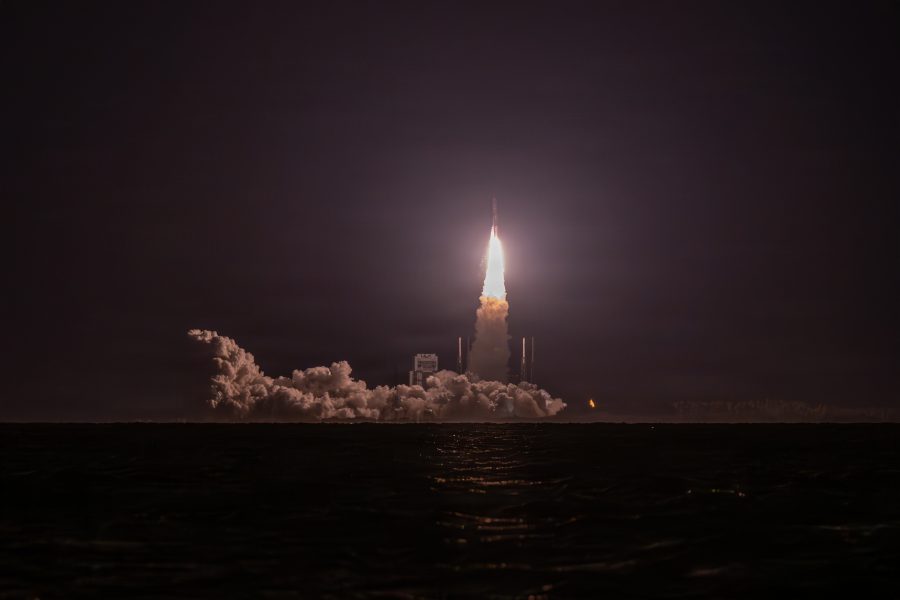
United Launch Alliance’s Vulcan rocket flew its second Space Force mission Feb. 12, carrying multiple Space Force payloads to geosynchronous orbit after observing a performance issue with one of its solid rocket boosters early in the flight.
The mission, USSF-87, took off from Cape Canaveral Space Force Station, Fla., just after 4 a.m., on a 10-hour journey carrying payloads for the Space Force’s Geosynchronous Space Situational Awareness Program as well as an undisclosed test and experimentation mission.
The launch was successful but following liftoff, ULA confirmed it had observed an issue involving one of the vehicle’s four solid rocket motors. In a later statement, the company’s Vice President for Atlas and Vulcan Programs Gary Wentz characterized it as a “significant performance anomaly.”
“Despite the observation, the Vulcan booster and Centaur performed nominally and delivered the spacecraft directly to geosynchronous orbit,” the company said. “The integrated U.S. government and contractor team is reviewing the technical data, available imagery, and establishing a recovery team to collect any debris. We will conduct a thorough investigation, identify root cause, and implement any corrective action necessary before the next Vulcan mission.”
It’s not immediately clear how this latest anomaly might impact the company’s upcoming launch plans. ULA is scheduled to launch the Space Force’s 10th GPS III satellite in March, a Next-Generation Overhead Persistent Infrared satellite in May, and spacecraft for the Space Development Agency’s Tranche 1 Tracking Layer in June.
Space Systems Command said in a statement that its System Delta 80, which oversees the launch enterprise, “will work closely with ULA per our mission assurance space flightworthiness process before the next Vulcan national security space mission.”
ULA and SpaceX are the only two launch providers with rockets certified to fly the Defense Department’s most pressing missions, though Blue Origin’s New Glenn, which flew its second mission last November, is making progress toward certification. ULA had planned to launch 10 Vulcan rockets last year, but ultimately only flew the vehicle once due to an investigation into an anomaly with its second stage booster.
It is unclear if there is any relation between previous issues with the Vulcan and the rocket’s Feb. 12 anomaly.
Company officials said this week the firm is “laser focused” on increasing its launch rates and plans to fly up to 18 missions in 2026.
“We have an inventory of already built rockets that will allow us to get up to that rate through this year,” interim CEO John Elbon told reporters Feb. 10, prior to the launch. “What we need to do is execute our launch activities at the Cape and at Vandenberg, and that’s very achievable for us.”
During the same briefing, Wentz said USSF-87 was Vulcan’s longest to date, and is the class of launch the rocket was designed to fly.
“This is the type of mission that the team actually designed this launch vehicle to support,” he told reporters Feb. 10, prior to the launch. “It’s significant payloads to very complex orbits, multi-manifested, national security space, direct to GEO. This is tailor-fitted for that mission; this is why we put Vulcan in place.”
The mission, USSF-87, featured an undisclosed number of payloads for the Space Force’s GSSAP program, which has been called the service’s “neighborhood watch” constellation, observing activities in geosynchronous orbit. The Space Force launched its first six GSSAP satellites in pairs and had indicated USSF-87 would repeat that pattern, but declined to say how many of the satellites were onboard the mission.
“Data from the GSSAP will uniquely contribute to timely and accurate orbital predictions, enhancing our knowledge of the GEO environment and further enabling space flight safety, including satellite collision avoidance,” Space Systems Command said in a statement.
Besides GSSAP, the launch carrried other research and development and training systems. According to SSC, Guardians will use the spacecraft to “refine tactics, techniques, and procedures for precision on-orbit maneuvers” and that they would “enhance and validate resiliency and protection” in GEO. The command would not confirm further details about their mission.