
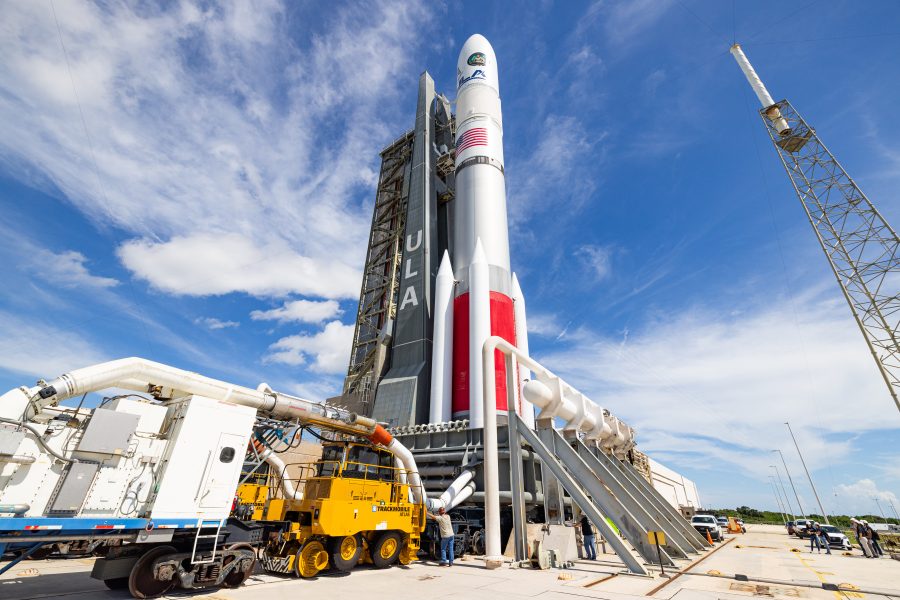
United Launch Alliance executives say the firm is “well positioned for the future” despite falling short of its projected launch cadence in 2025 and seeing longtime CEO Tory Bruno depart in early January for competitor Blue Origin.
ULA’s interim CEO John Elbon told reporters Feb. 10 that the firm is “laser focused” on meeting the demands of its military, civil, and commercial customers.
“We have a backlog of over 80 missions and combined with that a strong commitment from our board that’s focused on moving us forward into the future,” Elbon said in a phone briefing. “We’re just confident in the bright future ahead of us.”
ULA had planned for 20 launches in 2025, at least 10 of those missions flying on its new Vulcan Centaur rocket. However, a late 2024 booster malfunction during the rocket’s second test flight disrupted those plans. In the end, the company flew just six times and only once on Vulcan, and several Space Force missions were put on hold as a result.
Then last month, Bruno announced he was leaving the company to lead national security programs at Blue Origin. Elbon acknowledged Bruno’s departure is significant for the firm, citing the significant role he played in helping get Vulcan’s development over the finish line.
“Tory, to some degree, was the face of ULA,” Elbon said. “But our strength is really in the engineering expertise and the production expertise and the launch expertise—the 3,000 people that do that work. I remain just incredibly proud of the team, and we’re going to do great things going forward.”
While ULA, a Boeing-Lcokheed Martin joint venture, once dominated the military space launch market, SpaceX in recent years has unseated the firm, largely due to its reusable Falcon 9 rocket, which launched 165 times last year. Competition from companies like Blue Origin, a new entrant to national security launch business, could pose further threats.
In 2023, multiple news outlets reported that ULA was up for sale, naming Blue Origin among the interested buyers, though a deal never materialized. Asked whether a potential sale is on the table or if ULA plans to diversify and expand into the satellite business, as both SpaceX and Blue Origin have done, Elbon said the company and its board are developing an internal strategy and aren’t ready to disclose future plans.
“Both Boeing and Lockheed are very supportive of ULA,” he said. “They’re excited about the future. There’s a lot of growth in space, and so over the next period of time, we’ll be sorting out the specific path forward.”
For now, the company is focused on achieving a stable launch rate for 2026. ULA is targeting between 18 and 22 flights this year—up to 18 on Vulcan and up to four on its legacy Atlas vehicle—and Elbon said the firm is well positioned to meet that launch rate.
The company recently completed several infrastructure projects at its launch site at Cape Canaveral Space Force Station in Florida, which Elbon and Chief Operating Officer Mark Peller said will go a long way toward helping ULA meet its launch goals for the coming year. That includes building a second mobile launch platform for Vulcan and a second integration facility, which Peller said will effectively double the company’s East Coast launch rate.
At Vandenberg Space Force Base in California, the company is in the midst of modifying its launch facility to accommodate Vulcan. Those upgrades should be finished this spring or early summer.
“We have an inventory of already built rockets that will allow us to get up to that rate through this year,” Elbon said. “What we need to do is execute our launch activities at the Cape and at Vandenberg, and that’s very achievable for us.”
ULA’s 2026 manifest includes at least seven missions for the Space Force and the National Reconnaissance Office. The first of those is slated to launch Feb. 12 from Cape Canaveral with at least two payloads for the Space Force. The service’s acquisition arm, Space Systems Command, declined to confirm how many satellites will be part of the mission, USSF-87, but it will include at least one Geosynchronous Space Situational Awareness Program spacecraft, which will observe and track activity in GEO.
The mission also features an undisclosed number of research and development and training payloads designed to help Guardians “refine tactics, techniques, and procedures for precision on-orbit maneuvers” and “validate resiliency and protection in geosynchronous orbit.” SSC declined to provide further details about the spacecraft.
Vulcan delays have strained ULA’s relationship with the Space Force over the past few years—prompting Boeing and Lockheed to stand up an independent review team in 2024 to assess ULA’s production readiness. According to Elbon, the firm has addressed those concerns and today has a strong partnership with the Pentagon.
“I think we are on a good trajectory to have a successful year launching the manifest that we’ve laid out, and our relationship with the Space Force and the Pentagon in general will just continue to grow as a result of that,” he said. “All will be well going forward.”