
The Pentagon’s top weapons tester noted progress on key munitions for the Air Force in his latest report, covering everything from dogfighting missiles to hypersonics.
The office of the Director of Operational Test and Evaluation released its annual report this month, looking at 18 major Air Force programs in various stages of testing. Of those 18, four are for munitions.
Released from Oversight
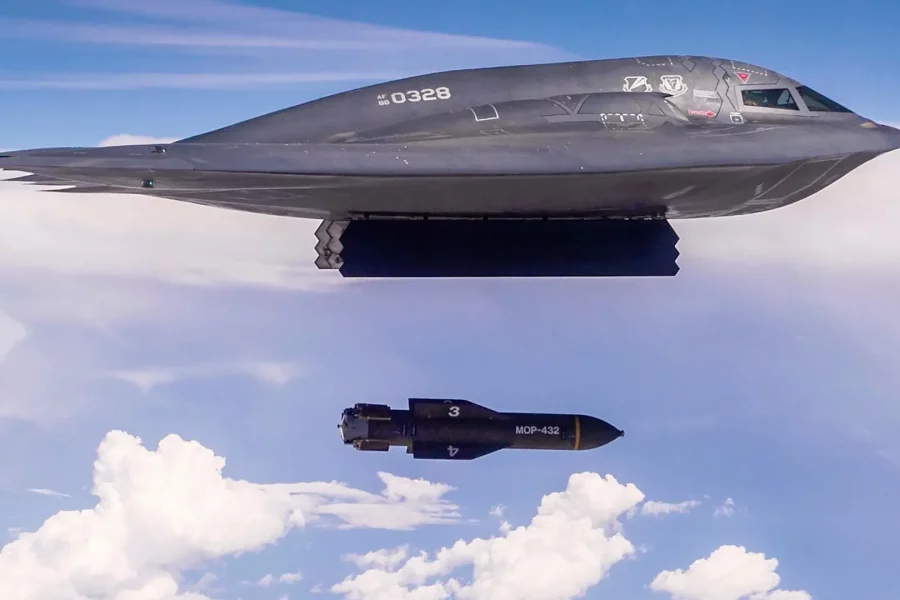
One such weapon made major headlines in 2025: the Guided Bomb Unit-57 Massive Ordnance Penetrator. The Air Force dropped 14 GBU-57s in Operation Midnight Hammer in June 2025 when it struck Iranian underground nuclear facilities.
It was the first publicly reported use of the 30,000-pound bunker-busting bombs in combat, and its success—the report notes that the bombs “met release parameters, guided accurately to their aimpoints, and functioned as intended”—led DOT&E to remove the weapon from its oversight list.
The MOP includes a hardened casing that can cut through layers of concrete, steel, and rock. Sensors inside the bomb can detect the depth of penetration to time detonation at a specified depth. The Air Force started working on a modification to the MOP in response to an “urgent operational need,” developing a “smart fuze” to ensure the weapon works even when intelligence on the target is limited.
The service finalized a deal with Boeing in early February for more than $100 million to restock its MOP stores, Air & Space Forces Magazine reported.
Another program released from DOT&E oversight is the AGM-183A Air Launched Rapid Response Weapon, or ARRW.
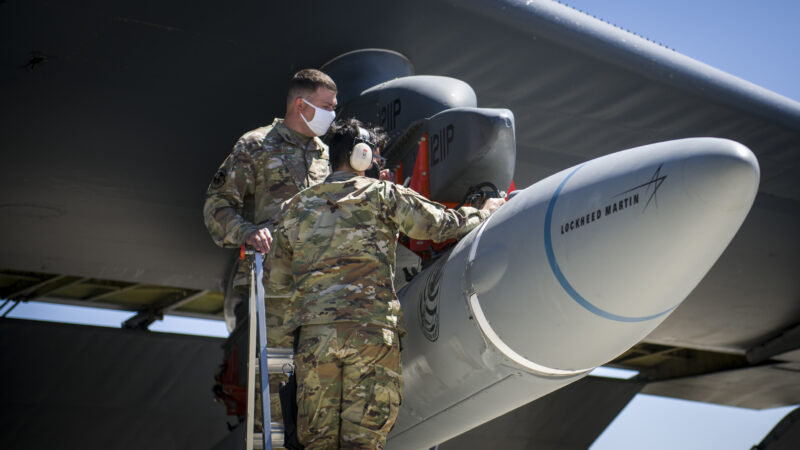
The ARRW is one of two main hypersonic efforts being pursued by the Air Force and was revived with funding restored to the program in the fiscal 2026 budget.
Former Air Force Secretary Frank Kendall told Congress in 2023 that the service was “more committed” to its other program, the Hypersonic Attack Cruise Missile. That decision followed a series of early unsuccessful tests for the ARRW.
But, in 2025, then-Chief of Staff of the Air Force Gen. David Allvin reversed course, telling congressional leaders the service would move ahead with procurement of the ARRW.
The ARRW is a conventional, air-launched, boost-glide, hypersonic weapon being produced by Lockheed Martin. It is intended to reach speeds faster than Mach 5.
The fiscal 2026 budget allotted $362 million for ARRW procurement, and the ARRW program office plans to award the first production contract in fiscal 2026, a spokesperson with Air Force Life Cycle Management told Air & Space Forces Magazine.
Upgrades
The DOT&E report also noted a successful software upgrade to the decades-old AIM-120 Advanced Medium-Range Air-to-Air Missile, or AMRAAM, that has “significantly” improved its range.
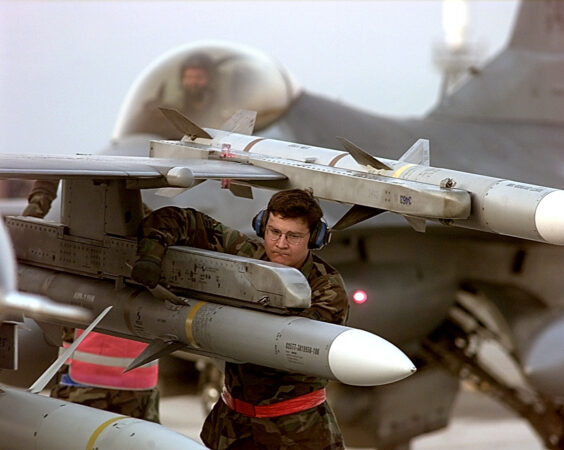
(Photo by Senior Airman Jeffrey Allen, U.S. Air Force. (Released))
AMRAAM production began in 1987, and the dogfighting missile is operational on the F-15, F-16, and F-22 aircraft. It was first deployed for use in 1991.
Experimental tests conducted in 2024 expanded the range and lethality of the weapon, builder RTX told Air & Space Forces Magazine in September 2025.
The exact range of the AMRAAM is operationally sensitive, but pre-software upgrade, the D3 variant was believed to be able to fly about 80 miles.
Officials did not disclose how much the upgrades had extended the missile’s range.
Raytheon officials said at the time of the announcement that modern electronics freed up space on the munition for a larger engine, providing more thrust. The main improvement, however, came from a more efficient battery and software.
That allowed engineers to extend the time of flight, which expanded its range.
“The propulsion and aerodynamic properties of the missile … in that F3R variant … always had the capability to go further. We just had not been able to take advantage of it,” said Jon Norman, Raytheon vice president of requirements and capabilities. “So, at this point, it’s the way we’re flying it. It’s flying higher and longer. We can fly at a much faster speed at release, which just improves the performance of the missile.”
DOT&E officials are continuing to monitor work on the GBU-53/B Stormbreaker Small Diameter Bomb Increment II, or SDB II.
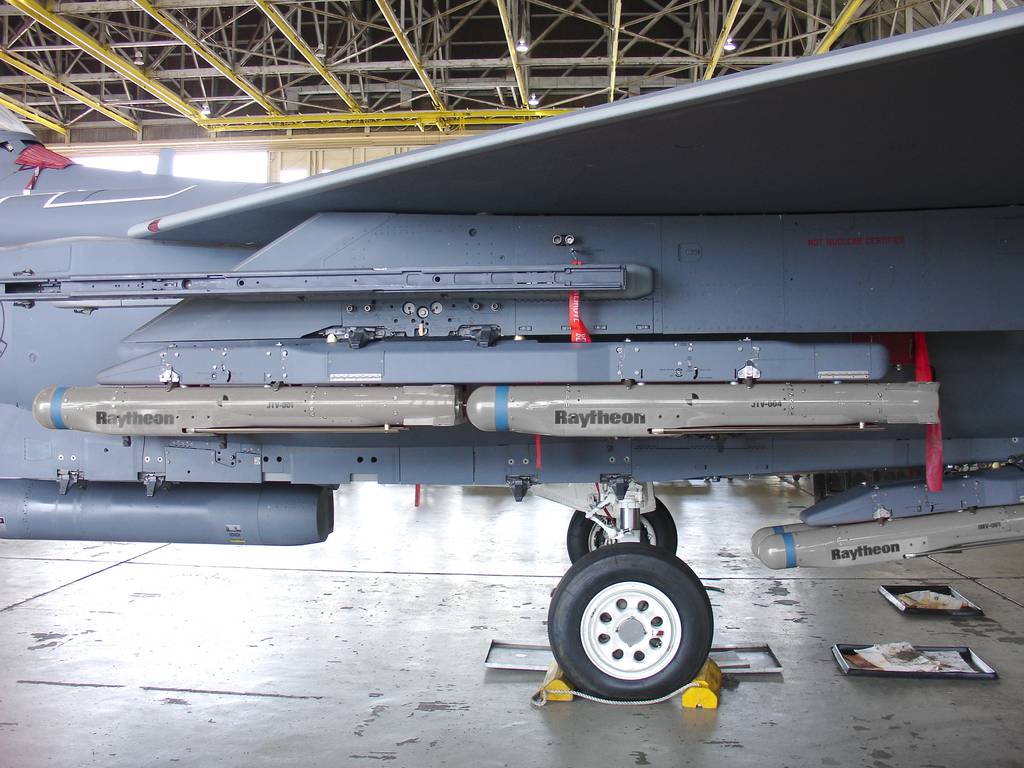 An F-15E fighter aircraft is armed with the Small Diameter Bomb II, under development by Raytheon for the Air Force and Navy. Courtesy of Raytheon.
The 250-pound air-to-ground glide bomb is a network-enabled weapon with an encrypted weapon data-link radio, allowing it to strike moving targets in adverse weather at standoff ranges.
The network capabilities allow either airborne or ground controllers to send in-flight target updates and enable users to abort a mission post-release, according to Navy data.
The weapon is a joint Air Force-Navy program which saw Increment II fielding on an F-15E in 2020, followed by initial operational capability on the aircraft in 2022. The Navy integrated the weapon on its F-18E/F in late 2023.
The bomb was used by U.S. fighters to target Houthi sites in Yemen in 2025.
The Pentagon weapons tester wants the services to continue streamlining the weapon’s cryptographic processes and to work with test ranges to mitigate F-35 self-lasing restrictions, allowing SDB II to be used by all platforms.
