
The Space Force has adopted a more incremental approach to migrating new and legacy orbital warfare systems onto a consolidated, cloud-based command and control platform, according to the head of the Space Rapid Capabilities Office.
The program, dubbed Rapid Resilient Command and Control, or R2C2, was established in 2023 to operate Space Force satellites that are highly maneuverable and designed to respond to threats in orbit. That mission has become more important in recent years as U.S. Space Command calls for satellites to be even more responsive to a contested and congested space environment, a concept called dynamic space operations.
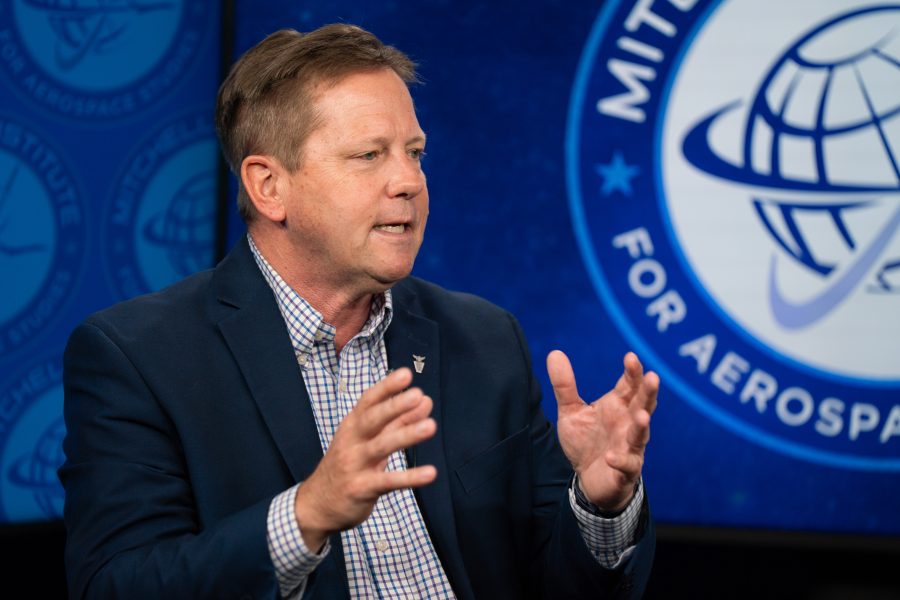
The Space RCO, led by Kelly Hammett, is spearheading the R2C2 development effort. The organization had hoped to start onboarding new programs to the baseline platform this year by focusing on rapidly developing and fielding software. But challenges transitioning legacy ground systems have slowed that progress.
Speaking with reporters at AFA’s Warfare Symposium in Aurora, Colo., Hammett described the original R2C2 strategy as “very audacious.” The program saw some early successes, like transitioning systems to a commercial cloud environment, and quickly bringing on a pool of nontraditional companies to help manage the effort. But the goal to migrate between 15 and 25 legacy programs onto the new platform in two years, while simultaneously developing the baseline system, proved too big a challenge, Hammett said.
“That didn’t pan out exactly the way we wanted,” he said. “We have not been able to effectively bring those flying programs in.”
The Space Force has long struggled to deliver ground command and control systems on time and on budget. Well-known examples include the GPS Next-Generation Operational Control Segment, or OCX, and the Advanced Tracking and Launch Analysis System. Space acquisition leaders have called for reforms to ground system development and procurement, including the adoption of commercial best practices like incremental development and delivery.
To course correct on R2C2, Hammett and his team have spent the last year “retooling” the R2C2 migration strategy. The Space RCO hired Space Dynamics Laboratory, a nonprofit research center owned by Utah State University, as its lead systems integrator. It also increased its delivery cadence from every eight weeks to a two-week cycle and it plans to use an existing contract mechanism called Marvin to hire more software developers who may not have a traditional space background and train them to operate in unclassified and classified environments.
“We hired these guys because the experiment was, these are not space ground people, they were software experts,” Hammett said. “We have got to get them on the team giving us more capacity to write code and bring in new mission partners.”
Hammett didn’t provide a timeline for completing the legacy transition and integrating newer systems as they come online. He stressed that the scope of the effort won’t change—R2C2 will still integrate all orbital warfare on one C2 platform—but the process will be more piecemeal and will take “a little longer” than originally planned.
Meanwhile, the Space Force is moving ahead with plans to develop a fleet of small, maneuverable satellites to augment and eventually replace one of its more well-known orbital warfare constellations, the Geosynchronous Space Situational Awareness Program. The service is on the verge of selecting an initial pool of providers for that acquisition effort, called RG-XX. Col. Bryon McClain, who leads that effort as Space Systems Command’s Program Executive Officer for Space Combat Power, told reporters in January that his team is working closely with orbital warfare operators within Mission Delta 9 to define ground system requirements.
McClain indicated that as the Space RCO works through R2C2 development, SSC is considering whether RG-XX will leverage some “temporary capabilities” used by classified programs in other mission areas.
“I do not intend to procure a new ground system for RG-XX that competes with any other common ground system,” he said. “We are working through internally what is the right answer using things that already exist.”