
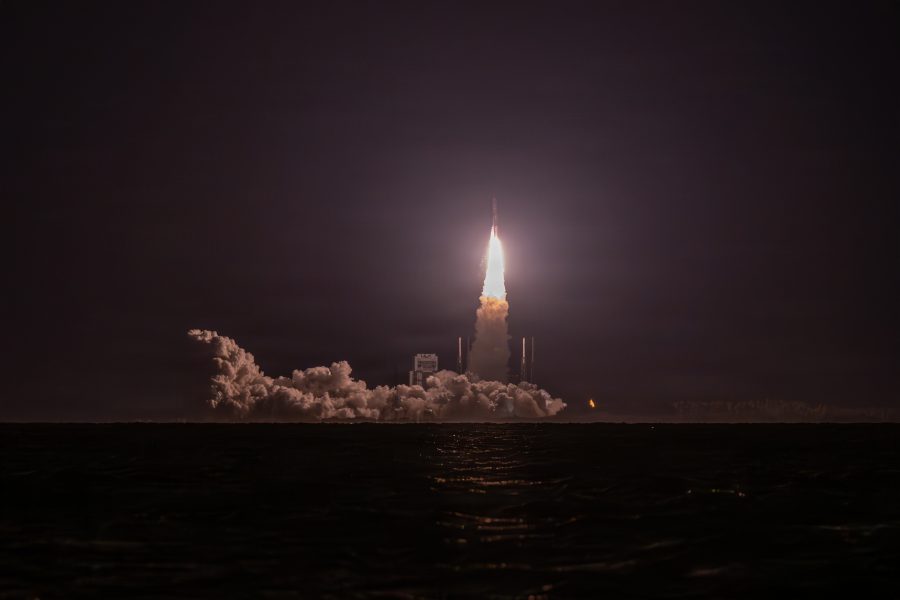
The Space Force is changing launch providers for an upcoming GPS III launch amid an ongoing investigation into United Launch Alliance’s Vulcan rocket.
The payload, initially slated to fly this month on Vulcan, will now launch on a SpaceX Falcon 9 rocket no sooner than late April, Space Systems Command said March 20.
“With this change, we are answering the call for rapid delivery of advanced GPS capability while the Vulcan anomaly investigation continues,” Systems Delta 80 Commander Col. Ryan Hiserote said in a statement. “We are once again demonstrating our team’s flexibility and are fully committed to leverage all options available for responsive and reliable launch for the Nation.”
The Vulcan anomaly occurred Feb. 12 during the Space Force’s USSF-87 mission. During the the flight, which carried two satellites for the Geosynchronous Space Situational Awareness Program, ULA observed an issue involving one of the vehicle’s four solid rocket motor boosters. The launch was still deemed successful and the payloads were delivered to orbit, but the company characterized the flaw as a “significant performance anomaly.”
The Space Force has since paused all military launches scheduled to fly on Vulcan as the anomaly investigation continues, and ULA said it will not launch the rocket until it identifies a root cause and implements any required corrective actions.
In light of the mission swap, Vulcan will now launch the Space Force’s USSF-70 mission, which was originally awarded to SpaceX and is schedule for the summer of 2028. The payload for that mission is Northrop Grumman’s Geosynchronous Auxiliary Support Tanker, GAS-T, which will dock with a client satellite to demonstrate remote proximity operations.
Vulcan had been schedule to launch seven national security missions this year, including the GPS III mission and the Space Force’s first launch of its Next-Generation Overhead Persistent Infrared satellite, a missile warning spacecraft scheduled to fly in May.
It’s not clear if the service will be able to change rockets for other missions manifested on Vulcan. GPS satellites are qualified for both rockets, which makes them easier to swap. The service has demonstrated its ability to re-manifest GPS III spacecraft multiple times through an effort known as Rapid Response Trailblazer.
“The ability to switch from one provider to another is present in those vehicles that just isn’t in some of the other families of vehicles,” SSC’s Deputy Commander Andrew Menschener told reporters Feb. 25.
Meanwhile, ULA officials told reporters last month they were hoping to turn a corner this year, after repeated development and testing delays over the last few years pushed back Vulcan’s certification to fly military missions.
“We have a backlog of over 80 missions and combined with that a strong commitment from our board that’s focused on moving us forward into the future,” ULA’s interim CEO John Elbon said in early February, just days before the USSF-87 mission. “We’re just confident in the bright future ahead of us.”
