
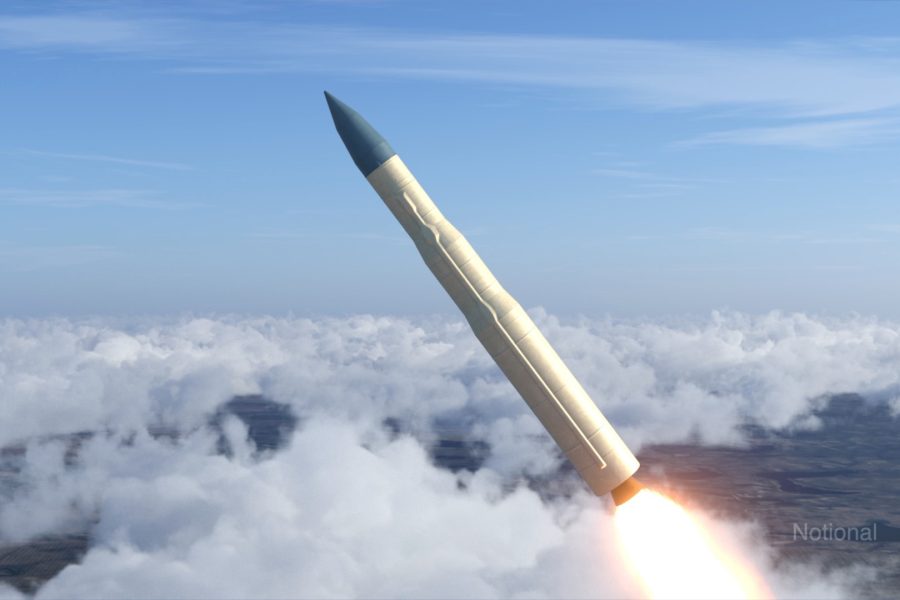
AURORA, Colo.—Senior U.S. military officials involved in restructuring the troubled LGM-35A Sentinel intercontinental ballistic missile program now project confidence it will achieve operational capability in the early 2030s.
A test launch of the missle is planned for 2027, and officials expect the overhaul of the Sentinel program to be completed by the end of this year.
“We’ve been through a program restructure that I actually think gives us more flexibility in deployment. We’ll bring more capability faster to the force,” said Air Force Global Strike Command boss Gen S.L. Davis, who briefed reporters alongside U.S. Strategic Command head Navy Adm. Richard Correll and director of critical major weapon systems Air Force Gen. Dale R. White.
The restructuring comes at a critical time in the Pentagon’s nuclear modernization program. With the expiration earlier this month of the 2011 New START treaty, there are no longer any legal limits on Russian and U.S. long-range nuclear forces.
No new American-Russian arms control talks have been set, and China has balked at joining the prospective negotiations. That has raised the possibility that the U.S. may opt to increase the size of the nuclear force it has deployed.
The restructuring of the Sentinel program comes after its soaring costs led to a so-called Nunn-McCurdy breach in 2024. That required the Pentagon to certify that the Northrop Grumman-made system was critical to national defense to continue. Officials say they do not yet have a new cost estimate for the program.
The ICBM program has already fallen behind the initial goal of entering service in 2029. That means that some LGM-30 Minuteman III missiles will serve into the 2050s instead of being phased out by 2036, as originally planned.
The ground facilities for the Sentinel have largely been the source of the problems rather than the missile itself. Under the restructuring, Sentinel will no longer use the same silos as the Minuteman III, which are already around 60 years old. If those Minuteman III silos were to be refurbished under the old plan, they would have been around 150 years old at the end of the Sentinel’s projected service life of about 70 years.
Instead, new silos would be built. Officials say this should be faster and less expensive because the new silos are modular and the work will not need to be done on silos that are currently being used.
All told, the 450 new silos will be needed as 400 Minuteman III missiles sit on alert, and there are spare silos. Northrop Grumman is now building a prototype silo in Utah, which broke ground Feb. 13.
“It’s opened up a lot of additional possibilities,” Davis said. “I don’t think we have the answer exactly how we’re doing that yet, but we have more flexibility.”
The construction of new silos also allows the use of “swing space” in some areas. That is, the use of sites on existing government-owned land, which would reduce the cost of acquiring private land.
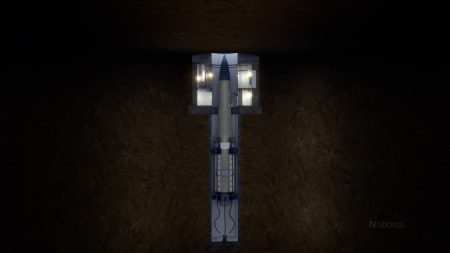
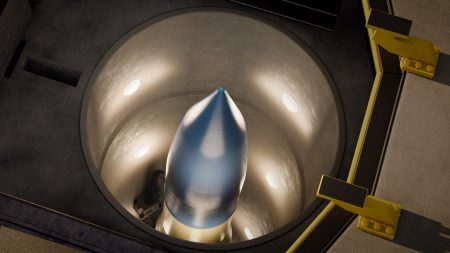
A Sentinel program office official, who declined to be identified under ground rules set by the Air Force, said the extent of the public land that would be needed was still under review. Some of the land is at Malmstrom Air Force Base, Mont., one of the three current and future Air Force ICBM bases.
The first Sentinel base will be F.E. Warren Air Force Base, Wyo, and the program entails far more than just the silos. In addition to F.E. Warren and Malmstrom, Minot Air Force Base, N.D., is the nation’s other ICBM base. The Air Force will build 24 launch centers and three missile wing command centers, spread over 32,000 square miles in five states and connected by roughly 5,000 miles of fiber-optic cables, officials said.
Sentinel is larger than the Minuteman III and is projected to have greater range and accuracy, the Air Force and Northrop Grumman said. The shroud on top of the missile features a propulsion system not present in Minuteman IIIs.
“This is what gives us the fine point that allows us to place the re-entry vehicle precisely on target, that greater accuracy that comes with the Sentinel system,” a Northrop Grumman official said.
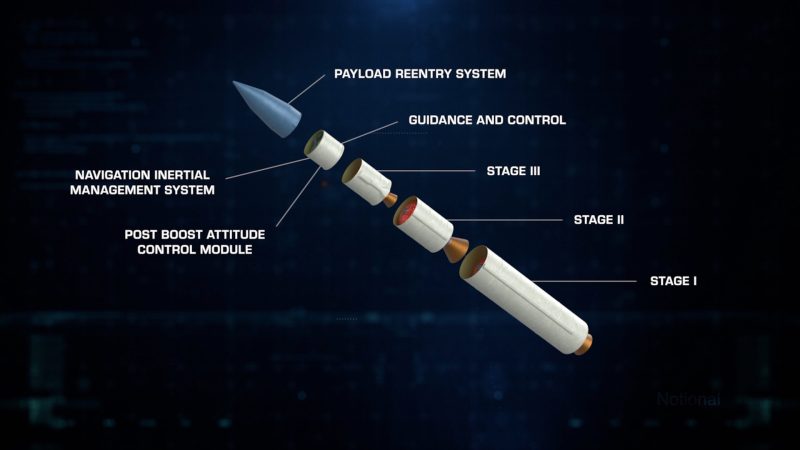
While Sentinel is being restructured as a program, it may also be altered as a strategic weapons system. America’s 400 Minuteman III missiles are on alert with a single nuclear warhead, though the system can carry up to three, a capability which is tested using non-nuclear Multiple Independently-targetable Reentry Vehicles. The ability to upload MIRVs remains a requirement.
“We have the ability to do that,” Correll said, speaking broadly about multiple reentry vehicles. “That’s obviously a national-level decision that would go up to the president.
The previously stated plan was to deploy each Sentinel with a single warhead. Officials declined to say how many warheads an individual Sentinel will be able to carry.
“As STRATCOM commander, I pay very close attention to how many missiles are available on a day-to-day basis,” Correll added. “And I can tell you, we have what we need, and we continue to have what we need.”