
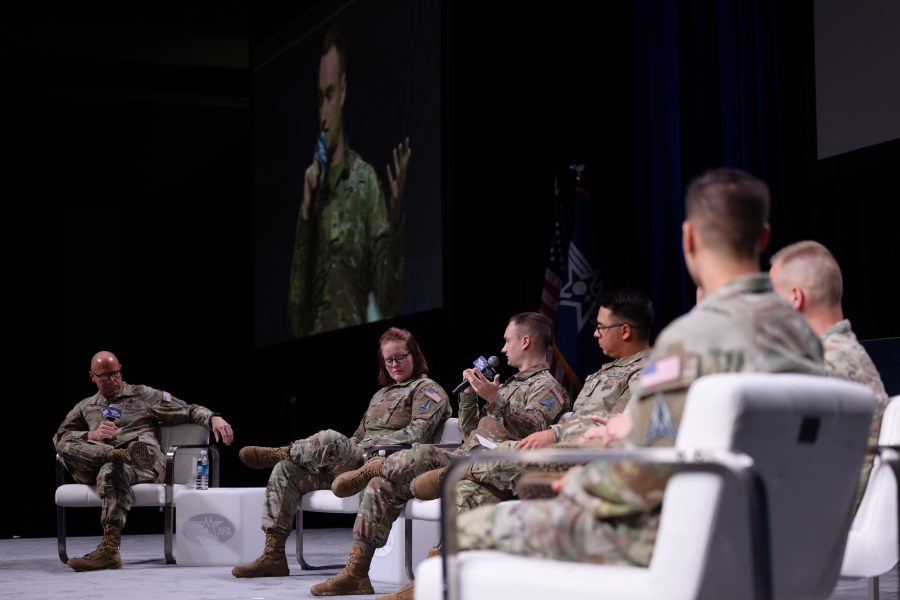
AURORA, Colo.—Winners of the Space Force’s fourth annual, service-wide Polaris Awards had the chance to discuss the actions that led to their awards from the main stage here at AFA’s Warfare Symposium on Feb. 24, in a panel discussion moderated by Chief Master Sergeant of the Space Force John Bentivegna.
The Polaris Awards, established in 2022, cover four individual categories and a team award that represent the Space Force values of Character, Connection, Commitment, and Courage.
Character Award: Maj. Adriane Payn, Space Force Element to the National Reconnaissance Offic
Payn serves as the mission assurance lead for two of the nation’s premier electro-optical satellites. She led the review of more than 1,650 manufacturing processes and parts to ensure the quality of more than $6 billion in flight hardware. Payn also identified a critical defect in a software tool and coordinated to prevent its use, saving one month of schedule and $300,000 in funds.
The major said discovering the software defect served as a test of character, since her team found the defect before the problem had arisen.
“There wasn’t a failure yet, there was nothing that had gone wrong,” she said. “And that’s really when character mattered because there was no one pushing us, it’s still theoretical.”
The team could have ignored the defect or let the contractor handle it.
“But we didn’t,” she said. “We took ownership.”
Her team went directly to the subcontractor and resolved the defect to avoid any future failures.
Connection Award: Sgt. Michael Campos, 33rd Range and Aggressor Squadron
Campos bolstered joint force collaboration by holding three tactics training seminars on offensive cyber operations that bridged the gap between the cyber and aerospace domains. He also provided more than 40 hours of targeted cyber training, preparing an eight-member team supporting the Space Flag 25-2 exercise.
Campos said the biggest hurdle in the cyber field is explaining what it is he and his teammates do. His go-to response in those scenarios is to explain that if cyber goes down, it will wreak havoc on all sorts of systems and command and control across a network.
“We always say we never do cyber for cyber’s sake,” Campos said. “Everything we do is layer effects for other domains.”
Commitment Award: Spc. 4 Logan Pinder, 76th Intelligence, Surveillance, and Reconnaissance Squadron
Pinder helped to stand up the Space Force’s sole time-dominant, multidisciplinary intelligence squadron. He taught himself advanced automation programming to engineer a data converter that reduced 80-gigabyte file processing from 100 hours to five minutes, enabling operational capability for an advanced on-orbit sensor and saving $850,000 in development costs. He also created the service’s first multiintelligence training pipeline, building a system of cross-functional teams and training analysts to integrate three intelligence disciplines.
The specialist’s unit noticed the 100-hour lag in getting intelligence from the sensor, and it was Pinder who told his commander he would like to take a crack at solving it rather than outsource the project to an $850,000 price tag.
It took Pinder about three weeks to develop the program that fixed the problem.
“And as a result of that, we started getting operational intelligence to the warfighter when they needed it and not a week after it was over,” Pinder said.
Pinder, an intel specialist, would like to see more coupling of intel with cyber across the force.
“I would love to be a part of filling those gaps between those different domains because I think it’s absolutely critical that we work together, rather than be separate in our own boxes,” Pinder said.
Courage Award: 1st Lt. Robert Bartkowiak, 3rd Test and Evaluation Squadron
Bartkowiak earned the award for his work pushing the boundaries of tests that led to the discovery of a new system capability. The lieutenant built a coalition of 34 Department of Defense stakeholders and civilian agencies, which helped secure $42 million in support of three major initiatives and reviving a dormant $10 million satellite for test and evaluation.
From the start, the test area is full of risks, Bartkowiak said. That includes operating in a domain where operators can’t see and have communications limited to their vehicles. But decisions made during testing have a direct effect on warfighters who use the equipment, he said.
His team’s goal is to provide the capability and mitigate risk so that users have a dependable capability.
“If I show up to the job and I say, ‘no we’re not going to execute this test today,’ I’m saying to the warfighter I’m going to give you this risk and you’re going to go fight with that risk,” Bartkowiak said.
Team Excellence Award: Team Archer, 37th Tactical Intelligence Squadron
The team served as lead Mission Delta 3 coordinator and event administrators for the Chief Master Sergeant of the Space Force’s Guardian Arena III. They organized two regional and one national robotics competition and finalized the development of the Space Force’s first advanced foreign instrumentation signals intelligence pipeline. With no acquisition or cyber experience, the team took over a $1.7 million intelligence support system installation, enabling personnel to complete the multisite project two days early.
First Lt. Christian Montelongo, deputy commander, and Tech Sgt. Robert Powell, flight chief, represented the team at the awards.
Much of the team’s success came down to the trust that leaders and subordinates have in each other and their fellow teammates, Montelongo said.
The team conducts what Montelongo called “PhD-level” analysis on physics problems for the Space Force. The goal is to take new Guardians straight out of technical school and get them up to that level of analysis quickly.
“And really, we have to lean on each other and our core values to really be able to accomplish that,” Montelongo said. “We’re going to give you this problem set and say, you are the expert on it, and we’re going to trust you to do this analysis yourself.”