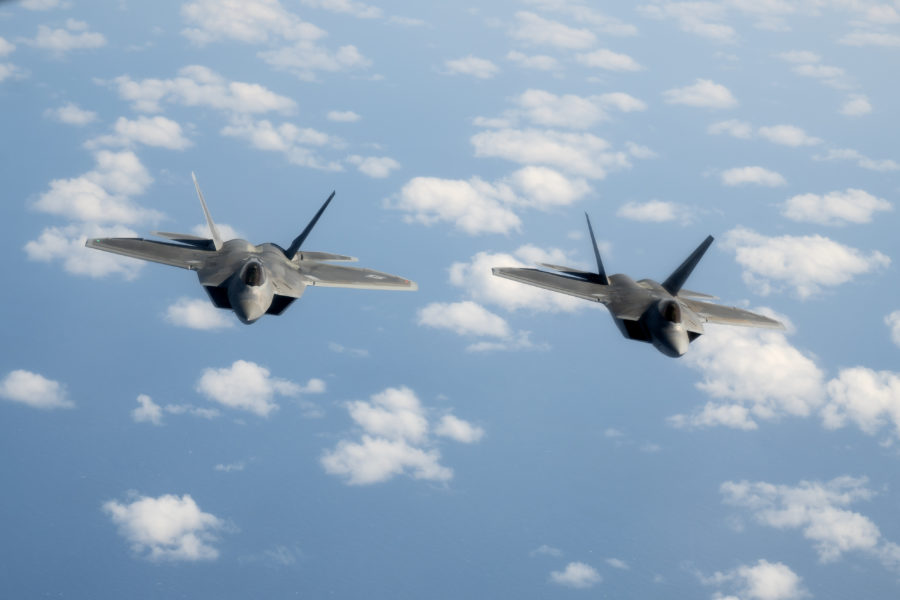
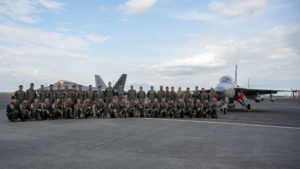
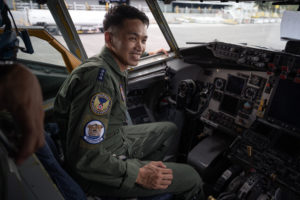
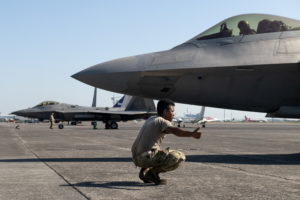
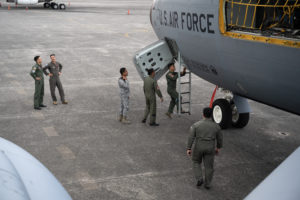
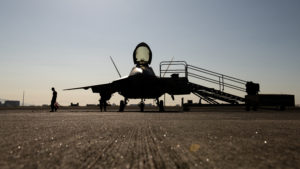
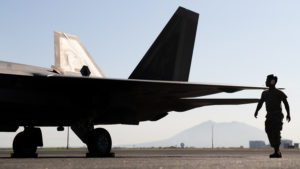
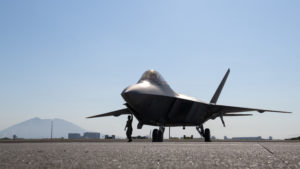
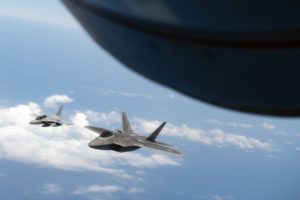
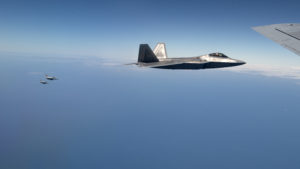
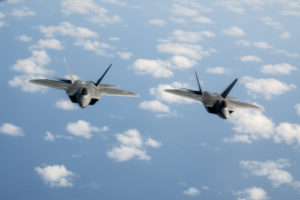
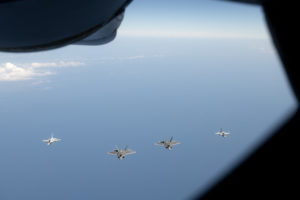
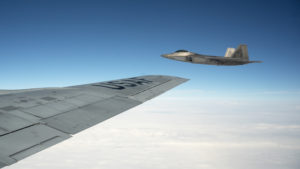
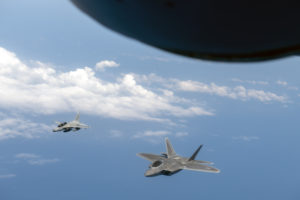
F-22A Raptors assigned to the 525th Fighter Squadron fly behind a KC-135 Stratotanker over the South China Sea, March 13, 2023.U.S. Air Force photo by Senior Airman Jessi Roth
Audio of this article is brought to you by the Air & Space Forces Association, honoring and supporting our Airmen, Guardians, and their families. Find out more at afa.org
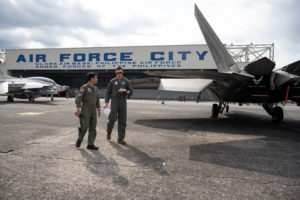
The U.S. Air Force took an important first step March 13 when F-22 Raptors deployed to Clark Air Base, marking the first time U.S. fifth-generation fighters have ever deployed to the Philippines, the USAF announced.
“This was the first time that F-22s, or any 5th-generation aircraft, have landed on and operated out of the Philippines,” Capt. Karl Schroeder, a Raptor pilot assigned to the 525th Fighter Squadron, said in an Air Force news release. “This milestone with a regional ally aids in providing stability and security to the Indo-Pacific.”
The F-22 deployment, which took place on March 13 and 14, comes as the U.S. is undertaking a major effort to strengthen and expand its posture in the Pacific to deter China’s growing military might.
On March 13, the U.S., Australia, and Britain announced a deal that will provide nuclear submarines to Canberra in the 2030s and 2040s. Under that pact, U.S. and British attack submarines are to rotate through a base near Perth, Australia, starting in 2027.
The U.S. Marines plan to establish a Marine Littoral Regiment in Okinawa by 2025 while Japan is moving ahead with a plan to build up its defense capability, including by buying Tomahawk land-attack cruise missiles from the U.S.
The Air Force, for its part, has been working on expanding its access to bases in the region under its Agile Combat Employment, or ACE, plan that aims to disperse its aircraft and make them harder for China to target.
“There’s a strategic calculation on the part of the Biden administration to build up our allies,” Patrick Cronin, an expert on the Asia-Pacific at the Hudson Institute, told Air & Space Forces Magazine.
“They’ve been leaning forward in terms of showing that we really will defend you if you’re threatened,” Cronin said. “The fact that we had brought F-22s now into Kadena meant it was easy to deploy to a place like the Philippines on a mission and on exercises, so that also made it possible.”
The F-22s are from the 525th Fighter Squadron, which recently wrapped up a weeklong deployment to Tinian, one of the three Northern Mariana Islands. It was the first time that those islands, which are U.S. territory, hosted the fifth-generation fighters.
The U.S. has a Mutual Defense Treaty with the Philippines dating back to 1951, and the hope is that US cooperation with Manila will deepen over the coming years.
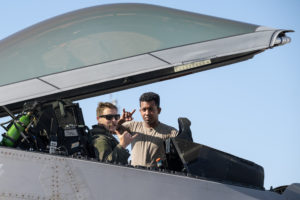
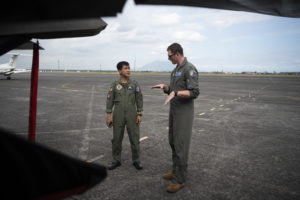
“The Raptor pilots were able to get their eyes on the layout of the land, as well as the different Philippine air bases,” the Air Force release stated. “Being familiar with the airspace and the territory below will allow for increased capability and integration in the future.”
Clark Air Base is not a new location for U.S. aircraft. It first hosted American planes in 1910s when the Philippines was U.S. territory. It was an important base for the U.S. Army Air Forces and Air Force during World War II and the Vietnam War, before eventually being turned over to the Philippines.
But as the Air Force release notes, the U.S. hopes to be able to operate from more locations in the Philippines in the future.
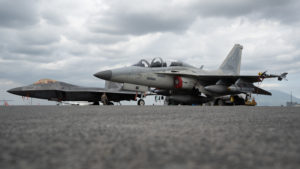
“With any operation there are always multiple roles and responsibilities to make the mission happen,” Capt. Joe Baumann, an F-22 pilot assigned to the 525th Fighter Squadron, said in the Air Force release. “With the FA-50’s capability for precision strike and the Raptor’s ability to establish air dominance, we make a lethal combo to support one another on multiple mission sets.”
“It is important for us to integrate with our allies to show that we have the capability to conduct safe and effective operations anywhere in the world while supporting multinational objectives,” Baumann added.
The Raptor engaged in simulated dogfighting, their forte, while the Filipino pilots observed, according to the Air Force. The American aircraft also took on gas from KC-135 Stratotankers from Kadena as another demonstration of American capabilities over the South China Sea.
“This marks yet another exciting moment in our rapidly growing and modernizing alliance, and an important step in our mutual efforts to protect a free and open Indo-Pacific region,” DOD spokesperson Lt. Col. Marty Meiners told Air & Space Forces Magazine.
Audio of this article is brought to you by the Air & Space Forces Association, honoring and supporting our Airmen, Guardians, and their families. Find out more at afa.org
Audio of this article is brought to you by the Air & Space Forces Association, honoring and supporting our Airmen, Guardians, and their families. Find out more at afa.org President Donald Trump and government and military leaders past and present...
The Air Force announced Aug. 13 it recently tested prototypes for a portable ground station for commanding and controlling semi-autonomous Collaborative Combat Aircraft, and a spokesperson now says the plan is to award a contract for the effort next summer.
One year into a new campaign to boost readiness rates for the B-1B Lancer and B-52H Stratofortress bombers, Air Force Global Strike Command is claiming some early wins and planning to forge ahead with more improvements.
Over the past few months and peaking in August, crews with the 910th Airlift Wing out of Youngstown Air Reserve Station, Ohio, have been running nighttime, low-flying missions to kill a ubiquitous and deadly adversary that’s plagued Americans for centuries—mosquitoes.
An Iranian ballistic missile attack on a key U.S. air base in Jordan damaged multiple U.S. warplanes, people familiar with the matter confirmed to Air & Space Forces Magazine.
General Atomics has unveiled the first renderings of its Wildfire drone, which it plans to pitch for the Air Force’s hunt for a new, low-cost Massed Modular Aircraft.
In the small world of Air Force weather specialists, combat weather specialists are a niche unto themselves, deploying with Army ground units to provide forecasts and, if need be, fight alongside those Soldiers. For Staff Sgt. Francisco Estrada, the hardest part of the job isn’t the possibility of ground combat,…
Startups Anduril Industries and Heremus have agreed to integrate Anduril’s autonomy software onto Hermeus’ hypersonic demonstrator aircraft “Quarterhorse”—uniting two technologies that have drawn keen interest and investment from the Air Force.
✓
Thank You!
Check your inbox to verify your email address and finish setting up your AFA account.
★
Welcome Back!
An account with this email already exists. Please log in to continue.
Subscribe to the Air & Space Forces Daily Report
The latest news from Air & Space Forces Magazine, as well as news from other leading publications, delivered right to your inbox every morning!
We’re sorry, there has been an error. Please review your input or try again later.