
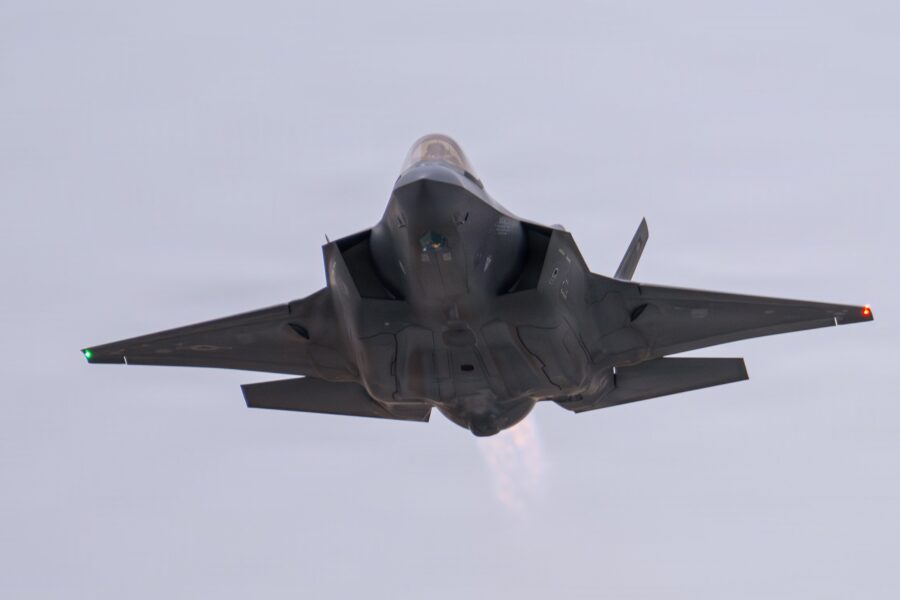
The Pentagon is requesting funds to buy 85 F-35s in its fiscal 2027 budget, 38 of them A vairants for the Air Force, a number that analysts say is not enough to reverse the service’s fighter shortfall.
President Donald Trump’s rollout of his much-anticipated $1.5 trillion defense budget pledges to restore “the readiness and lethality of the force.” The request would provide $30.6 billion for Air Force aircraft procurement, a significant increase over years past. The plan, however, does not provide specific funding numbers for key aircraft programs.
A White House fact sheet says the buget request prioritizes the “rapid development and production of the F-47 six-generation fighter aircraft but does not mention the unmanned Collaborative Combat Aircraft or B-21 Raider programs.
The Air Force stands to receive 38 F-35As of the 85 Lighting IIs, an Office of Management and Budget official confirmed to Air & Space Forces Magazine.
Retired Lt. Gen. David A. Deptula, dean of the Mitchell Institute for Aerospace Studies, said that number falls short of making a meaningful impact toward increasing airpower.
“If the budget does fund 85 F-35s overall, with only 38 going to the Air Force, my reaction is that this is a mixed signal—on one hand, 85 aircraft is still a meaningful production number for the military and it helps preserve industrial-base stability, but on the other hand, 38 for the Air Force is not a serious rebuild rate for a service operating the oldest and smallest fighter force in its history,” Deptula said. “It may keep the line warm, but it does not reverse the fighter inventory shortfall.”
If approved, the service would receive 14 more F-35s than it did in last year’s budget, but also 10 less than the Air Force requested in 2025. This year is also the first time in the last decade the Air Force has received less than half the F-35 fighters requested by the Pentagon.
To Deptula, the underlying issue is that the Air Force needs to grow capacity while also modernizing.
“The Air Force cannot continue a ‘divest to invest’ approach if modernization never catches up with divestment,” he said. “In that context, 38 F-35As feels more like budget triage than a true recapitalization rate. This number suggests the Air Force is still being forced to balance near-term procurement against other large bills—F-47 development, B-21, Sentinel, readiness recovery, munitions, and CCA. So, I would not call 38 F-35As a disaster in isolation, but I also would not call it evidence that the Air Force is being rebuilt at the speed the strategic environment requires.”
Last July, 16 retired Air Force four-stars, including six former Chiefs of Staff, sent a letter to Congress urging lawmakers significantly increase the purchase of F-35 fighters.
At the time, Gen. Philip M. Breedlove, former Supreme Allied Commander Europe, said the F-35 should be a procurement priority because it is the most advanced U.S. fighter in production for meeting the Air Force’s “fight tonight” requirement.
Allies have procured the F-35 to have interoperability with the U.S., said former Chief of Staff Gen. T. Michael Moseley, who stressed that the Air Force should be provided with the resources to give the fighter a new engine and increase its lethality, not forced to cut back on it.
“Why wouldn’t we want to continue to build that airplane … in larger numbers?” Moseley said.
While the White House budget fact sheet says little about the F-35, it places a clear priority on shipbuilding, detailing that it is planning $65.8 billion in 2027 to procure 18 battle force ships and 16 non-battle force ships.
Deptula said he views the focus on shipbuilding at this stage as more of a “strategic communications centerpiece” than a lack of emphasis being placed on airpower modernization.
“The absence of public F-47 and B-21 details should not be mistaken for lack of priority,” Deptula said. “Aircraft modernization is still buried in broader procurement and development accounts. For Air Force watchers, that means we should be cautious about drawing conclusions on F-47 or B-21 until the detailed justification materials are public.”