
The Pentagon’s Joint Interagency Task Force 401 took a step toward making an Amazon-like online marketplace for counter-drone tech a reality this week with its first acquisition under the Replicator 2 effort.
The task force, stood up last fall, purchased two DroneHunter F700 low-collateral counter drone systems that are scheduled to be shipped to two undisclosed U.S. installations for additional testing and use in April, according to a recent Pentagon announcement.
The $3.5 million contract is relatively small in the world of defense acquisitions, but it’s the right size for JIATF-401’s objective of equipping warfighters with counter-drone systems that are tailored for a specific threat environment.
“We are not intending to be a program office; we’re buying the stuff that can be made available to the warfighter as rapidly as possible and then let the user experiment with it so that a service can decide if this is something that we want to now purchase at scale,” JIATF Spokesman Lt. Col. Adam Scher told Air & Space Force Magazine.
The Pentagon initially launched Replicator in 2023 to build thousands of autonomous drones. Replicator 2, which is designed to counter small unmanned aerial system threats, emerged several months after commercial drones flew unchecked over Joint Base Langley-Eustis, Va., in late 2023. A spate of incidents followed as drones were spotted over Air Force installations in Utah, Ohio and Germany as well as during similar incidents around four bases in the United Kingdom: RAF Lakenheath, RAF Mildenhall, and RAF Feltwell (all located close to each other); and RAF Fairford.
Lawmakers raised concerns with the Pentagon that bases at home and abroad seemed to be vulnerable to low-cost commercial drone incursions. U.S. Northern Command began to develop “flyaway kits” equipped with a general package of counter-drone systems designed to be shipped to installations within 24 hours.
But the DroneHunter purchase is intended for two specific installations and “is not part of a flyaway kit,” Scher said.
“JIATF 401 has worked with all the senior leaders across the services to validate a prioritized list of sites for homeland defense, and we are delivering capability according to that list,” said Scher, who would not discuss the list of installations for operational security reasons. “We get information about an installation that has a gap and requires a need, and we start looking at the right solutions for it.”
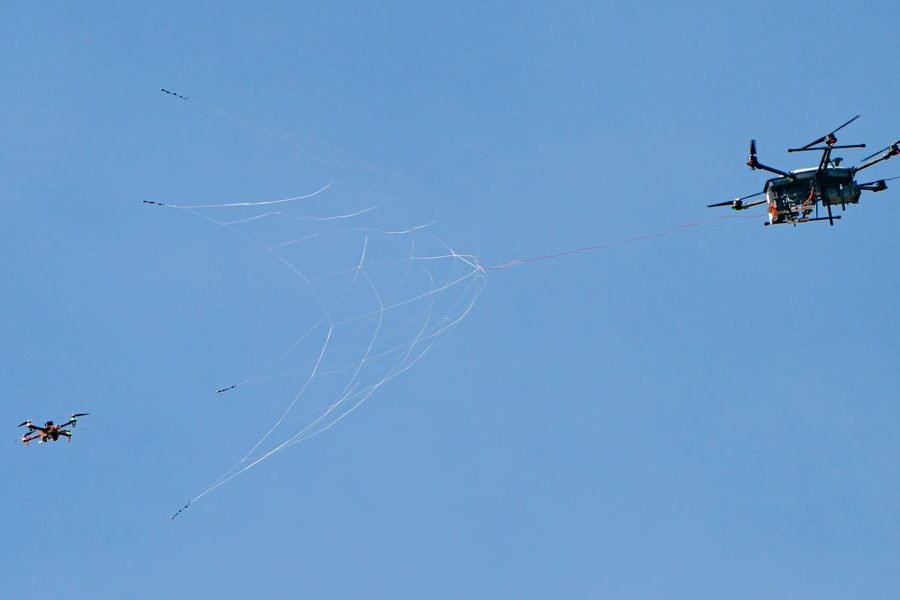
DroneHunter, made by Fortem Technologies, is a reusable, artificial intelligence-driven interceptor drone that launches a tethered net to capture small, low-flying drones in areas where the “risk to civilian populations and infrastructure must be minimized,” according to the Pentagon press release.
“The DroneHunter systems are designed to be low-collateral solutions because some of the other types of explosive counter UAS systems that are appropriate for the battlefield are just not appropriate here when our installations and our service members and families live among the community,” Scher said.
Army Brig. Gen. Matt Ross, director of JIATF-401, called the DroneHunter purchase a “key first step in accomplishing our Replicator 2 mission, according to a press release.
The feedback taken from warfighters using the DroneHunter Systems will be available on a new Counter-UAS Marketplace which is scheduled to have initial operating capability by March 1, Scher said.
“The marketplace is going to be online and would work like Amazon.com,” he said. “User feedback based on these purchases would be up on the marketplace, so that other installation commanders could view comments from warfighters that have tested DroneHunter at installation X and may choose to buy the system as well,” Scher said. “That is the ecosystem we’re seeking to develop.”
Moving forward, JITF-401 will continue to purchase specialized counter-drone capabilities “to give the maximum number of tools to our installation commanders,” Scher said. “We’re going to help installations and warfighters decide by buying a little bit, letting them try it, and then they will decide what is right for them over the long term.”