
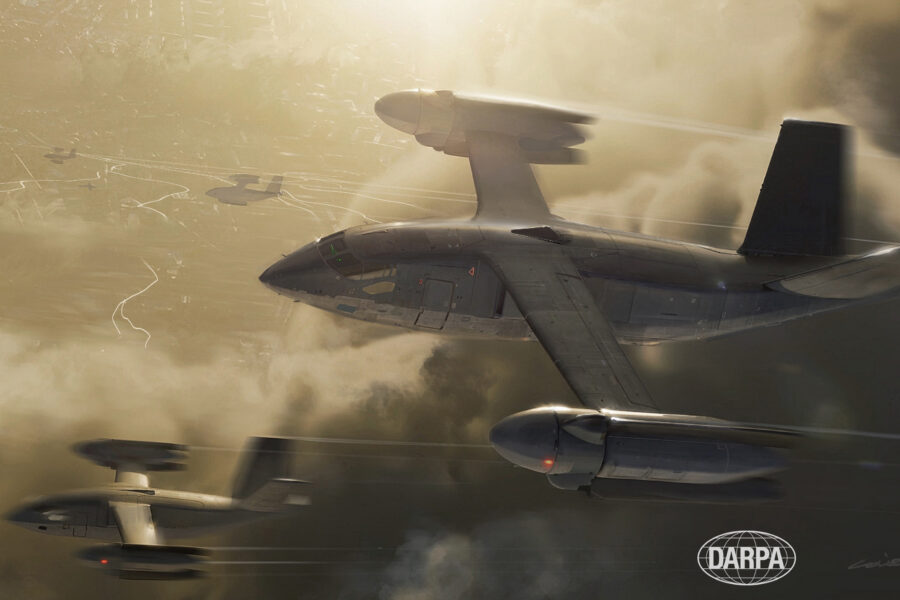
A top defense rotorcraft company is now building a new vertical takeoff and landing X-plane that can achieve jet-like speeds, aimed at special operations missions and cutting ties to traditional runway-based aircraft.
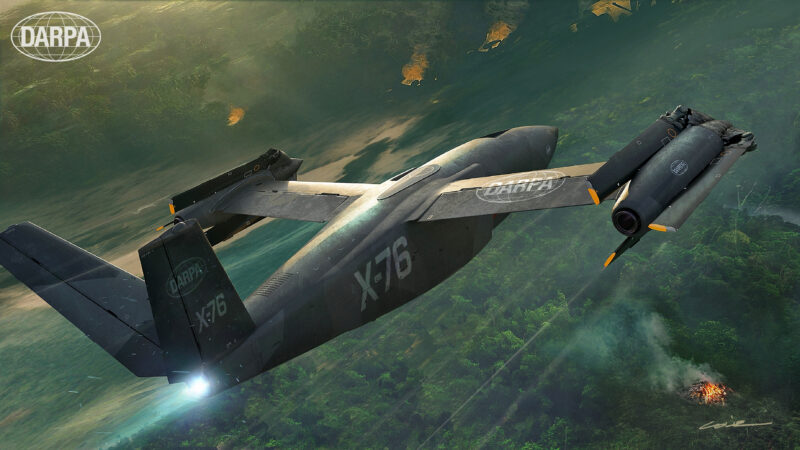
Bell Textron Inc. announced March 9 the designation of the X-76 and said it has passed the critical design review phase for a Defense Advanced Research Projects Agency program called Speed and Runway Independent Technologies, or SPRINT.
“For too long, the runway has been both an enabler and a tether, granting speed but creating a critical vulnerability,” said U.S. Navy Cmdr. Ian Higgins, who is serving as the DARPA SPRINT program manager. “With SPRINT, we’re not just building an X-plane; we’re building options. We’re working to deliver the option of surprise, the option of rapid reinforcement, and the option of life-saving speed, anywhere on the globe, without needing any runway.”
The experimental aircraft must be able to achieve speeds of 400 to 450 knots (460-517 miles per hour), hover in austere environments, and operate from unprepared surfaces. For comparison, the Air Force’s jet-powered cargo aircraft, the C-5 and C-17, average around 450 knots.
Test flights are planned for early 2028, according to the release.
What makes the X-76 so unique is its proposed stop-fold tiltrotor design.
The design allows the aircraft to take off, hover, and land much like the existing V-22 Osprey tiltrotor aircraft currently used by the Air Force, Navy, and Marine Corps. When ready for forward flight, the aircraft’s nacelles tilt forward. The stop-fold design is different from existing tiltrotor technology because as the nacelles tilt, the proprotors slow, stop, and then fold back. The aircraft then switches from the turboshaft used for takeoff to a separate turbofan jet propulsion system.
The company demonstrated its High-Speed Vertical Takeoff and Landing technology in 2023 at Holloman Air Force Base test facilities.
Bell has previously released depictions of three size versions of the airframe, the largest of which is the size of a C-130 airplane. The company is designing both crewed and uncrewed versions of the X-76.
As early as 2020, Air Force Special Operations Command began querying the industry through Air Force Research Laboratory solicitations for a CV-22 replacement for missions including infiltration and exfiltration of personnel, personnel recovery, aeromedical evacuation, and tactical mobility.
The CV-22’s top speed maxes out at 280 knots, and its maximum gross weight is listed as 60,500 pounds.
Bell officials have said the X-76’s technology could scale to gross weights as low as 4,000 pounds or as high as 100,000 pounds.
In May 2024, Bell and Aurora Flight, a Boeing subsidiary, were awarded contracts for the first phase DARPA SPRINT. Bell won the Phase II and III contract to proceed with aircraft design and build in 2025.
In 2022, Bell also won the Army’s contract to develop the Future Long-Range Assault Aircraft, later dubbed the MV-75, a tiltrotor aircraft planned to replace the UH-60 Black Hawk, built by Sikorsky, a Lockheed Martin company.
That program was valued at $1.3 billion in the short term, with a potential long-term value of $70 billion.
In June 2025, Bell delivered two virtual MV-75 prototypes. Virtual prototypes are advanced simulators that perform as “digital twins” of the actual aircraft cockpit.
Bell has a decadeslong history with vertical takeoff and landing technology. The company worked on VTOL prototypes in the early 1960s for the Army and Air Force, and later platforms, including the X-14, X-22, XV-3, and the XV-15 for NASA, according to a company release.
An uncrewed, light version of the stop-fold, high-speed VTOL is used as part of a concept Bell calls the Sea-based Logistics Unmanned Refuel/Re-arm Platform, or SLURRP.
The concept has uncrewed aircraft landing on small, floating platforms that can refuel or rearm them at sea.
Bell also produces the V-22 for the U.S. military.
Those aircraft, the first widely fielded tiltrotor aircraft in the military, have been hailed as game-changers by some but also gained a reputation for safety issues.
A 2025 Congressional Research Services report notes that 65 military personnel and civilians have died in mishaps involving the V-22 since the program’s inception. Since 2022, the services have experienced four fatal mishaps that killed 20 service members and injured another 20.
Component failures contributed to at least two of those four mishaps.
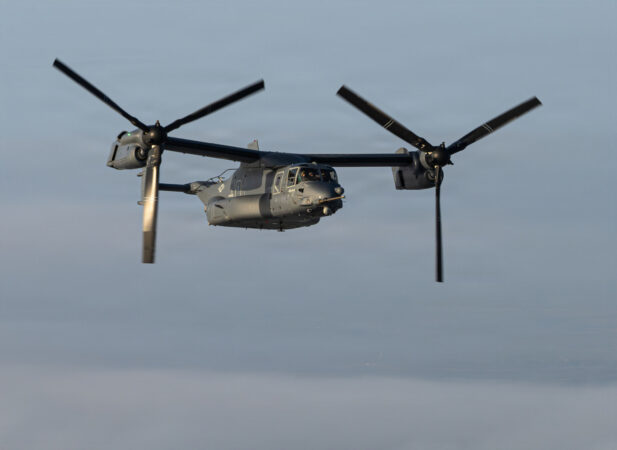
The Department of Defense has purchased 360 V-22s for the Marine Corps, 53 for the Navy, and 56 for AFSOC as of 2025.
Between fiscal years 2015 and 2024, the Air Force reported a rate of 11.55 mishaps per 100,000 flight hours on the CV-22 as compared to an average of 1.65 mishaps per 100,000 hours across the service’s entire fleet.
Air & Space Forces Magazine reported in early February that the CV-22 Osprey fleet began receiving new proprotor gearboxes in January and that the Air Force plans a comprehensive midlife upgrade to address safety and reliability concerns across the fleet.
A December 2023 gearbox failure caused an Air Force CV-22 to crash off the coast of Japan, killing eight Airmen.