
Pentagon leaders, eager to move fast and avoid the delays and cost creep that plague large-scale government programs, are empowering officers outside traditional structures with authorities and oversight for some of the biggest military programs on record.
But the Air Force and Space Force four-stars tackling those responsibilities say they don’t intend this unusual structure to be a permanent change to the system.
These Direct Reporting Program Managers, or DRPMs (pronounced DER-pums in Pentagon speak), are still relatively new in their jobs. Yet their existence is already drawing praise and critiques from former Pentagon officials and experts who spoke with Air & Space Forces Magazine.
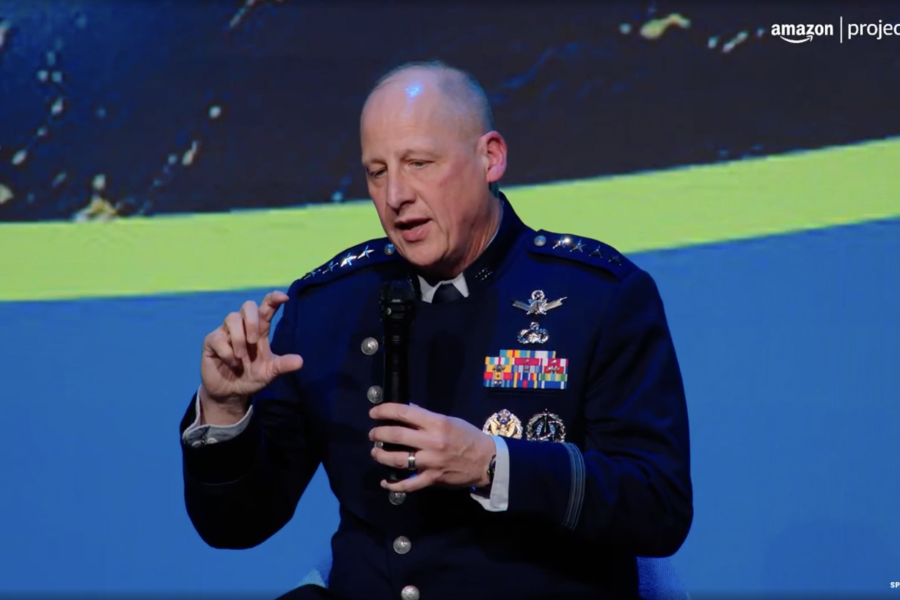
The Trump administration introduced its first DRPM as a means to grasp the sprawling Golden Dome missile defense effort, which includes elements across multiple agencies and services. They tapped Space Force Gen. Michael A. Guetlein, a career acquisition specialist, to be the DRPM for Golden Dome, reporting directly to Deputy Secretary of Defense Stephen Feinberg.
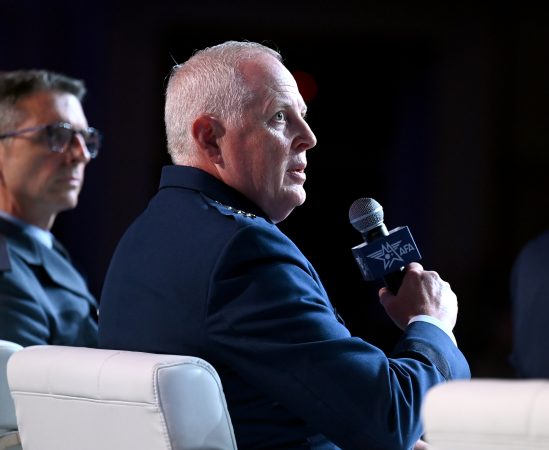
Then late last year, officials expanded the idea. Four of the Air Force’s largest, highest-risk programs—the F-47 fighter, B-21 bomber, VC-25B Air Force One, and Sentinel intercontinental ballistic missile system—were bundled together under the banner of “Critical Major Weapons Systems,” and placed under the watchful eye of Gen. Dale R. White, the DRPM for them all. Now the Navy has a DRPM too: Vice Adm. Robert Gaucher oversees submarine production and reports to the Deputy Secretary.
Both Guetlein and White downplayed the notion that DRPMs are now here to stay as permanent positions during appearances at the McAleese Defense Programs Conference in mid-March.
“We are actually planning to disband the DRPM concept once we get the momentum and get the capability into the field, and fold that back into the services and into the agencies,” Guetlein said of Golden Dome. “When we stood up the manpower documents and everything, everything for Golden Dome is temporary. There is not an enduring manpower document or any of that kind of stuff going forward. So the intent is to stand down at some point in the future.”
White was less explicit, but he did say “the ideal world would be, you don’t need a DRPM.”
“My idea going into this was not to try to go around the system, but to work within the system as much as I can,” White added. “And everything I do is in partnership with the current Air Force acquisition structure.”
Too Important to Fail
This vision of a temporary top-level figure to shepherd these key programs to some early operational point makes sense given Deputy Secretary’s Feinberg business background, said Todd Harrison, a longtime budget analyst with the American Enterprise Institute.
“That is kind of a private equity model. … What they’re doing is they’re taking these kind of core programs and saying ‘they’re too important to fail, but we’re worried that they’re on a path to failure, so we’re going to give them special attention, we’re going to rehabilitate them,’” Harrison said. “‘And if things go well, then they can move back and the service can take them over again. If it doesn’t go well, we’re going to have to find a new construct.”
Guetlein and White may be particularly suited to give the special attention needed. White has spent much of the last decade overseeing some of the programs in his portfolio now, including B-21 and F-47, and spent time at nearly every major Air Force acquisition and development organization, including the Rapid Capabilities Office. Matt Donovan, who held several Pentagon roles in the first Trump administration including Undersecretary of the Air Force, described White as a “unicorn” in that sense.
Guetlein likewise has vast experience ranging from Space Systems Command to the National Reconnaissance Office to the Missile Defense Agency to Headquarters Air Force.
The big question both generals now face is whether they can effectively work within the current acquisition system—a system that Pentagon officials, lawmakers, and analysts have long derided and tried to reform.
Even now, as the DRPMs get started, Defense Secretary Pete Hegseth has embarked on an ambitious effort to reform the weapons development and acquisition process. Many elements, such as dismantling the Joint Capabilities Integration and Development System and delegating certain acquisition program decisions, have pushed authorities back to the services.
“It certainly strikes me as something that makes sense if the current acquisition process isn’t working well, which I think most of us can agree that it’s too slow and it takes too long. But there’s a lot of pieces to [consider],” Donovan said.
Chain of Command
One big piece to consider is how the DRPMs exist and interact with the normal chain of command, which flows up through the service chief and department secretary.
Both Guetlein and White now outrank the three-star officers who lead their services’ main acquisition commands, Air Force Materiel Command and Space Systems Command. And by reporting to the Deputy Secretary, they are no longer responsible to the Secretary of the Air Force and the Assistant Secretary of the Air Force for Acquisition, Technology, and Logistics or the Assistant Secretary of the Air Force for Space Acquisition and Integration.
“It cuts out the whole chain of command for the services,” said former Air Force Secretary Frank Kendall, who was a service secretary for the Biden administration and headed Defense Department acquisition during the Obama years. “I don’t know how they get around the statutes that require programs to report through a program executive officer, through the acquisition executive in the military department, to the Defense Department’s acquisition executive. … So it creates a very awkward chain, a double chain of command for people.”
Donovan likewise argued that the DRPM construct seems to sideline the services’ role in acquisition.
“I wonder if this is really diluting the authority of the of the service secretaries. I think it’s obvious that it is. In what way, we’re not sure,” Donovan said. “But when you take a look at the service acquisition executives, I don’t even think they have confirmed [assistant secretaries.]”
Indeed, the Trump administration has yet to nominate a permanent Assistant Secretary of the Air Force for Acquisition, Technology, and Logistics or Assistant Secretary of the Air Force for Space Acquisition and Integration. It’s not the longest stretch the jobs have been vacant, but both Donovan and Kendall questioned whether the administration will be able to find qualified and interested nominees given how the jobs’ portfolios have changed.
Harrison, however, argued that bypassing the typical chain of command isn’t a problem—it’s a necessary feature.
“In the traditional acquisition organization, these decisions are made down at lower-level program offices, and it has to percolate up,” he said. “And if there’s some sort of controversy in the decision and not everyone’s willing to sign off, it could take forever for the decision to get all the way up to someone like the Deputy Secretary that can just say, ‘This is what we’re doing.’ And so I think they’re bypassing that organizational, bureaucratic inertia with these these new organizations.”
White, for his part, seemed to make the case that he’s not operating too far out of the service chain of command. He said he stays closely connected with current Air Force Secretary Troy E. Meink—noting that their offices are only steps away from each other in the Pentagon.
“You have to be careful with the amount of authority that I’ve been given. You could weaponize that, and that is certainly not the choice I’ve chosen,” he said. “In fact, I choose to use the authorities only when and if I need to. The majority of the time, I have found the system is willing to bend and work with me to be able to make sure we get what we need to get done.”
Lean and Agile
Beyond the questions about chain of command, the DRPMs face another issue in working within the system: avoiding bureaucratic bloat.
White said he is working to ensure the DRPM office doesn’t replicate work already being done elsewhere by limiting the size of his office.
“I was given authority to get quite a few personnel, and I have a transition lead, who’s a colonel, she’s amazing,” White said. “And when we started standing up the team, I told her, ‘OK, here’s the deal. As we stand up the staff, no more than 20.’ And she was like, ‘What do you mean, no more than 20?’ I’m like, ‘There’s probably 10,000 people that work these programs. We don’t need any more.’”
They’ve mostly stuck to that goal, White said, with 24 personnel in his office and no plans to grow.
Guetlein’s job is different—by nature, it pulls together many disparate elements from the Army, Missile Defense Agency, Space Force, and other agencies with the specific intent of making sure they can be integrated to work together. But like White, Guetlein said his goal is to avoid duplication of effort.
“When we stood up the Golden Dome office, we stood it up to be very lean and efficient,” he said. “So I have a very flat organization, but I have decentralized execution across all the services and agencies.”
Donovan, while complimentary of White and Guetlein, was skeptical that their organizations can remain that small.
“All the trappings that come along with a four-star position, I would submit that there are probably a lot more supporting people assigned to that type of position than what [White] might let on,” Donovan said.
Harrison, however, argued that the nature of the DRPM role means these generals don’t need large staffs.
“They want to be able to make decisions fast, and they can outsource a lot of the work, because they’re still leveraging all the existing program offices,” Harrison said. “Really, what they’re supposed to be doing at this level is just helping make decisions and tradeoffs and allocate resources, not do the execution themselves.”
Indeed, White said that rather than duplicate the functions of existing acquisition offices, his goal is to provide those offices with “a level of freedom of maneuver in decision space that they’ve never seen before, and I’m going to empower them in ways that they never thought was possible.”
In other words, Harrison said, the job of the DRPM is to “jumpstart” the system: “Get it working, get it moving again.”
Long-Term Fixtures?
Exactly how and when Pentagon leaders might decide that the DRPMs have jolted the system enough that they are no longer needed remains to be seen.
Donovan voiced skepticism that the roles will be as temporary as White and Guetlein say, even though he didn’t doubt the men’s sincerity.
“I do know that once you stand up an office, a function, and start assigning people to it, especially at the four-star level, I mean it’s probably there to stay for the foreseeable future, would be my opinion,” he said, pointing to years of bureaucratic growth in the Pentagon.
Kendall and Harrison, on the other hand, disagreed on whether DRPMs are a good idea but both pointed out that the DRPM reporting structure may make it particularly easy to dismantle.
“There’s no real gain by having it reported to the deputy secretary, and the next deputy secretary we get will certainly undo it and put it back where it was,” Kendall predicted. “I have a very hard time imagining somebody else trying to run programs this way.”
“Because these are direct reports to the deputy secretary, I think when you have a different deputy secretary there, they may look at this very differently and not want all these direct reports,” Harrison said. “That’s why I don’t see it as being permanent.”
White, who worked under Kendall until about 16 months ago, made the case that the current deputy secretary is uniquely suited to oversee this new structure.
“The way he and I work together is a model that I think is going to be something that we can use to actually transform acquisition,” White said. “I’m always cautious when you get to this place where you have an acronym that is going to save the world. So we have a great team of leaders that work these programs. [Feinberg] is No. 1, one of the smartest people I’ve ever worked with. His business mind is absolutely exceptional … and No. 2, in my 30-plus years of doing this, I have never seen anyone invest the time like he does.”