
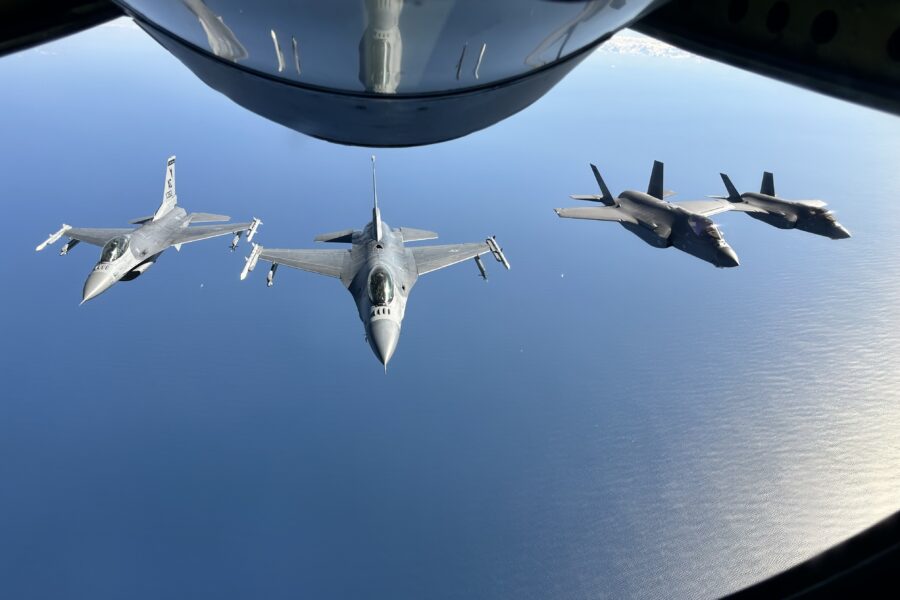
Air National Guard and Air Force Reserve leaders warn that the Air Force must modernize their fighter fleets along with the Active force, or they risk losing combat-tested talent and making the reserve forces irrelevant in future operations.
Speaking at a media roundtable during AFA’s Warfare Symposium in February, Lt. Gen. John P. Healy, chief of the Air Force Reserve, said more than 80 percent of his aircraft inventory are legacy jets with limited future lifespans.
“I am keenly aware of some of my units that are scheduled to divest without any plan of recapitalization,” he said. “I am, some could say, loud and annoying when it comes to [ensuring] we can maintain this fighting force.”
“Some of these units that are 100 percent combat veterans,” he added, and the challenge is “to ensure that talent, that experience doesn’t walk out of the door during a normal, planned divestment.”
The challenge is similar in the Air National Guard. Maj. Gen. Bryony Terrell, special assistant to the ANG director, said more than half of Guard fighter squadrons have no roadmap for modernization.
“Thirteen of our 24 fighter squadrons have no advanced recapitalization plan,” Terrell said. “Some are programmed to receive legacy aircraft, and some have no identified follow-on platform at all. The Air National Guard must modernize alongside the Air Force—not after it.”
F-16 squadrons at Atlantic City, N.J., Air National Guard Base; Buckley Space Force Base, Colo.; Joint Base San Antonio, Texas; and Morris Air National Guard Base, Ariz., are all at risk of losing aircraft, she said.
In the Reserve, according to Air Force Reserve spokesman Sean Houlihan:
- The 924th Fighter Group at Davis Monthan Air Force Base, Ariz., deactivated its A-10 mission in September, without a follow-on fighter mission
- The 926th Fighter Wing at Nellis Air Force Base, Nev., divested their last 10 operational F-16s in late 2025; and
- The 442nd Fighter Wing at Whiteman Air Force Base, Mo. is scheduled to lose its A-10s by the end of 2028;
Guard and Reserve leaders want to replace those legacy aircraft with new F-15EX and F-35 fighters, noting that the Air Force cannot meet mission requirements without their components. Air National Guard fighter units today represent 21 percent of the total Air Force, 30 percent of its combat power, and are responsible for 94 percent of homeland defense missions. They do all that for only 7 percent of the total Air Force budget, according to a 2025 Guard fact sheet.
Chairman of the Joint Chiefs of Staff Gen. Dan Caine, himself a former Air Guardsman, cited the Guard and Reserve contributions to Operation Epic Fury in his first press conference after the war began.
“The integrated Reserve and National Guard Forces have continued to demonstrate the value of America’s Reserve Forces, including the Wisconsin Army National Guard operating in Kuwait and Iraq and Air National Guard units from a variety of states, to include Vermont and Virginia,” he said.
Singling out the Vermont Air National Guard’s 158th Fighter Wing, he noted that its F-35 crews had been mobilized for and flown in support of Operation Absolute Resolve against Venezuela in January, then flew directly to the Middle East in anticipation of Epic Fury. The back-to-back operations highlight how central Guard and Reserve forces are to the overall Air Force.
A Long-Term Problem
Heather Penney, a former Air National Guard F-16 pilot and director of studies and research at the Mitchell Institute for Aerospace Studies, said the rapid drawdown of the Cold War force—and under investment in the 2000s—paved the way for today’s aged force.
“We got to this position because of major divestments in the 1990s,” Penney said. “We cut the force structure in half and slowed down our recapitalization programs.”
Instead of acquiring 750 F-22s as originally planned, the Air Force bought only 187. Meanwhile, counter-insurgency campaigns in Afghanistan, Iraq, and Syria increased demand for airpower.
“We had less force structure and had to use it harder because of flying hours and operations in the Middle East,” Penney said. “We prematurely curtailed the lifespan of those aircraft.”
If a typical fighter lifespan is 30 years, the cost to maintain and sustain those aircraft starts rising at about the 15-year mark, she said.
Air National Guard spokesman Maj. Jonathon LaDue acknowledged that the Guard’s Block 30 F-16s have limited structural airframe life remaining and must be retired over the next decade. Newer Block 40, 42, 50, and 52 jets, now averaging 36 years old, are also challenged. Current plans call for keeping them in service until around 2040, when they will approach 50 years of age, LaDue wrote in an email response.
“Fifty-year service life fighters are not an acceptable deterrent in the current and future threat environments,” LaDue wrote.
Transferring legacy aircraft from the Active force to the reserve components doesn’t solve the problem. The fiscal 2026 budget request indicated seven Guard wings will receive post-block F-16s in the coming years, but while that buys time after legacy A-10 Thunderbolt IIs are retired, LaDue said, it “is not a valid Total Force recapitalization or an enduring mission.”
Healy, the Reserve chief, has sought to gain F-15E or EX jets to replace some retiring aircraft in the Reserve. “For every one of these 10 units that are going away, I’m looking at [whether] we can get an F-15 unit behind it—whether it’s a Strike Eagle or an EX,” Healy said. “I’m pressing hard. If we’re divesting of an F-16 unit, I want an F-35 unit behind it.”
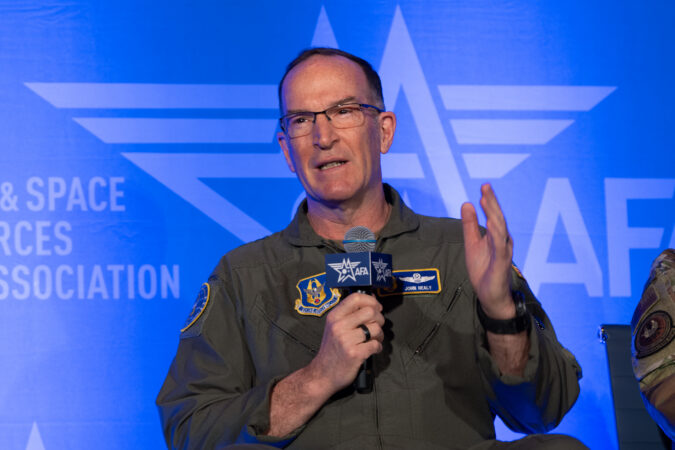
Photo by Jack Dempsey for Air & Space Forces Association
Reserve units are more cost effective than Active units, Healy suggested, saying he can run an F-16 unit for $12 million less than the Active force can annually. Savings are even higher for other platforms, he said: $24 million less for an F-15EX unit and $28 million less than an F-15E unit.
But whatever the cost is to operate, the central challenge facing the Air Force is the shrinking size of the fighter force. An August 2025 report to Congress projected adding 300 advanced fighters by 2030, when the total fighter force is projected to be 1,400 fighters, 240 more than in the inventory today. The problem is that the Air Force’s stated requirement is 1,558 manned fighters to “achieve missions with high confidence and low risk.”
The Pentagon is expected to release its 2027 budget request later this spring and could increase planned procurement numbers. F-15EX production is expected to reach 24 jets in fiscal 2027, according to the Air Force’s report, and if additional funding is available, that could rise as high as 36. Air Force F-35 purchases, meanwhile, have yet to top 48 in any given year, and last year were only 24.
Post-block F-16s will continue to be upgraded with active electronically scanned array radars, multifunctional information distribution systems, joint tactical radio systems, and integrated electronic warfare suites, according to the report, and later-model F-22s will also continue to be upgraded. But the Air Force has no plans to update its oldest Block 20 F-22s, which are no longer seen as combat capable.
Fear of Losing Flying Missions
All of that has Guard and Reserve leaders worried about future flying missions. Some units are already being converted to other uses. In 2023, Mansfield Lahm Air National Guard Base, Ohio transitioned from a C-130 flying unit to the 179th Cyberspace Wing. In 2019, the Puerto Rico Air National Guard’s 156th Airlift Wing, previously a C-130 unit, transitioned to a contingency response and communications mission, LaDue wrote.
And last year, the Maryland Air National Guard divested all its A-10s and converted to a cyber wing. Maryland is now the only state in the Union without a flying mission in the Air Guard. That future could hit other states as well.
“Without replacement, 12 Air National Guard fighter squadrons are at risk of losing their airframes and flying missions in the next five years,” according to a 2025 ANG fact sheet.
Talent Exit
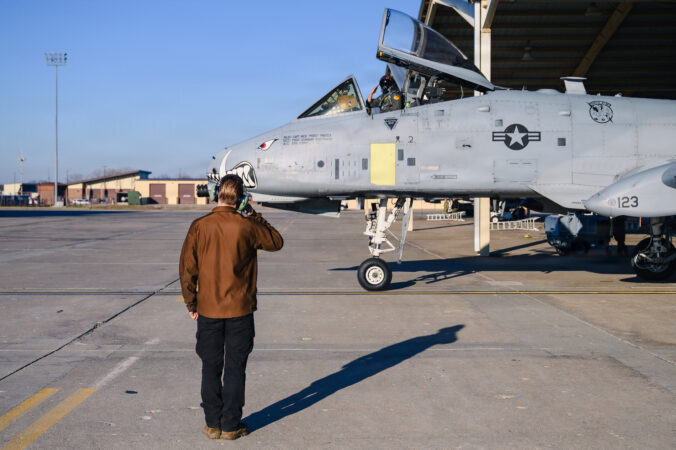
When a unit loses its flying mission, the change radically alters personnel requirements.
“It truly is a huge shift for everyone involved when flying is not the mission,” said Brig. Gen. Shannon “Sinjin” Smith, commander of the Idaho Air National Guard, offering his personal perspective.
In a 2025 Mitchell report, Penney argued that the Air Force can ill afford the loss of pilots in the reserve components, given that the total Air Force was already short of requirements by nearly 1,850 pilots. Unlike the Active force, which transfers Airmen when their units shut down, members in the Guard are on the hook if they want to move to take a new flying position elsewhere.
She argues that the Guard’s 89 percent average retention rate over the past two decades has been crucial to maintaining core expertise in the service, and that shutting units now will disproportionately impact experience levels across the Air Force. By contrast, the Active component managed just 40 percent retention between 2017 and 2022.
“Most reserve component pilots have more flying hours, sorties, simulator time, and deployments than pilots in active component squadrons,” Penney wrote. “Shuttering fighter squadrons in the reserve component will further stress the Active component.”
The fallout of cutting flying missions for the Guard and Reserve hits harder than for the Active component.
The Active Duty moves people to the mission if a base closes, or a squadron is deactivated, Smith said. But when you remove the mission from a Guard or Reserve location, “most Guardsmen are not going to move to the new mission.”
Lags in reserve modernization also hurt retention of Active-Duty talent in the Guard and Reserve.
“The odds of an F-35 pilot getting out of the Air Force and going to an F-16 unit are pretty low,” Smith said.
The modernization problems hitting the Guard and Reserve are not limited to fighters, Smith said.
“It’s way bigger than fighters,” he said. Tanker units and airlift missions face their own strains. Those have a ripple effect on fighters also.
“You can never have a fighter based where you need it without airlift and refueling,” Smith said.
Another Mitchell study, authored in 2025 by retired Col. John Venable and Joshua Baker, noted that replacing an Active squadron on deployment takes two Guard or Reserve squadrons. Meanwhile, 10 Guard squadrons will be held back for homeland defense during a major war, leaving the Reserve with only six deployable squadrons, Venable’s report says. But realistically, only four Reserve squadrons could deploy to support combat operations in the Indo-Pacific.
Much will hinge on how successful the Air Force can be in increasing its budget over the next five years. Maximizing fighter production and leveraging cost savings through multiyear contracts would help, but only over time. Meanwhile, the Reserve cannot continue to divest without recapitalization, Healy said: “I think we’re finally at a point where we’re putting a stop to that.”
Terrell said fixing the modernization gap will rely on increasing F-35 and F-15EX purchases.
“If procurement opens up, I think there’s going to be a more open and balanced approach, and that’s what we’re hoping for,” Terrell said. “The key to all of that, though, is to have a plan. And right now, today, we don’t have a total force recapitalization plan that includes funding. So that means year-to-year we’re trying to figure out how the Air Force is going to roll out these platforms.”