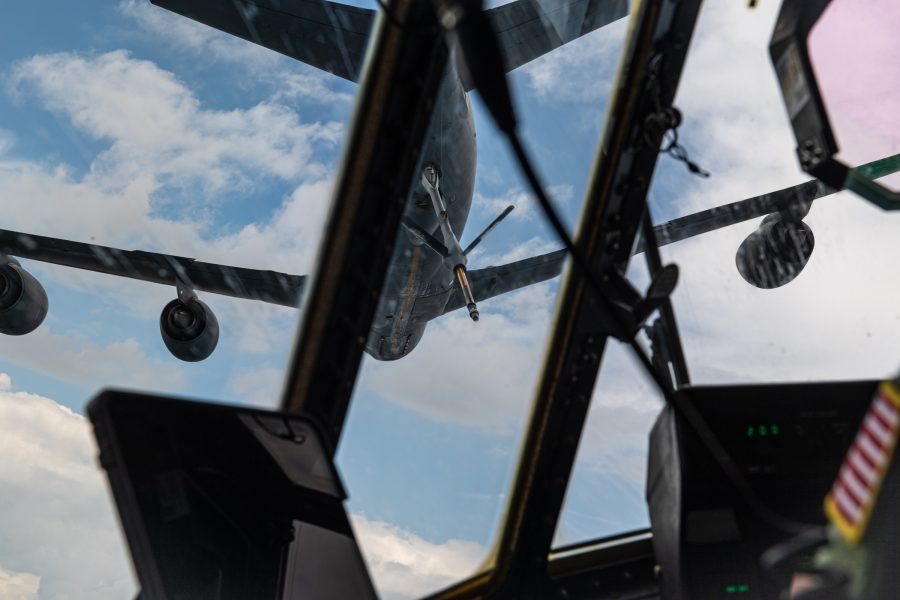
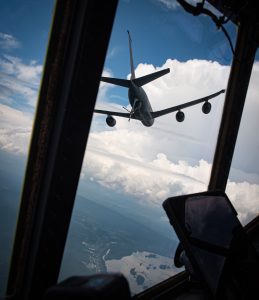
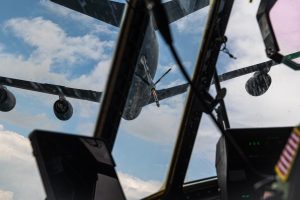
A KC-135R from the 171st Aerial Refueling Wing flies in formation with a EC130J from the 193rd Special Operations Wing in Harrisburg, Pennsylvania, June 27, 2023. U.S. Air National Guard photo by Senior Airman Diana Snyder
Audio of this article is brought to you by the Air & Space Forces Association, honoring and supporting our Airmen, Guardians, and their families. Find out more at afa.org
While U.S. Air Force’s jets and bombers are the nation’s fight-tonight force, aerial refueling before and after those forces go into the fight is often the key to those missions.
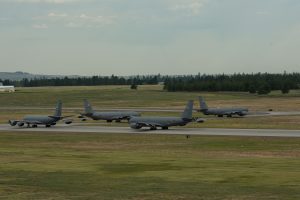
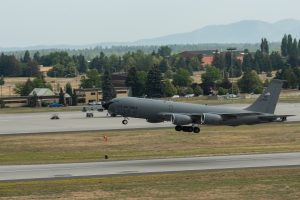
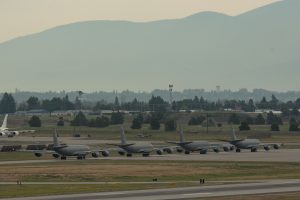
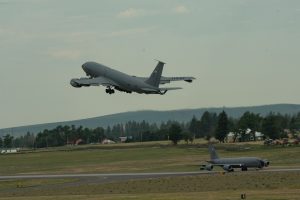
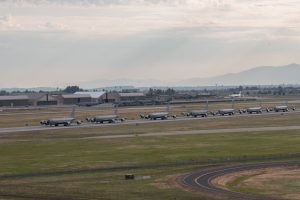
On the 100th anniversary of the first aerial refueling mission, the Air Force sought to highlight the behind-the-scenes efforts of some of its most essential planes with Operation Centennial Contact. More than 150 tankers from 26 installations were involved in large-scale flyovers across the country.
All 50 states were originally slated to have flyovers, but weather conditions forced some units to adjust their flight paths and schedules.
Air Mobility Command’s tankers allow sorties to go on at length with limited interruption—from fighter combat air patrols and intercontinental bomber missions to keeping the E-4B “Doomsday Plane” in the skies.
“Today’s U.S. Air Force air refueling capabilities deliver unrivaled rapid global reach for U.S. forces and our Allies and partners throughout the globe,” Air Mobility Command said in a news release. “Aerial refueling serves as a force multiplier, increasing the speed, range, lethality, flexibility, and versatility of combat aircraft.”
According to the Air Force, the first aerial refueling occurred on June 27, 1923, with aviators from the Army Air Service, the Air Force’s predecessor.
“On that day, 1st Lt. Virgil Hine and 1st Lt. Frank W. Seifert, flying a DH-4B, passed gasoline through a gravity hose to another DH-4B piloted by Capt. Lowell H. Smith and 1st Lt. John P. Richter, accomplishing the first aerial refueling,” the AMC release stated.
To highlight what has turned from an experiment into something that is now a “critical capability” to the Department of Defense’s operations, Air Mobility Command had its fleet of tankers—from the 1950s-era KC-135 Stratotankers to KC-10 Extenders and the newest KC-46 Pegasus showcase their mission. The participating units were extensive, according to an AMC spokesperson:
97th Air Mobility Wing (Altus Air Force Base, Okla)
459th Air Refueling Wing (Joint Base Andrews, Md.)
101st Air Refueling Wing (Bangor Air National Guard Base, Maine.)
117th Air Refueling Wing (Sumpter Smith Joint National Guard Base, Birmingham, Ala.)
168th Wing (Eielson Air Force Base, Alaska)
92nd Air Refueling Wing (Fairchild Air Force Base, Wash.)
190th Air Refueling Wing (Forbes Air National Guard Base, Kan.)
434th Air Refueling Wing (Grissom Air Reserve Base, Ind.)
154th Air Refueling Wing (Joint Base Pearl Harbor-Hickam, Hawaii)
155th Air Refueling Wing (Lincoln Air National Guard Base, Neb.)
189 Air Refueling Wing (Little Rock Air Force Base, Ark.)
6th Air Refueling Wing (MacDill Air Force Base, Fla.)
452nd Air Mobility Wing (March Air Reserve Base, Calif.)
22nd Air Refueling Wing (McConnell Air Force Base, Kan)
134th Air Refueling Wing (McGhee Tyson Air National Guard Base, Tenn.)
305 Air Mobility Wing (Joint Base McGuire-Dix-Lakehurst, N.J.)
60th Air Mobility Wing (Travis Air Force Base, Texas)
186th Air Refueling Wing (Key Field, Miss.)
128 Air Refueling Wing (General Mitchell Air National Guard Base, Wis.)
151th Air Refueling Wing (Roland R. Wright Air National Guard Base, Utah.)
“Air refueling propels our Nation’s air power across the skies, unleashing its full potential,“ Air Mobility Command boss Gen. Mike Minihan said in a news release. “It connects our strategic vision with operational reality, ensuring we can reach any corner of the globe with unwavering speed and precision.”
The Air Force is hoping to rethink aerial refueling yet again, with a next-generation air refueling system (NGAS) and more KC-46s replacing KC-135s that entered the fleet closer to that first aerial refueling than today. While flying some of the Air Force’s aging refueling aircraft over the skies of the U.S., the AMC also wanted to show why it needs to plan for the future and recapitalize the tanker fleet to “remain relevant in the current and future security environments,” the command said.
Audio of this article is brought to you by the Air & Space Forces Association, honoring and supporting our Airmen, Guardians, and their families. Find out more at afa.org
The Air Force got a glimpse of its potential future this week, when an F-15EX fighter flew alongside a Collaborative Combat Aircraft during a major Pacific exercise.
The Air Force is quietly wrapping up a round of market research on arming its tanker fleet with weapons capable of shooting down incoming enemy threats. The service awarded contracts to four firms beginning in February to study options for equipping refuelers such as the KC-135 Stratotanker and KC-46 Pegasus…
An F-15EX fighter touched down at Kadena Air Base, Japan, this week—thought still not on a permanent basis. The Eagle II is on a “visit” to the crucial Pacific base on Okinawa, according to a July 1 release.
On July 4, thousands of people will brave 100-degree weather in downtown Washington, D.C., for America’s 250th anniversary. And high above them, the pilots of the U.S. Air Force Thunderbirds will be hot too—not that it will stop their red, white, and blue F-16s.
A B-2 Spirit on June 27 used a ship-killing missile to strike a decommissioned amphibious transport vessel during a Pacific exercise, marking a significant expansion of the stealth bomber’s maritime strike capabilities.
Air Force will soon issue new guidance on the use of artificial intelligence and will implement a sweeping modernization of Basic Military Training by 2027 following a summit of top service leaders.
The arrival of the Air Force’s B-21 Raider at its first operational base is fast approaching, and the service’s plans for its newest stealth bomber are coming into focus. In an exclusive interview with Air & Space Forces Magazine on June 26, Air Force Secretary Troy Meink said plans to…
An Air Force pilot learning to fly the new OA-1K inadvertently shut off the plane’s fuel in the middle of a training sortie last October, leading to the Skyraider II crashing in an Oklahoma field, according to a new investigation report.
✓
Thank You!
Check your inbox to verify your email address and finish setting up your AFA account.
★
Welcome Back!
An account with this email already exists. Please log in to continue.
Subscribe to the Air & Space Forces Daily Report
The latest news from Air & Space Forces Magazine, as well as news from other leading publications, delivered right to your inbox every morning!
We’re sorry, there has been an error. Please review your input or try again later.