
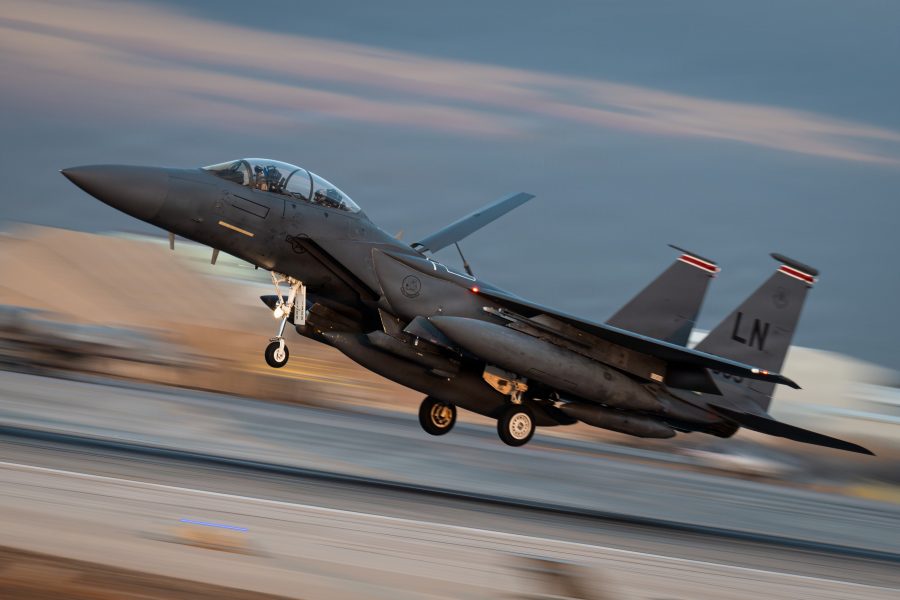
Kuwaiti aircraft are suspected to be responsible for the shootdown of three U.S. Air Force F-15E Strike Eagles on March 2, people familiar with the matter told Air & Space Forces Magazine.
The friendly fire episode occurred around 7 a.m. local time on the third day of the U.S. war against Iran. At least one Kuwaiti F/A-18 is believed to be responsible—Kuwait flies F/A-18s and Eurofighter Typhoons.
All six aviators—three pilots and three weapons systems officers—are alive, were recovered safely, and are in stable condition, U.S. military officials said.
U.S. Central Command declined comment on the suspected role of the Kuwaiti planes. “It would be inappropriate to comment given the incident is under investigation,” said Navy Capt. Tim Hawkins.
CENTCOM said on March 2 that the American aircraft “were mistakenly shot down by Kuwaiti air defenses,” but it did not say whether American fighters were shot down by surface-to-air or air-to-air systems. But people familiar with the episode said March 3 that surface-to-air fire is no longer the leading theory.
The exact circumstances of the downing of the American warplanes are not yet clear, but Iran has retaliated with missiles and drones against Kuwait and countries across the Gulf. Iran’s strategy has been to put military pressure on Gulf states in the hope that they urge President Trump to stop the war.
CENTCOM said the incident occurred during “active combat,” which included “attacks from Iranian aircraft, ballistic missiles, and drones.”
A former Air Force fighter pilot told Air & Space Forces Magazine the incident is “perplexing,” given that allied pilots are trained to follow procedures to prevent such dangerous mistakes.
“If you’re flying air defense missions, the first thing you do is interrogate using your transponder,” the former pilot said. American pilots broadcast an Identification Friend or Foe code that identifies them as friendly to allied forces.
“If you’re beyond visual range, you interrogate the other aircraft to see if they’re squawking a friendly code,” the pilot said. “If you don’t have a friendly identification, then you proceed to a visual identification.”
The fact that all six crew members ejected safely, the former pilot said, “tells me they were shot from the rear quadrant, and probably by a heat-seeking missile without a really large warhead.”
It is not clear if the U.S. planes had their IFF systems on. “It’s pretty hard to mistake an F-15E for an Iranian aircraft, and particularly if they’re not maneuvering in any kind of aggressive fashion,” the former pilot said.
Even if for some reason, the F-15s were flying without transponders turned on, “that’s not a basis to engage those aircraft,” the former pilot said. “They have to be demonstrating some hostile intent. If they’re just flying, that’s not hostile intent.”
The friendly fire episode did occur at a moment when Kuwaiti forces were on edge. A day before the shootdown of the F-15s, on March 1, six U.S. Army Soldiers were killed by an Iranian drone attack on a U.S. tactical operations center at the Shuaiba port in Kuwait.
Chairman of the Joint Chiefs of Staff Gen. Dan Caine acknowledged the “loss” of the three F-15Es in a press briefing at the Pentagon on March 2 and said the U.S. knew the incident “was not from hostile enemy fire.” He declined to comment any further.
Images and videos circulating on social media appear to show one of the F-15Es spiraling toward the ground with smoke and fire coming from its tail. Its two vertical stabilizers are missing, apparently shot from the rear, as well as Airmen being recovered by local civilians.
CENTCOM commander Adm. Brad Cooper said March 3 that 200 fighters have participated in the operation, conducting 2,000 strikes. F-15Es are among the aircraft participating in the mission.
Kuwait’s Ministry of Defense said in a statement that it “confronted a number of hostile aerial targets” around dawn on the day of the shootdown, before adding a later statement that several U.S. aircraft crashed.
Kuwait’s military said “joint technical measures were taken” after the shootdown, but did not provide further details.
The incident was the first loss of an American aircraft since Epic Fury began Feb. 28 with a massive wave of American and Israeli airstrikes on Iran, which soon retaliated by launching drones and missiles at bases and civilian areas across the Middle East.
The F-15E downing is the second known incident of U.S. fighters being taken out by friendly fire in the Middle East in the past 15 months; in December 2024 during operations against the Iran-backed Houthis in Yemen, a Navy F/A-18F Super Hornet was returning from a mission and preparing to land on the aircraft carrier USS Harry S. Truman when it was misidentified as a threat and shot down by crew aboard the USS Gettysburg cruiser.