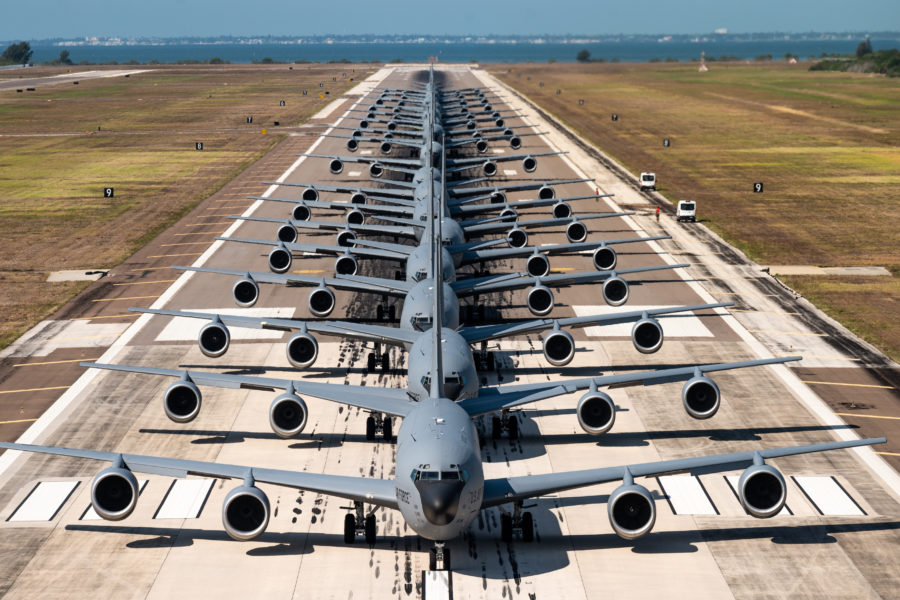
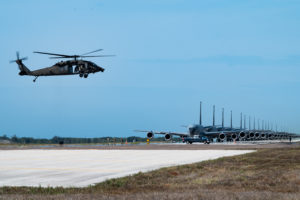
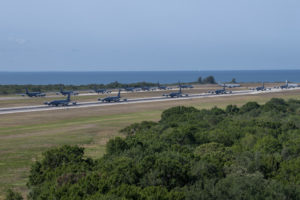
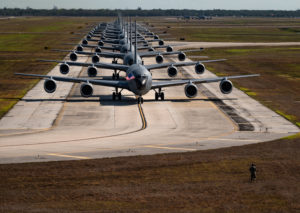
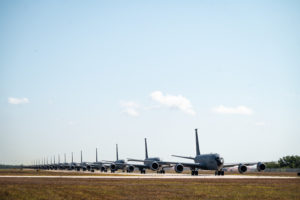
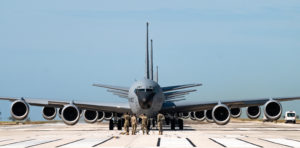
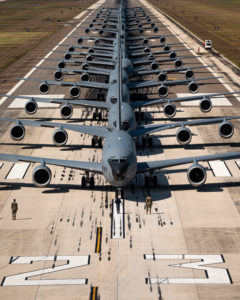
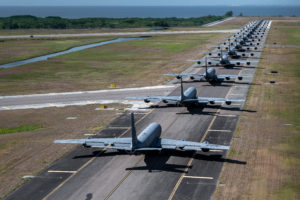
U.S. Air Force KC-135 Stratotanker aircraft assigned to the 6th and 927th Air Refueling Wings participate during Operation Violent Storm April 26, 2023, at MacDill Air Force Base, Florida. Violent Storm proved that MacDill AFB has the capability to project overwhelming air power in a short timeframe. U.S. Air Force photo by Tech. Sgt. Alexander Cook
Audio of this article is brought to you by the Air & Space Forces Association, honoring and supporting our Airmen, Guardians, and their families. Find out more at afa.org
Spread out over more than half a mile, 18 KC-135 Stratotankers lined up on the runway at MacDill Air Force Base, Fla., on April 26—the sixth Air Force elephant nationwide in the past six weeks.
The event was part of MacDill’s Operation Violent Storm, an exercise designed to force units to work together to rapidly mobilize the fleet. More than 700 Airmen contributed to ready the KC-135s in less than six hours.
“What Operation Violent Storm showcases is our ability to, in rapid succession, provide airpower for America,” said Col. Adam Bingham, 6th Air Refueling Wing commander, in a statement. “We are able to put booms in the air that fuel America’s strategic fighters and bombers who will ultimately be delivering hope and projecting violence at a time that America really needs it.”
The operation was the 6th Air Refueling Wing’s first large-scale elephant walk since 2016, according to a release. Airmen from the 927th Air Refueling Wing, the 6th ARW’s Reserve associate unit, also participated, as did U.S. Army UH-60 Black Hawks assigned to the 5th Battalion.
The MacDill event is the latest in a surge of “elephant walks” across the Air Force in recent weeks, all at different bases:
Seven E-3 Sentry airborne warning and control, or AWACS, aircraft lining up for a “weather flush” on March 21 at Tinker Air Force Base, Okla.
20 mobility aircraft—seven KC-135 Stratotankers, eight C-17 Globemaster IIIs, and five KC-46 Pegasus—also participated in a severe weather exercise March 24 at Altus Air Force Base, Okla.
21 tankers—16 KC-46s and five KC-135s—lined up as part of an Agile Combat Employment exercise at McConnell Air Force Base, Kan., also on March 24.
4,000 Airmen and 80 trainer aircraft gathered on the runway at Sheppard Air Force Base, Texas, on April 7, to showcase the power of its people as well as its planes.
Audio of this article is brought to you by the Air & Space Forces Association, honoring and supporting our Airmen, Guardians, and their families. Find out more at afa.org
More than 40 years after the original YF-117 operational prototype flew test runs from a Lockheed Martin Skunk Works facility, an F-117 returned for a $1 million refurbishment to look its best when it assumes its place in history alongside other iconic aircraft on permanent exhibit at the National Air…
A U.S. Air Force F-22 pilot controlled a YFQ-44A Fury Collaborative Combat Aircraft this month while both aircraft were in flight, according to an Oct. 16 release, another milestone in the service’s ambitious CCA efforts.
The Marine Corps recently conducted its first-ever “ripple” release of eight Small Diameter Bomb IIs from an F-35B, a key early step in proving out the capability for all F-35 variants.
The Air Force will field operational prototypes for an autonomous drone to replace its MQ-9 Reaper in 2028, Secretary of the Air Force Troy Meink said Oct. 14.
One of the Air Force’s critical B-2 Spirit stealth bombers has returned to Whiteman Air Force Base, Mo., after an extensive course of maintenance to restore its stealth coating and preserve its structural integrity.
BAE Systems has received a contract from Lockheed Martin to install an upgraded Block 4 electronic warfare system into new F-35 Joint Strike Fighters, as well as to retrofit some older jets.
The Air Force has figured out a way for maintainers to inspect what had been a “blind spot” in F-16 engines, after problems in that area led to the catastrophic crashes of two jets in recent years.
The Air Force has begun evacuating stealth fighters, gunships, and special operations planes ahead of Hurricane Isaias expected landfall over the Gulf Coast this weekend.
The Air Force’s B-52 bomber may soon be able to carry up to 20 stealthy long-range anti-ship missiles to strike moving targets at sea, a key capability in a potential fight with China.
✓
Thank You!
Check your inbox to verify your email address and finish setting up your AFA account.
★
Welcome Back!
An account with this email already exists. Please log in to continue.
Subscribe to the Air & Space Forces Daily Report
The latest news from Air & Space Forces Magazine, as well as news from other leading publications, delivered right to your inbox every morning!
We’re sorry, there has been an error. Please review your input or try again later.