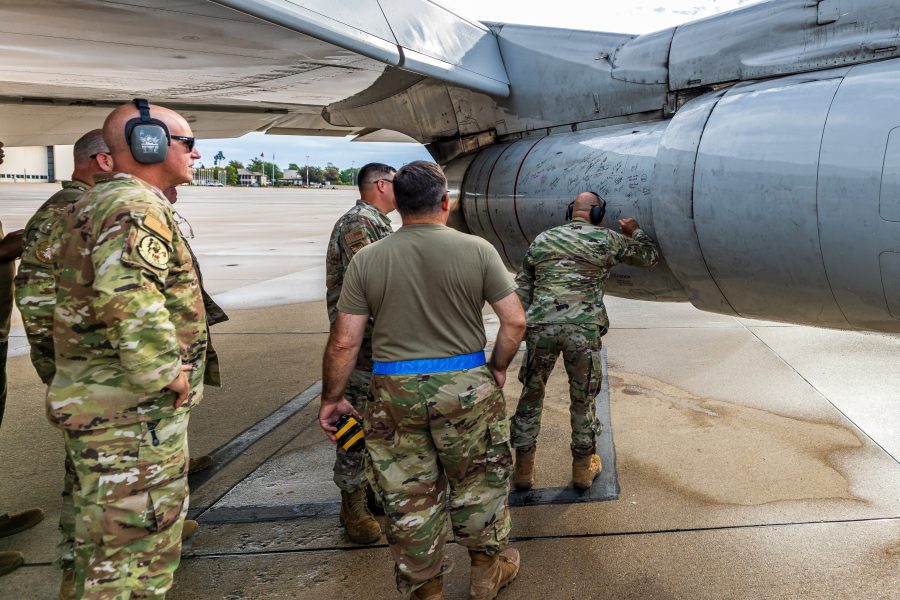
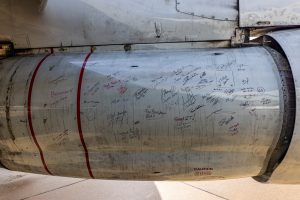
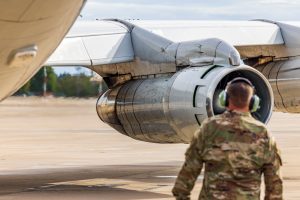
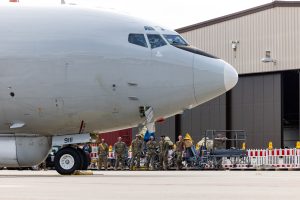
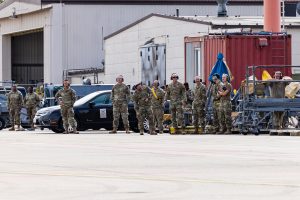
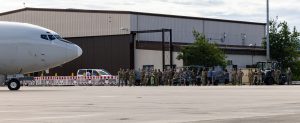
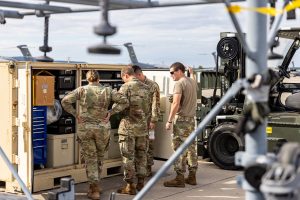
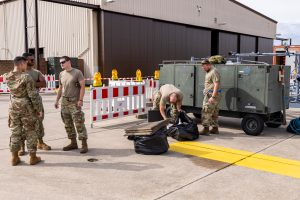
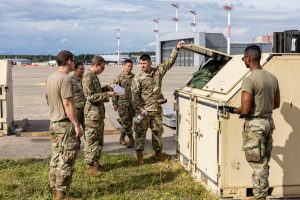
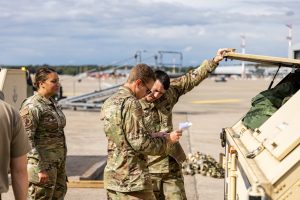
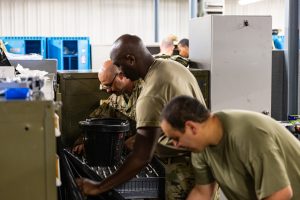
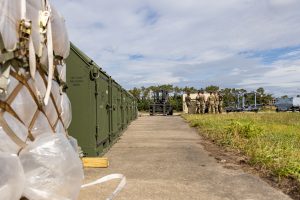
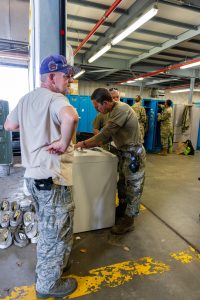
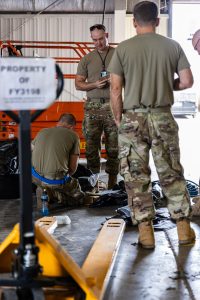
U.S. Airmen with the 116th Air Control Wing, Georgia Air National Guard, sign an engine of an E-8C Joint STARS for its last mission at Ramstein Air Force Base, Germany, Sept. 21, 2023. The JSTARS have been in service since 2002. U.S. Air National Guard photo by Master Sgt. Jeff Rice
Audio of this article is brought to you by the Air & Space Forces Association, honoring and supporting our Airmen, Guardians, and their families. Find out more at afa.org
A crew of Airmen at Ramstein Air Base, Germany, flew the final operational sortie of the E-8C JSTARS aircraft on Sept. 21, paving the way for the last of the fleet to be retired early next month.
Members of the Georgia Air National Guard’s 116th Air Control Wing flew the very last of more than 14,000 sorties for the JSTARS, which is used for targeting, battle management, and command and control.
“It’s bittersweet,” Col. Christopher Dunlap, commander of the 116th Air Control Wing, said in a release. “I’ve been flying this mission on this aircraft since the spring of 2003. There’s been a lot of changes over the years.”
A spokesman for the 116th ACW told Air & Space Forces Magazine that two JSTARS aircraft now remain at Robins Air Force Base, Ga. The tentative plan is to send the last one to the “Boneyard” at Davis-Monthan Air Force Base, Ariz., in the first week of November.
Until then, “the aircraft may be used locally for aircrew proficiency training as needed,” the spokesman added.
Still, the final operational sorties mark one of the final milestones for the E-8. Primarily used for ground moving target indication, JSTARS also served as a battle management platform. Its most distinctive feature is the 27-foot long, canoe-shaped radome under the forward fuselage that houses a 24-foot long, side-looking phased array antenna.
The aircraft first supported combat operations during Desert Storm and played a key role in the Air Force’s contributions during the Global War on Terror. More recently, the E-8 flew missions over Eastern Europe in the run-up and immediate aftermath of Russia’s 2022 invasion of Ukraine.
The Air Force has been planning to move on from JSTARS for a while. In June 2021, service leaders announced their intent to cut the aircraft from Robins, which has hosted them since 1996.
In its place, Robins is getting a Battle Management Control squadron, an E-11A Battlefield Airborne Communication Node (BACN) squadron, a Spectrum Warfare group, and support units focused on the service’s Advanced Battle Management System (ABMS).
The first E-8 departed Robins in February 2022. A month later, the service announced its intent to divest 12 of 16 aircraft in fiscal 2023 and 2024, and Congress expedited the move by repealing a previous law requiring the Air Force to maintain at least six E-8s.
This past March, the Air Force budget request revealed a plan to accelerate the divestment plan, with the entire fleet retiring by the end of fiscal 2024, which started Oct. 1.
Service leaders have said the Air Force needs to retire JSTARS because it would not survive in a future fight with an advanced adversary like China. Instead, they want to invest in various information and targeting technologies, including space-based platforms.
Over the last several months, Robins has wound down JSTARS operations, deactivating squadrons and conducting final flights. In June, the Active-Duty 461st Air Control Wing completed its last operational mission at Ramstein.
The 116th ACW spokesman said before the final aircraft is officially retired, there will be “a private farewell celebration for alumni of the JSTARS program.”
Audio of this article is brought to you by the Air & Space Forces Association, honoring and supporting our Airmen, Guardians, and their families. Find out more at afa.org
More than 40 years after the original YF-117 operational prototype flew test runs from a Lockheed Martin Skunk Works facility, an F-117 returned for a $1 million refurbishment to look its best when it assumes its place in history alongside other iconic aircraft on permanent exhibit at the National Air…
A U.S. Air Force F-22 pilot controlled a YFQ-44A Fury Collaborative Combat Aircraft this month while both aircraft were in flight, according to an Oct. 16 release, another milestone in the service’s ambitious CCA efforts.
The Marine Corps recently conducted its first-ever “ripple” release of eight Small Diameter Bomb IIs from an F-35B, a key early step in proving out the capability for all F-35 variants.
The Air Force will field operational prototypes for an autonomous drone to replace its MQ-9 Reaper in 2028, Secretary of the Air Force Troy Meink said Oct. 14.
One of the Air Force’s critical B-2 Spirit stealth bombers has returned to Whiteman Air Force Base, Mo., after an extensive course of maintenance to restore its stealth coating and preserve its structural integrity.
BAE Systems has received a contract from Lockheed Martin to install an upgraded Block 4 electronic warfare system into new F-35 Joint Strike Fighters, as well as to retrofit some older jets.
The Air Force has figured out a way for maintainers to inspect what had been a “blind spot” in F-16 engines, after problems in that area led to the catastrophic crashes of two jets in recent years.
The Air Force has begun evacuating stealth fighters, gunships, and special operations planes ahead of Hurricane Isaias expected landfall over the Gulf Coast this weekend.
The Air Force’s B-52 bomber may soon be able to carry up to 20 stealthy long-range anti-ship missiles to strike moving targets at sea, a key capability in a potential fight with China.
✓
Thank You!
Check your inbox to verify your email address and finish setting up your AFA account.
★
Welcome Back!
An account with this email already exists. Please log in to continue.
Subscribe to the Air & Space Forces Daily Report
The latest news from Air & Space Forces Magazine, as well as news from other leading publications, delivered right to your inbox every morning!
We’re sorry, there has been an error. Please review your input or try again later.