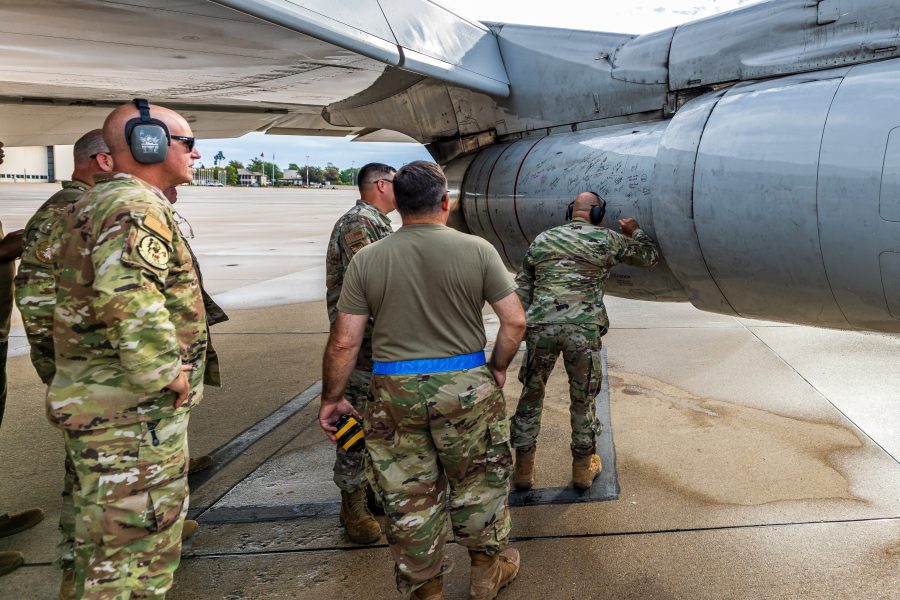
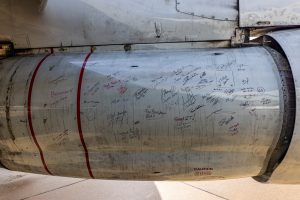
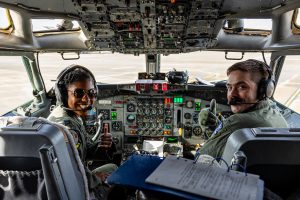
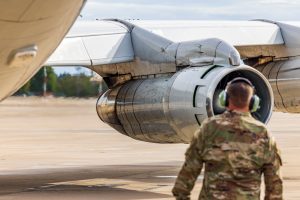
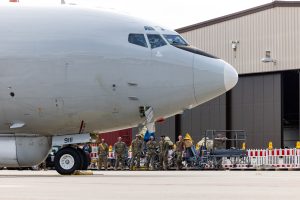
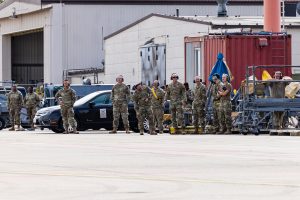
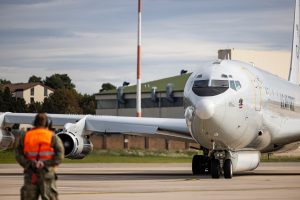
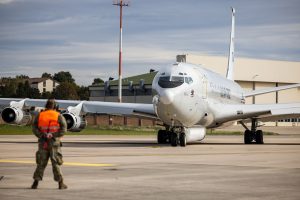
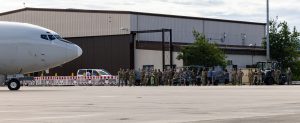
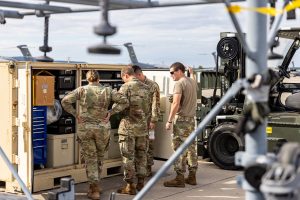
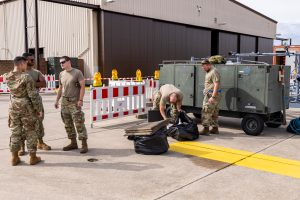
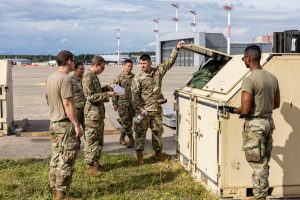
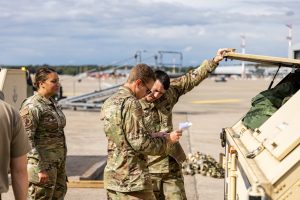
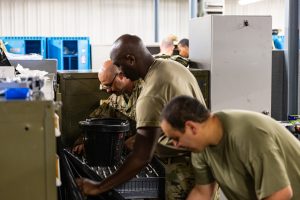
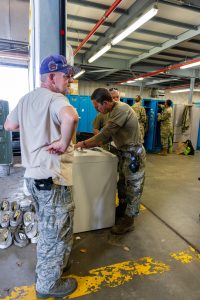
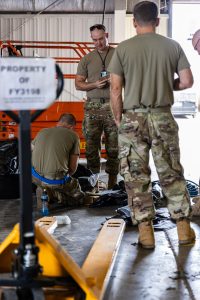
U.S. Airmen with the 116th Air Control Wing, Georgia Air National Guard, sign an engine of an E-8C Joint STARS for its last mission at Ramstein Air Force Base, Germany, Sept. 21, 2023. The JSTARS have been in service since 2002. U.S. Air National Guard photo by Master Sgt. Jeff Rice
Audio of this article is brought to you by the Air & Space Forces Association, honoring and supporting our Airmen, Guardians, and their families. Find out more at afa.org
A crew of Airmen at Ramstein Air Base, Germany, flew the final operational sortie of the E-8C JSTARS aircraft on Sept. 21, paving the way for the last of the fleet to be retired early next month.
Members of the Georgia Air National Guard’s 116th Air Control Wing flew the very last of more than 14,000 sorties for the JSTARS, which is used for targeting, battle management, and command and control.
“It’s bittersweet,” Col. Christopher Dunlap, commander of the 116th Air Control Wing, said in a release. “I’ve been flying this mission on this aircraft since the spring of 2003. There’s been a lot of changes over the years.”
A spokesman for the 116th ACW told Air & Space Forces Magazine that two JSTARS aircraft now remain at Robins Air Force Base, Ga. The tentative plan is to send the last one to the “Boneyard” at Davis-Monthan Air Force Base, Ariz., in the first week of November.
Until then, “the aircraft may be used locally for aircrew proficiency training as needed,” the spokesman added.
Still, the final operational sorties mark one of the final milestones for the E-8. Primarily used for ground moving target indication, JSTARS also served as a battle management platform. Its most distinctive feature is the 27-foot long, canoe-shaped radome under the forward fuselage that houses a 24-foot long, side-looking phased array antenna.
The aircraft first supported combat operations during Desert Storm and played a key role in the Air Force’s contributions during the Global War on Terror. More recently, the E-8 flew missions over Eastern Europe in the run-up and immediate aftermath of Russia’s 2022 invasion of Ukraine.
The Air Force has been planning to move on from JSTARS for a while. In June 2021, service leaders announced their intent to cut the aircraft from Robins, which has hosted them since 1996.
In its place, Robins is getting a Battle Management Control squadron, an E-11A Battlefield Airborne Communication Node (BACN) squadron, a Spectrum Warfare group, and support units focused on the service’s Advanced Battle Management System (ABMS).
The first E-8 departed Robins in February 2022. A month later, the service announced its intent to divest 12 of 16 aircraft in fiscal 2023 and 2024, and Congress expedited the move by repealing a previous law requiring the Air Force to maintain at least six E-8s.
This past March, the Air Force budget request revealed a plan to accelerate the divestment plan, with the entire fleet retiring by the end of fiscal 2024, which started Oct. 1.
Service leaders have said the Air Force needs to retire JSTARS because it would not survive in a future fight with an advanced adversary like China. Instead, they want to invest in various information and targeting technologies, including space-based platforms.
Over the last several months, Robins has wound down JSTARS operations, deactivating squadrons and conducting final flights. In June, the Active-Duty 461st Air Control Wing completed its last operational mission at Ramstein.
The 116th ACW spokesman said before the final aircraft is officially retired, there will be “a private farewell celebration for alumni of the JSTARS program.”
Audio of this article is brought to you by the Air & Space Forces Association, honoring and supporting our Airmen, Guardians, and their families. Find out more at afa.org
An important U.S. Air Force E-3 Sentry AWACS command and control plane was among the aircraft damaged in a March 27 Iranian missile and drone attack on Prince Sultan Air Base, Saudi Arabia, people familiar with the matter told Air & Space Forces Magazine.
Multiple American service members were wounded and some aircraft were damaged in a March 27 Iranian attack on Prince Sultan Air Base, Saudi Arabia, people familiar with the matter told Air & Space Forces Magazine.
The 34th Fighter Squadron won the Raytheon Trophy for its air superiority performance in 2025 in two major Middle East operations and a series of responses in the Pacific. The F-35 Lightning II squadron received the honor following its role in Operation Rough Rider targeting Houthi rebel missile sites in…
Three additional B-1B Lancers arrived at RAF Fairford on March 26, bringing the total number of bombers stationed at the U.K. base to 21—one of the largest bomber deployments in recent history.
The Pentagon formally split the combined U.S. Forces Japan and the Fifth Air Force into separate commands, ending a dual-hatted arrangement that had been in place for more than 60 years. The separation means that the former combined commander, Air Force Lt. Gen. Stephen Jost, will remain head of U.S.…
The Air Force’s nascent Collaborative Combat Aircraft program is beating former Secretary Frank Kendall’s goal of producing drone wingmen at about one-third the cost of an F-35, an official leading the effort said March 25.
Audio of this article is brought to you by the Air & Space Forces Association, honoring and supporting our Airmen, Guardians, and their families. Find out more at afa.org A photo of a B-52 Stratofortress flying with an apparent pair...
The Air Force may have used a secretive intelligence, surveillance, and reconnaissance drone over Venezuela earlier this year. Now, observers think they may have spotted an even more classified aircraft amid operations in Iran.
The Pentagon’s top weapons tester noted progress on key munitions for the Air Force in his latest report, covering everything from dogfighting missiles to hypersonics.
✓
Thank You!
Check your inbox to verify your email address and finish setting up your AFA account.
★
Welcome Back!
An account with this email already exists. Please log in to continue.
Subscribe to the Air & Space Forces Daily Report
The latest news from Air & Space Forces Magazine, as well as news from other leading publications, delivered right to your inbox every morning!
We’re sorry, there has been an error. Please review your input or try again later.