
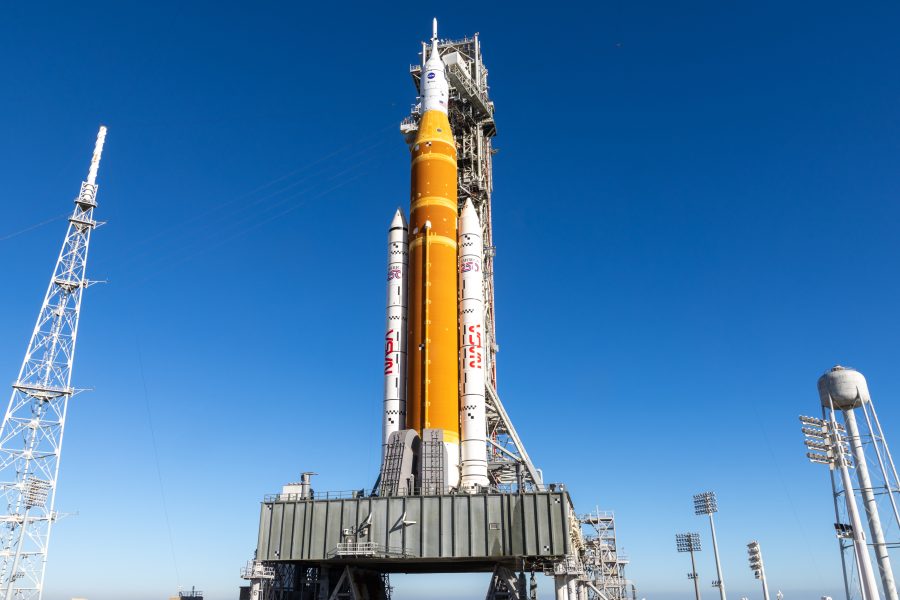
In many ways, the Space Force’s role in NASA’s Artemis II mission, scheduled to lift off from the Eastern Range the evening of April 1, is the same as any other launch it supports. Space Launch Delta 45, which oversees operations at Cape Canaveral Space Force Station, Fla., will ensure the launch is safe and the base is secure, and will monitor weather risks in advance.
But the size, nature, and level of public interest in NASA’s first crewed lunar flight since 1972 means those routine range support tasks require more personnel, more analysis, and more security guardrails than a standard launch, officials told reporters March 30.
One of the biggest differences is the amount of personnel required to support Artemis II. Lt. Col. Gregory Allen, commander of the delta’s 1st Range Operations Squadron, said that for a typical launch, about four or five operators are “on console” at the range’s mission control center. Artemis will require around 28 crew members. That’s primarily because the Boeing-built rocket that’s flying the mission, the Space Launch System, lacks an onboard command-destruct system, known as an automated flight safety system.
As of 2025, AFSS is required for all new rockets, but SLS wasn’t designed with that technology built in. That means the Space Force needs additional personnel on the ready to operate the necessary range instrumentation to track and abort the mission in the case of an emergency.
“When you don’t have an autonomous flight safety system, you have to call up multiple range assets and resources for that function,” Allen said. “That is exactly why we have so many personnel on console for this.”
Another safety consideration involves managing and protecting the large crowd of onlookers expected to gather to watch the launch. The Artemis I mission in 2022 drew nearly 200,000 spectators, and some local Florida media outlets have reported that number could double for Artemis II.
Delta commander Col. Brian Chatman said public safety is the range’s top priority. For the upcoming launch, Cape Canaveral personnel will support NASA’s Kennedy Space Center team, providing security support where needed “to make sure that people are staying in the defined areas” and are not breaching any “keep-out zones.”
The safety team, led by Col. Meredith Beg, determines the size of the keep-out zones based on a number of factors, including mission risk and scope, and in this case, the size of the crowd. Beg said crowd size is a variable in that analysis and any risks that arise will factor in the potential public safety impact when the range determines whether the launch is “go or no-go.”
“The more folks that are around, the higher the risk number can be,” she said. “This vehicle also has solid rocket boosters. Solid rocket boosters are obviously pretty toxic—well, at least the plumes are pretty toxic—so we’re doing the analysis based on weather constraints or the day-of launch weather to see where those plumes are going. So there are chances that if the winds are such, we would not be able to have visitors and because that plume could migrate over them.”
Launch trajectory is another factor in defining the keep-out zones, Beg said—not just for the crowd gathered to watch, but for aircraft and ships operating in the area. For Artemis II, there is a “wide swath” of possible launch paths, or azimuths, the mission could follow.
“My team is analyzing every single one of those trajectories to understand what a potential flight path is so we can make those notifications to our air and sea partners to make sure that they’re not in harm’s way as the mission takes off the ground,” she said.
In the event that Artemis II has to abort its mission after liftoff, Space Launch Delta 45 has an Emergency Operations Center—which includes emergency management, first responders, and explosive ordnance technicians—on standby and “ready to surge,” according to Col. Chris Bulson, deputy commander for support. That includes maritime patrols as well as a unit called Detachment 3, which has four helicopters staged at the base and ready to rescue or recover Artemis II astronauts if needed.
“SLD 45 has a robust team of folks on standby for this particular mission that are well-versed with the SLS rocket, the systems on board, and have great teamwork with our Detachment 3 partners to assist them should the recovery be necessary,” Bulson said.
While the upcoming mission is a significant event for NASA and the Space Force, it’s just the beginning of what’s expected to be a busy run of moon-focused missions over the next several years. Asked whether the range is ready to support a higher cadence that could potentially include multiple Artemis flights in a single launch window, Chatman pointed to the spaceport’s significant growth in recent years.
“Over the course of ‘25, we did three launches in 24 hours, four launches in just over 36 hours,” he said. “We did two launches in the same launch window last year. We have more and more tightened our partnership, and continued to solidify the relationship with our KSC counterparts on the NASA side. … We’re really getting after some of those efficiency blocks that exist today to be able to facilitate the manifest that we perceive coming in the future.”