
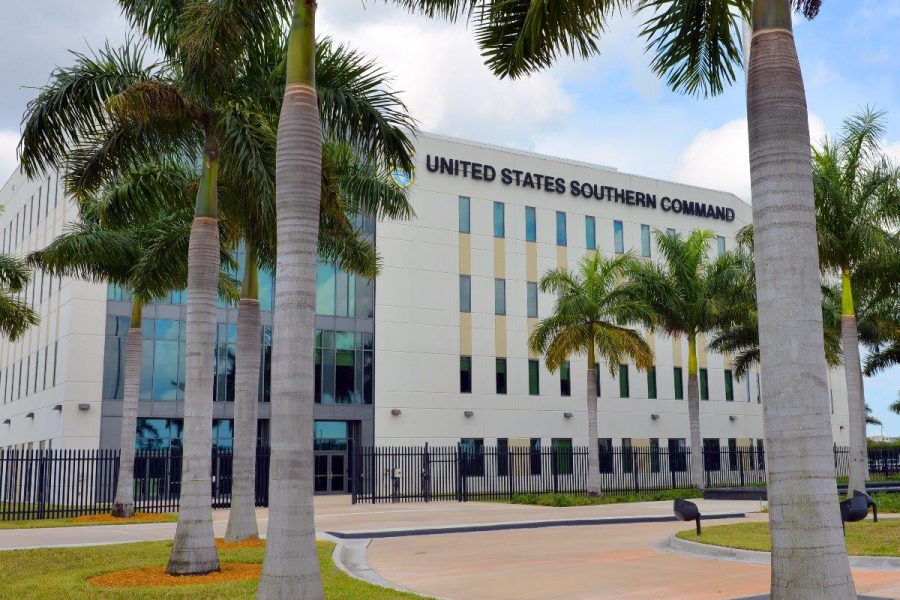
The Trump administration’s new National Security Strategy released in November makes clear the Western Hemisphere is the highest priority for the Pentagon, but to put that into action, U.S. Southern Command needs to grow—and fast, says the general nominated to lead it.
Marine Corps Gen. Francis L. Donovan, nominated to lead SOUTHCOM, testified before the Senate Armed Services Committee Jan. 15. In written testimony, Donovan said changes are needed.
“As I understand it, SOUTHCOM and its [area of responsibility] have been chronically under-resourced and under-funded,” Lt. Gen. Francis L. Donovan wrote in response to written questions. “Clearly, that is changing, which presents both challenges and opportunities. If confirmed, I expect to confront challenges related to capacity, operational tempo, and organizational structure.”
Navy and Air Force assets poured into Latin America rapidly over the past few months in support of Operation Southern Spear, the mission to combat drug trafficking and pressure the regime of Venezuela’s former president, Nicolás Maduro. Those and other units contibuted to the successful Operation Absolute Resolve, in which Maduro was captured and taken to the U.S. for trial.
While some forces have since departed the region, many still remain and could form the basis for a longer-term presence. Several senators and Donovan alluded to that expectation during the hearing.
“Do you expect because of this pivot to the Western Hemisphere that SOUTHCOM this year is going to have to be much different than SOUTHCOM last year?” Sen. Mark Kelly (D-Ariz.) asked Donovan.
“Senator, yes, I do,” Donovan replied.
In terms of force structure, SOUTHCOM notes on its website that it typically has about “1,200 military and civilian personnel” assigned to the command. In December, SOUTHCOM said it had about 15,000 troops in the Caribbean, more than a tenfold increase over the norm.
By comparison, U.S. Central Command has had about 40,000 personnel—and 5,000 assigned to its headquarters. In recent years, and U.S. Indo-Pacific Command has had more than 375,000 military and civilian personnel in its area of responsibility.
SOUTHCOM must build the infrastructure to support an increase in forces. Both Sen. Dan Sullivan (R-Alaska) and Sen. Tommy Tuberville (R-Ala.) pressed Donovan about whether SOUTHCOM’s headquarters in Miami is ready for that increase.
“I have been thinking a lot about that,” Donovan told Tuberville. He told Sullivan that “the concern now, as we have additional physical assets in place is [whether] the headquarters is staffed and structured to maintain and sustain logistics and supply and all the basic underpinnings of military capability?”
Beyond its Miami headquarters, SOUTHCOM has little in the way of infrastructure. Almost all of its major installations are in Puerto Rico, and even there the Pentagon had to reopen the shuttered Roosevelt Roads Naval Station to accommodate the forces participating in Operation Southern Spear.
A few small sites in Colombia, Peru, and Honduras are also SOUTHCOM assets, and the command has “Cooperative Security Locations” in El Salvador, Aruba, and Curacao—generally, civilian airports that can host U.S. military assets.
That capacity pales in comparison to overseas installations like Al Udeid Air Base in Qatar, which can host 10,000 troops, or Kadena Air Base in Japan, which covers nearly 5,000 acres.
On top of more people and more locations, SOUTHCOM is also grappling with a major shift in focus, but Donovan said the command is well positioned to do so.
“I have to credit the SOUTHCOM team that has done great work … on security cooperation. They’re known for that—allies and partners, building that partnership capacity and capability,” Donovan said. “The NSS directs us to enhance that now into full-spectrum capabilities to offer the best military solutions or advice to the Secretary and the President.”
Donovan’s current job, as vice commander of U.S. Special Operations Command, is well aligned to that requirement. So is his experience commanding a Force Reconnaissance Platoon, Battalion Landing Team, Marine Expeditionary Unit, Marine Expeditionary Brigade, a Marine Division, and multiple Naval Task Forces.
But as SOUTHCOM’s commander, he will need more than experience. He’ll need resources, and lawmakers want to be sure the Pentagon will provide that.
“SOUTHCOM has traditionally focused on security, cooperation, counterdrug, and disaster response, not high-intensity combat,” Sen. Mazie Hirono (D-Hawaii) said. “I am concerned that the nomination of a general with your background signals the intention to expand high intensity or special operations in the region without the right resources and institutional experience.”
Donovan pledged to advocate for more resources, and Sen. Tim Kaine (D-Va.) was optimistic he will succeed: “They put the Western Hemisphere as a high priority, and I think that means more budgetary resources coming to SOUTHCOM.”
Donovan refrained from answering questions on recent operations in his future area of responsibility, explaining that he did not want to discuss matters in which he was not involved.