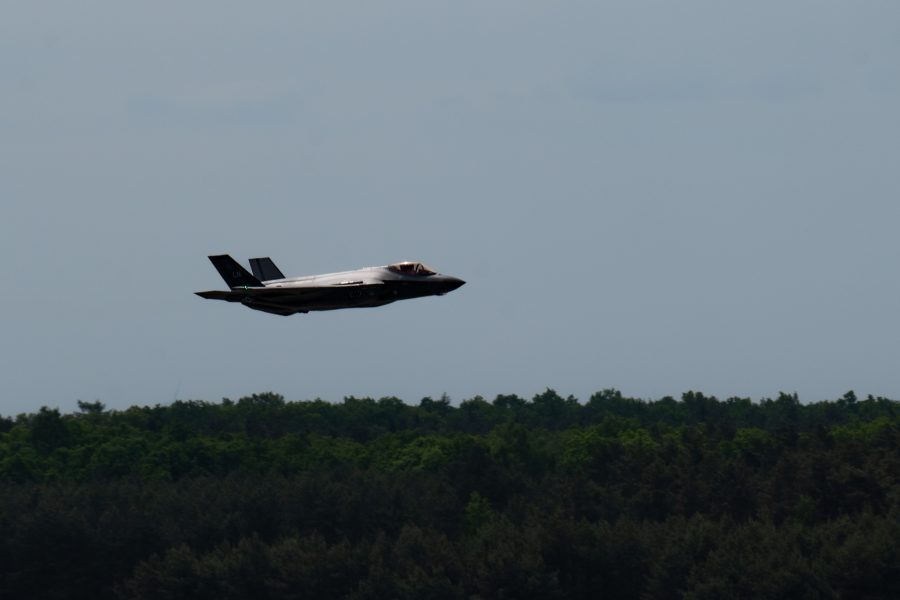
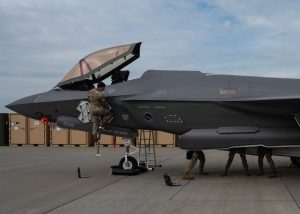
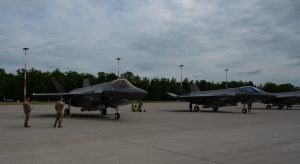
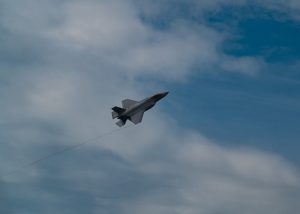
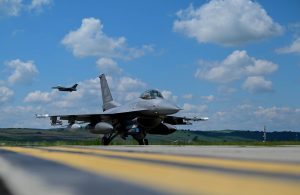
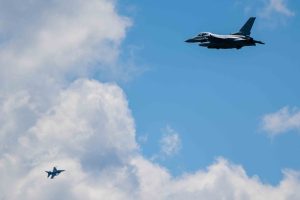
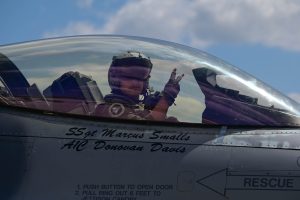
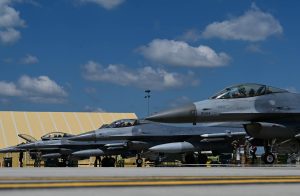
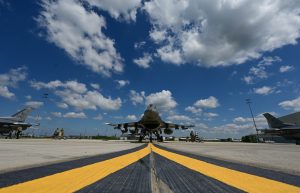
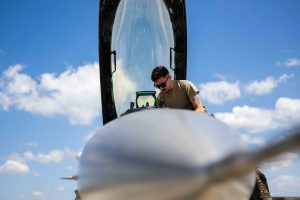
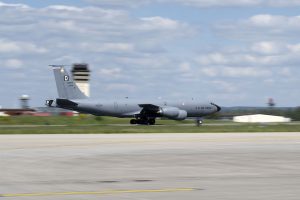
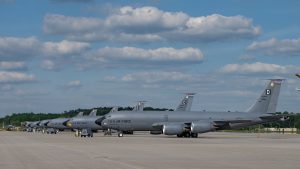
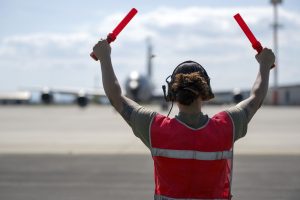
A U.S. Air Force F-35 Lighting II assigned to the 495th Fighter squadron arrives at Powidz Air Base, Poland for Astral Knight 24 at, May 10, 2024. U.S. Air Force photo by Staff Sgt. Gaspar Cortez
Audio of this article is brought to you by the Air & Space Forces Association, honoring and supporting our Airmen, Guardians, and their families. Find out more at afa.org
Stealthy U.S. Air Force F-35s, accompanied by NATO allies’ aircraft, are flying across Europe in an air and missile defense exercise, as the threat from ballistic missiles, cruise missiles, and drones has grown throughout the world, U.S. Air Forces in Europe said.
The U.S.-led exercise, dubbed Astral Knight, runs from May 6-21. U.S. Air Forces in Europe (USAFE) said “recent conflicts, such as those in Ukraine and Israel,” stressed the urgency of promptly countering aerial threats. NATO has also put a renewed focus on conducting more realistic training scenarios since Russia’s invasion of Ukraine brought the reality of a large-scale war to Europe.
The training involves live-fly and simulated combat operations involving some 50 U.S. aircraft over Poland and the Baltic nations. U.S. aircraft are operating out of Poland, Lithuania, and Romania. Six NATO countries, including Estonia, Latvia, Lithuania, Poland, the U.K., and the U.S., are participating in the exercise, with personnel from Denmark and Greece observing.
“Recent events show our most probable threats today and in the foreseeable future could target our main operating bases, making IAMD (Integrated Air and Missile Defense) and ABAD (Air Base Air Defense) that much more important,” James Shaw, USAFE-AFAFRICA’s Integrated Air and Missile Defense deputy division chief, said in the release.
The F-35s, based at RAF Lakenhealth, U.K., were deployed for the exercise. Four Lakenhealth F-35s were already forward deployed to Poland as part of the U.S. commitment to safeguard the skies over NATO’s eastern flank, though those aircraft are not slated to participate in the exercise. The fifth-generation stealthy jets are a particularly tough test for air defense systems.
Both NATO as a whole and the U.S. have conducted a series of exercises involving fighters and bombers to bolster the region’s sovereignty, as the alliance has sought to strengthen itself after Russia’s invasion of Ukraine.
While Ukraine is not yet a member of NATO, the alliance’s secretary general has stated that it is “inevitable” for Kyiv to join in the future, though that will not happen during the active conflict.
Russian attacks that have stressed Ukraine’s air defenses with relatively cheap Iranian-designed drones, Iran’s massive missile and drone attack on Israel, and at least 170 drone, rocket, and missile attacks on U.S. troops in Iraq, Syria, and Jordan since October have reinforced the critical need for such an exercise, USAFE noted in a press release on the exercise.
Improving NATO’s IAMD has been a top priority of Gen. James B. Hecker, who leads NATO Allied Air Command and U.S. Air Forces in Europe-Air Forces Africa, especially with the proliferation of drone attacks. Israel’s recent successful defense of over 300 ballistic missiles, cruise missiles, and drones was supported by the U.S. and coalition partners, allowing Israel to more effectively employ its multi-layered, sophisticated air and missile defense systems.
For Hecker, recent events—even before Iran’s attack on Israel—highlighted the “need for a very sophisticated integrated air and missile defense system,” he said at AFA’s Warfare Symposium in February. “That’s something that we need to continue to get better at.”
USAFE has put a renewed focus on air defense and as well countering it, including practicing taking out anti-air systems that could be used against the U.S. and its partners if necessary.
Astral Knight will “focus on testing the deployment and sustainment of IAMD assets and capabilities while exercising defense plans for distributed air operations” by using the USAF’s Agile Combat Employment concept, USAFE said. Operational control of some U.S. assets and personnel will also be transferred to NATO authority.
“Astral Knight demonstrates the collective defense capabilities of NATO allies and partners across Europe,” Hecker said in a statement. “By fostering early collaboration and integration in air and missile defense efforts among USAFE-AFAFRICA and NATO nations, we enhance our ability to deter and respond effectively to shared threats.”
The training is part of the Department of Defense’s Large Scale Global Exercise 2024 which runs through June and complements NATO’s separate Steadfast Defender exercise. A component of the Steadfast Defender series called Swift Response began its airborne phase on May 7, with paratroopers from the U.S, Spain, Hungary, and Italy commencing their training in Sweden, which marks Sweden’s inaugural participation in a NATO exercise since becoming a member nation in March.
“Presence matters. You have to be with your allies,” Air Force Lt. Gen. Steven Basham, the deputy commander of U.S. European Command, said during a May 10 event hosted by the Foundation for Defense of Democracies. “To be able to integrate, you have to be with your allies to campaign, to exercise. And by the way, it can’t be just episodic where you just come in at the last minute because that’s actually not working toward deterrence.”
Audio of this article is brought to you by the Air & Space Forces Association, honoring and supporting our Airmen, Guardians, and their families. Find out more at afa.org
An important U.S. Air Force E-3 Sentry AWACS command and control plane was among the aircraft damaged in a March 27 Iranian missile and drone attack on Prince Sultan Air Base, Saudi Arabia, people familiar with the matter told Air & Space Forces Magazine.
Multiple American service members were wounded and some aircraft were damaged in a March 27 Iranian attack on Prince Sultan Air Base, Saudi Arabia, people familiar with the matter told Air & Space Forces Magazine.
The 34th Fighter Squadron won the Raytheon Trophy for its air superiority performance in 2025 in two major Middle East operations and a series of responses in the Pacific. The F-35 Lightning II squadron received the honor following its role in Operation Rough Rider targeting Houthi rebel missile sites in…
Three additional B-1B Lancers arrived at RAF Fairford on March 26, bringing the total number of bombers stationed at the U.K. base to 21—one of the largest bomber deployments in recent history.
The Pentagon formally split the combined U.S. Forces Japan and the Fifth Air Force into separate commands, ending a dual-hatted arrangement that had been in place for more than 60 years. The separation means that the former combined commander, Air Force Lt. Gen. Stephen Jost, will remain head of U.S.…
The Air Force’s nascent Collaborative Combat Aircraft program is beating former Secretary Frank Kendall’s goal of producing drone wingmen at about one-third the cost of an F-35, an official leading the effort said March 25.
Audio of this article is brought to you by the Air & Space Forces Association, honoring and supporting our Airmen, Guardians, and their families. Find out more at afa.org A photo of a B-52 Stratofortress flying with an apparent pair...
The Air Force may have used a secretive intelligence, surveillance, and reconnaissance drone over Venezuela earlier this year. Now, observers think they may have spotted an even more classified aircraft amid operations in Iran.
The Pentagon’s top weapons tester noted progress on key munitions for the Air Force in his latest report, covering everything from dogfighting missiles to hypersonics.
✓
Thank You!
Check your inbox to verify your email address and finish setting up your AFA account.
★
Welcome Back!
An account with this email already exists. Please log in to continue.
Subscribe to the Air & Space Forces Daily Report
The latest news from Air & Space Forces Magazine, as well as news from other leading publications, delivered right to your inbox every morning!
We’re sorry, there has been an error. Please review your input or try again later.