
Some of the U.S. military assets that participated in the Jan. 3 high-stakes raid to capture Venezuelan President Nicolás Maduro have departed the region, as the Trump administration has seemingly deferred the option of a wider military campaign inside the country and is relying instead on a naval oil embargo to influence the country’s leadership.
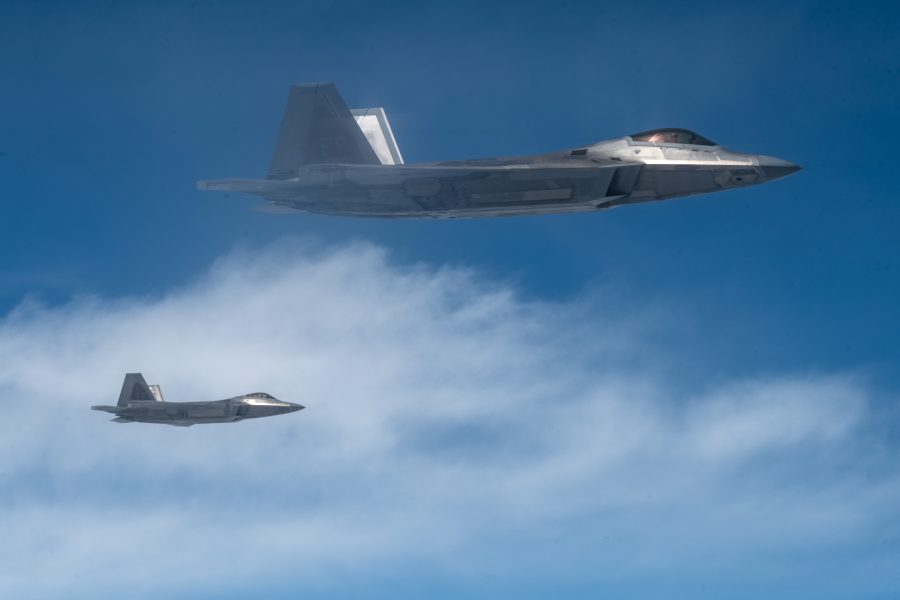
On Jan. 4, a dozen U.S. Air Force F-22 Raptors departed Puerto Rico, where they had landed following their participation in Operation Absolute Resolve. Those fighters appeared to have flown directly from their home base at Joint Base Langley-Eustis, Va., to participate in the operation and returned there two days later.
Other U.S. Air Force assets remain in the region, including F-35A fighters from the Vermont Air National Guard.
While the Pentagon is shuffling its forces in the Caribbean, Defense Secretary Pete Hegseth disclosed details about the size of the ground force that carried out the Maduro raid.
“Nearly 200 of our greatest Americans went downtown in Caracas—it seems those Russian air defenses didn’t quite work so well, did they—grabbed an indicted an individual wanted by American justice in support of law enforcement without a single American being killed, reestablishing American deterrence,” Hegseth said during a visit to Newport News, Va., on Jan. 5.
Though President Donald Trump has vowed to “run” Venezuela, the administration’s emerging strategy is to work with elements of the current regime who remain in place. As a result, the White House is playing down talk of reinserting troops on the ground or escalating the use of force.
“Venezuela thus far has been very nice, but it helps to have a force like we have,” Trump told reporters aboard Air Force One as he returned to Washington from Florida on Jan 4. “We were ready for a second wave. We were all set to go, but we don’t think we’re gonna need it.”
The de facto president, Delcy Rodríguez, Marudo’s vice president, has also sought to discourage another American attack, saying she wants the U.S. to “collaborate with us on an agenda of cooperation.”
The principal military role now appears to be at sea as the U.S. seeks to enforce a blockade against sanctioned oil tankers and to target drug traffickers.
A fleet of Navy ships, including the USS Gerald R. Ford aircraft carrier and USS Iwo Jima, remains in the region, as do other warships. The 22nd Marine Expeditionary Unit, with some 2,000 personnel, is part of the Iwo Jima amphibious ready group.
The Raptors that left the region were among the 150-plus aircraft that Joint Chiefs of Staff Air Force Gen. Dan Caine said participated in the mission. Service members were spotted posing with an American flag in front of the jets before their departure.
The departure of America’s premier air superiority fighter is a likely signal that the U.S. is not seeking to escort more aircraft into harm’s way, as it did Jan. 3, when Special Forces led by the Army’s Delta Force and helicopters from 160th Special Operations Aviation Regiment captured Maduro and his wife. Cuba’s government, which had a close relationship with Maduro, said 32 Cuban officers were killed in the American raid.
The F-22s were joined by F-35s and F/A-18 fighters, EA-18 electronic attack aircraft, and B-1B bombers, which attacked Venezuelan military sites, primarily air defenses, in support of the assault. F-22s also led a strike force into Iran earlier this year during the U.S. operation to bomb Iranian nuclear facilities.
Apart from the F-22s, there has been no significant visible drawdown of other U.S. military forces in the region. The Navy’s force posture is likely to remain at its current levels in the coming days.
The stated rationale for America’s monthslong military buildup in the Caribbean had been the Trump administration’s campaign against drug smugglers, which has targeted so-called “narco-terrorists.” Since Sept. 2, the U.S. military has destroyed at least 36 boats it alleges were carrying drugs, killing 115 people.
Maduro was indicted on drug trafficking and gun charges by the U.S. Department of Justice, and the Trump administration maintains that the raid to capture him was a law enforcement operation. He pleaded not guilty to the charges in a Manhattan courtroom Jan. 5 and said he had been “kidnapped.”