
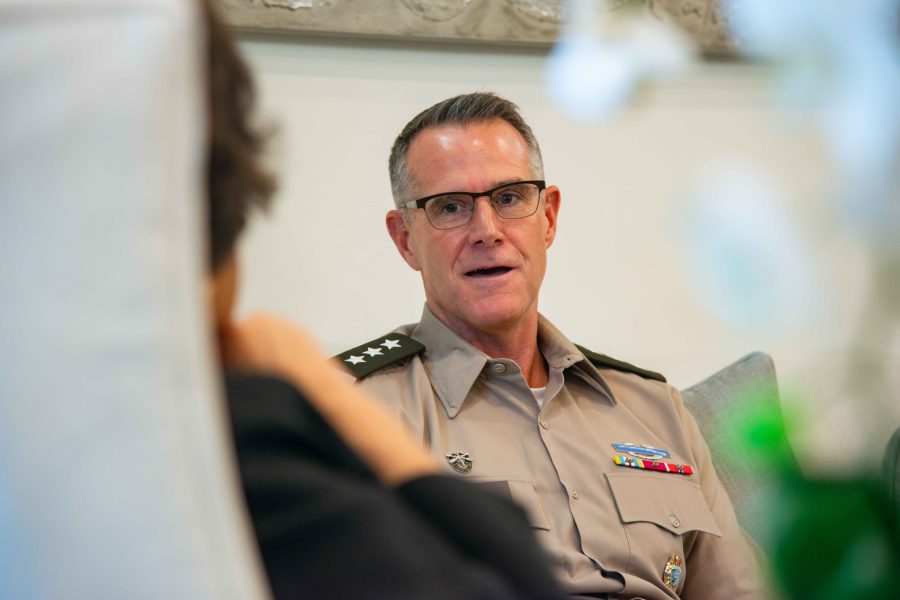
The Army nominee selected to lead U.S. Cyber Command and the National Security Agency urges caution before the U.S. should launch a dedicated cyber military service and touts the advantages of dual-hatting oversight over CYBERCOM and NSA, in written testimony released Jan. 15.
Army Lt. Gen. Joshua M. Rudd leaned heavily on his time in the Indo-Pacific, where the focus was China, to explain his qualifications for the job despite a lack of direct experience in cyberspace.
If confirmed, Rudd would be the first permanent leader of the two secretive commands since Air Force Gen. Timothy D. Haugh was abruptly fired in April 2025, nine months ago. The White House and Pentagon bypassed CYBERCOM’s deputy commander, Lt. Gen. William J. Hartman, and the heads of the military services’ cyber components, in selecting their choice for this position.
The gap between leaders, lawmaker questions about organizational shifts, and Rudd’s unconventional background—a career special operator, he is currently deputy commander of U.S. Indo-Pacific Command—underscore the unsettled state of the military’s cyber enterprise.
In written and verbal testimony, Rudd argues that he gained insight in to the value of cyber in his role at INDOPACOM and as head of Special Operations Command Pacific. “The reliance upon both signals intelligence and cyber capabilities are absolutely indispensable to our warfighters in my role at INDOPACOM,” Rudd said. “We look at it every day. We operationalize it, we integrate it, and we factor it into every one of our decisions and it enhances the way that we’re able to collectively, across the Joint Force, in all domains, generate the options that continue to deliver deterrence. … That’s been a continuous theme throughout my career.”
Rudd pledged in response to advance policy questions to “absolutely” enhance his expertise in cyber.
“While my career has focused on leading joint warfighting forces, my most immediate priority, if confirmed, would be to immerse myself in the deep technical expertise resident at both [CYBERCOM and NSA],” Rudd wrote. “This means my first action would be to listen and learn from the world-class military and civilian personnel who execute this mission every day. Second, I would build on my existing relationships and forge new ones across the interagency, with our industry partners, and with Congress to ensure our efforts are fully aligned.”
Rudd’s reference to the interagency highlights just how sprawling his new job will be. For more than a decade and a half, the director of the NSA has also served as the commander of CYBERCOM and the chief of the Central Security Service—a portfolio that includes tens of thousands of personnel both military and civilian and billions of dollars in budget authority.
CYBERCOM and NSA have overlapping mission sets and proponents of keeping both under one leader say close collaboration is key to ensure no conflicts. But others favor splitting the roles because the organizations are each too big and important to be led by a single person. Some see risks in exposing NSA’s intelligence-gathering tools and operations inadvertently through CYBERCOM.
According to media reports, the first Trump administration developed plans to sever the jobs, and there has been speculation that the idea could be revisited in this administration.
Rudd said he would be “objective” whenever the question is raised and assess it regularly. But he also made clear that he thinks the current arrangement works.
“The unity of effort that comes out of that current construct, I think, is really important to enabling the support of both those organizations to the warfighter to continue at speed and provide agility,” he said.
Time for a Cyber Force?
Whether or not the time has come for the U.S. establish a military service dedicated to cyber warfare is another lingering question that continues to draw attention.
Proponents of an independent “Cyber Force” argue that cyber is its own domain and is underprioritized by the other services when it comes to recruiting, training, and equipping forces. But others counter that the logistical, bureaucratic, and cultural legwork necessary to create and integrate a new service into the joint forces would be costly and distracting.
Regardless, leaders and experts agree that the readiness of Cyber Command’s forces is a major concern. To date, the Pentagon has tried to treat CYBERCOM like it treats U.S. Special Operations Command, granting it some “service-like” authorities while maintaining it as a joint command. In November, Defense Secretary Pete Hegseth laid out a new Cyber Force Generation plan, meant to give CYBERCOM more authority over the employment, training, and equipping of cyber forces.
Rudd—coming from a special ops background—argued in his written testimony that that the SOCOM model, which leaves the organizing, training and equipping of special operators to the individual services, but centralizes the deployment of those assets “has been a tremendous success for the nation” and that the reforms implemented by Congress and the Pentagon should be enough to solve the readiness challenge.
“We need to give them time to work,” Rudd wrote. “The key is execution.”
There are downsides to creating a new service he said. “I would want to assess whether such an effort could detract from our focus on confronting our adversaries or negatively impact readiness in the near term,” Rudd wrote. “These are risks that would need to be carefully weighed.”
While major organizational questions continue to dog CYBERCOM, Rudd listed as top priorities making sure the command is prepared to counter the “pacing challenge” of China and helping other commanders better understand and use CYBERCOM capabilities.
“In my view, we must accelerate the shift in the mindset that cyber is not merely a supporting capability, but the key enabler in operations across all domains,” he wrote. “Improved network interoperability between CYBERCOM, the combatant commands, and our partners will provide more rapid and useful cyber effects for combatant commanders.”
Those effects will need to include “potent offensive cyber capabilities,” Rudd wrote. But in verbal testimony, he declined to go into specifics on CYBERCOM’s offensive capabilities.