
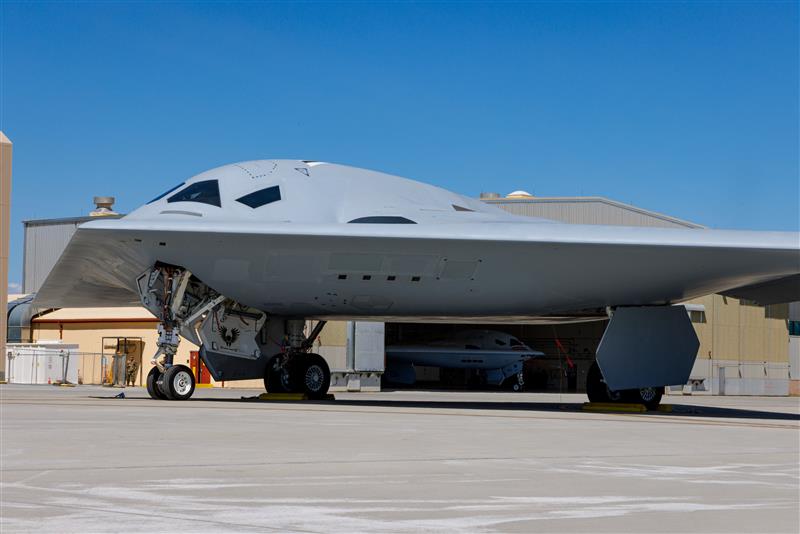
AURORA, Colo.—B-2 bombers dropped precision-guided bombs on Iranian targets this week, demonstrating the flexibility and utility of U.S. Air Force long-range strike capabilities. But not all weapons can be delivered by bombers, a fact Air Force leaders want to overcome as they develop next-generation aircraft and weapons.
Planners today carefully match weapons to targets, ensuring the right effects are achieved with each strike. But if they had more flexibility in terms of which aircraft can deliver which weapons, that would be even better, said Lt. Gen. Jason R. Armagost, deputy commander of Air Force Global Strike Command.
The issue is especially important as the Air Force prepares to field the next-generation B-21 bomber in 2027, Armagost said during AFA’s Warfare Symposium here last week.
“If a weapon is made, it should be capable of being carried by a bomber,” he said. “And going forward in the future, we need to open up the aperture about what that really, truly means from a functional perspective. … There are a lot of good ideas shared across the Air Force on how we do that, and some real opportunities. … We’re seeing things start to happen much quicker and in different ways.”
Tom Jones, president of B-21 builder Northrop Grumman’s Aeronautics Systems Sector, agreed: “The bomber should be able to carry any weapon that’s out there.”
To date, the Air Force has said the B-21 will be able to carry the B61 nuclear bomb, the AGM-181 Long-Range Stand Off nuclear missile, and the Next-Generation Penetrator—a successor to the 30,000-lb. AGM-57 Massive Ordnance Penetrator used last June to collapse Iranian nuclear sites under a mass of rubble.
But other weapons in development, such as the Stand-in Attack Weapon, the Joint Advanced Tactical Missile, and multiple hypersonic missiles, should also be deliverable via B-21s, they said. So should new low-cost cruise missile weapons and other concepts in development.
Whether those fit with the B-21 is still unclear, classified, or not yet determined. But Air & Space Forces Magazine has previously reported that Air Force officials have eyed using the B-21 for air-to-air missions—a role typically reserved for fighters.
Armagost argued that Suppression of Enemy Air Defenses, or SEAD, missions—typically performed by F-16 or F-35 fighters—should in the future be “native to all the various platforms.” That would equip each aircraft with the ability to fight through contested airspace—and demand a new class of weapons.
“It goes back to the point about what weapons should someone be able to carry,” he said. “That’s why that matters.”

A new Universal Armament Interface, described in Air Force budget documents, seeks to set “the standards needed to integrate new weapon capabilities on platforms at the speed of software.” The fiscal 2026 budget request submitted last year indicated the interface will be on the B-21 and weapons including:
- Advanced Anti-Radiation Guided Missile-Extended Range (AARGM-ER)
- Joint Air-to-Surface Standoff Missile (JASSM)
- Joint Direct Attack Munition (JDAM)
- Small Diameter Bomb I & II
- Stand-in Attack Weapon (SiAW)
- Long Range Anti-Ship Missile (LRASM)
- Joint Strike Missile (JSM)
Having more options “opens up your aperture of axis of attack, or axis of threat presentation,” Armagost said, which changes the calculus for adversaries, which then must consider more of its assets at potential risk.
But more flexibility means planners must put more thought into selecting the right weapon for each mission. “Target pairing to weapon platform matters greatly,” Armagost said. “It’s really, really important that we look at the physics of carriage … [to] ideally tailor a weapon platform and maximize the strike efficiency we gain from carriage capacity.”
How much the B-21 can carry remains classified, but the aircraft is about 30 percent smaller than the B-2, so its capacity will be less. A B-2 can carry two 30,000-pound MOPs or up to 80 JDAMs. The B-21 will be less.
Brig. Gen. Brian Laidlaw, director of operations at Air Combat Command, joined Armagost and Jones on the panel, making the case that long-range strike is a vital Air Force mission performed by fighters as well as bombers.
“I think throughout history, we’ve proven that often, not always, the Joint Force turns to the air component, because we have the ability to generate acts of violence against the enemy’s center of gravity at the time and place of the Joint Force commander’s choosing,” Laidlaw said.
That point was driven home just days later, as Operation Epic Fury unfolded, with with B-2 and B-1 bombers contributing long-range strikes all the way from the continental United States.