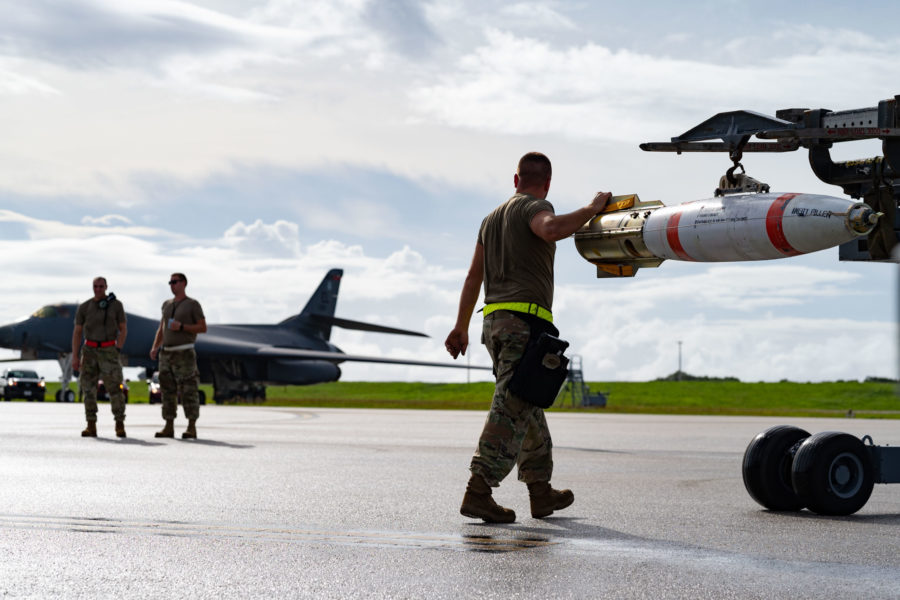
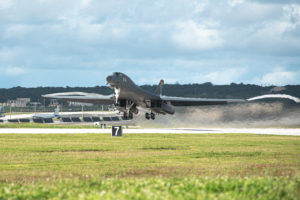
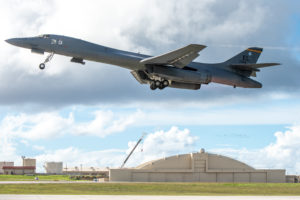
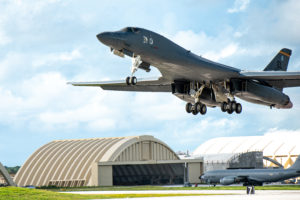
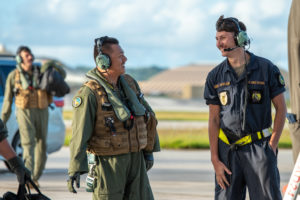
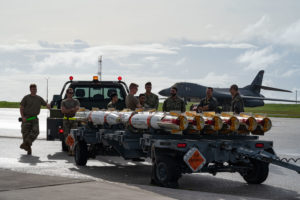
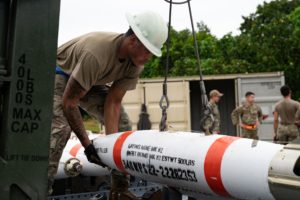
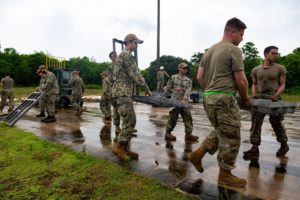
An Airman assigned to the 28th Munitions Squadron, Ellsworth Air Force Base, S.D., prepares to load an MK-62 Quickstrike Naval mine onto a B-1B Lancer in support of a bomber task force mission at Andersen Air Force Base, Guam, Oct. 21, 2022. Air Force photo by Staff Sgt. Hannah Malone.
Audio of this article is brought to you by the Air & Space Forces Association, honoring and supporting our Airmen, Guardians, and their families. Find out more at afa.org
B-1B Lancers deployed to Guam for a bomber task force joint training mission with the Navy, with Airmen and Sailors practicing loading and releasing naval mines from the B-1s.
The naval mine exercise, or MineX, took place Oct. 24, staged out of Andersen Air Force Base, according to a release from Pacific Air Forces.
As part of the exercise, Sailors from Navy Munitions Command’s Pacific Unit built and delivered the Mark-62 Quickstrike mines, then worked with Airmen from the 28th Munitions Squadron to load them onto the B-1s.
All told, an undisclosed number of B-1s were loaded with 21 mines total, each mine weighing about 500 pounds. A B-1 can carry up to 84 of the mines.
“MineX missions require close coordination and integration between the Navy and the Air Force,” Col. Chris McConnell, 37th Bomb Squadron commander, said in a statement. “As one of the aircraft capable of releasing mines, we have to work with our Navy partners to understand where those munitions need to be placed to meet the desired objectives.”
McConnell also stated that as part of the mission, the B-1s flew alongside “Navy partners and allies,” though PACAF did not specify what other aircraft or partner nations were included in the mission.
The exercise marks a quick start for the B-1s’ bomber task force deployment on Guam. An undisclosed number of the bombers from Ellsworth Air Force Base, N.D., arrived there Oct. 18. It marks the second time this year that B-1s have been deployed to Guam and the first BTF mission in the Indo-Pacific this fall.
The Ellsworth B-1s are no strangers to naval mine exercises, though. Just this past August, a B-1 from the 28th Bomb Wing was loaded with a Mark-65 Quickstrike mine and flew from Ellsworth to off the coast of California, where it dropped the munition. A similar exercise took place in 2014.
B-1s from Dyess Air Force Base, Texas, also dropped Mark-62 Quickstrike mines as part of Exercise Baltic Operations in 2018.
None of those B-1 exercises, however, took place in the Indo-Pacific, where the Pentagon has placed an increased emphasis as of late as part of its strategic competition with China—the Air Force and Navy did work together during Exercise Valiant Shield in 2018 and in 2019 to load and drop naval mines.
The B-1B is capable of carrying up to eight Mark-65 Quickstrike mines, which weigh 2,000 pounds each.
Audio of this article is brought to you by the Air & Space Forces Association, honoring and supporting our Airmen, Guardians, and their families. Find out more at afa.org
Audio of this article is brought to you by the Air & Space Forces Association, honoring and supporting our Airmen, Guardians, and their families. Find out more at afa.org The Air Force’s emerging Collaborative Combat Aircraft program would suffer delays...
Six U.S. Air Force F-35A fighters and 200-plus Airmen deployed to India on Sept. 26 for their first appearance in a large-scale exercise on Indian soil.
A recent $21 million contract award to three software companies could give the Air Force’s airlift and tanker units real-time software updates in degraded environments, including aircraft fuel, logistics, and other mobility fleet data.
U.S. Northern Command plans to sign an agreement with its European and Pacific counterparts to enhance coordination and close security seams in the Arctic, a strategically vital region that spans all three commands. The agreement comes at an important moment in NORTHCOM's evolution, as its mission grows more complex.
The Anduril-built Barracuda cruise missile recently received certification as the Air Force’s first large-scale production munition compliant with open systems architecture.
The Air Force has invested $87.4 million to upgrade the F-16 Fighting Falcon's electronic warfare capabilities, bolstering the fighter's self-protection against increasingly advanced threats. Bringing the total program value to $1.92 billion, the move is expected to jump-start fielding by funding low-rate initial production of the AN/ALQ-257 Integrated Viper Electronic…
One of the Air Force and Navy’s most common air-to-air missiles is falling short of a key readiness metric, and the services are ramping up stocks of a vital air-to-ground missile, according to recent Pentagon reports.
Nellis Air Force Base, Nev.—a longtime hub for A-10 Thunderbolt II tactical training, operational testing and maintenance—ended nearly a half-century of flying the venerable Warthog on Sept. 22.
✓
Thank You!
Check your inbox to verify your email address and finish setting up your AFA account.
★
Welcome Back!
An account with this email already exists. Please log in to continue.
Subscribe to the Air & Space Forces Daily Report
The latest news from Air & Space Forces Magazine, as well as news from other leading publications, delivered right to your inbox every morning!
We’re sorry, there has been an error. Please review your input or try again later.