
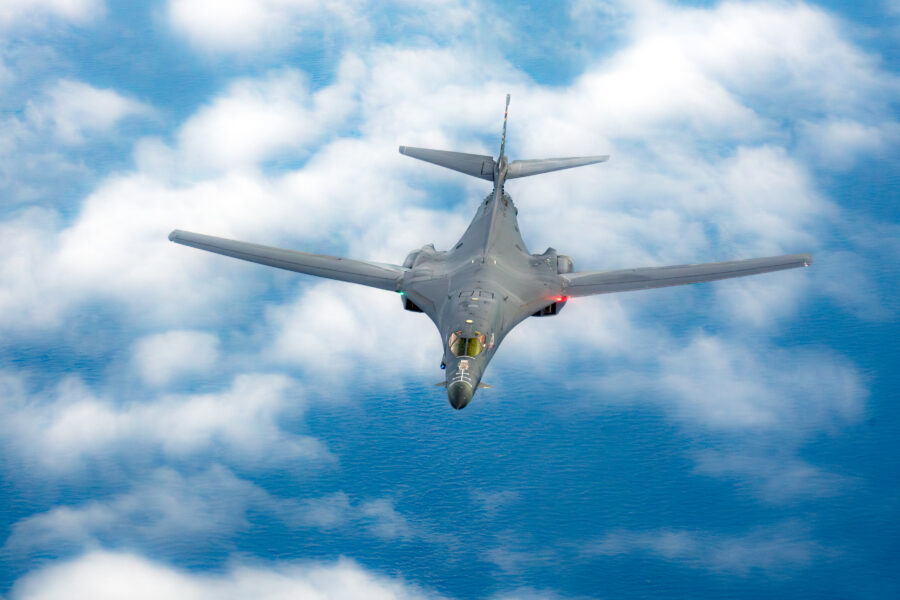
Nearly a dozen U.S. Air Force bombers—plus additional support aircraft—have arrived at bases in Europe as Pentagon leaders promise to ramp up bombing runs over Iran as part of Operation Epic Fury.
Five B-1B Lancer bombers arrived at Royal Air Force Fairford, United Kingdom, over the weekend, and another three diverted to Ramstein Air Force Base, Germany, due to inclement weather, according to open-source flight tracking data and aircraft spotters.
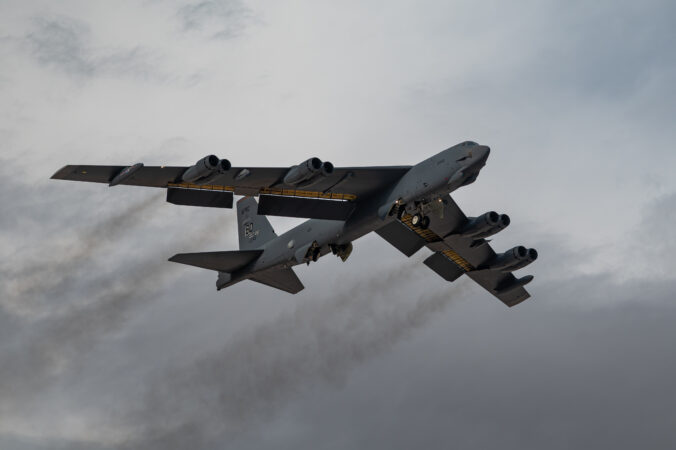
Three B-52s landed at Fairford on March 9.
The aircraft movements come just a few days after Secretary of Defense Pete Hegseth told reporters on March 5 that strikes in Iran were “about to surge dramatically,” referencing “more squadrons, more defensive capabilities, and more bomber pulses more frequently.”
The arrival of bombers at Fairford in particular has created headlines in the British press in the wake of U.K. officials changing course to allow U.S. warplanes to conduct strikes on Iran from British installations.
With one of the U.K.’s longest flight lines, Fairford is one of the few European bases capable of hosting bomber aircraft such as the B-1, B-2, and B-52. The U.S. has regularly based Bomber Task Force deployments from there in recent years.
But when the U.S. and Israel launched operations against Iran on Feb. 28, the United Kingdom denied access to its bases for Operation Epic Fury. They relented March 5, after an Iranian drone strike on a U.K. base in Cyprus.
On March 7, the U.K. government announced that “the United States has started using British bases for specific defensive operations to prevent Iran from firing missiles into the region, which is putting British lives at risk.”
In addition to RAF Fairford, U.S. forces are expected to deploy to Naval Support Facility Diego Garcia in the Indian Ocean.
The new locations cut roundtrip flight times from the United States to the Middle East roughly in half for bomber crews. Flights from such locations as Minot Air Force Base, N.D.; Dyess Air Force Base, Texas; and Ellsworth Air Force Base, S.D., were taking as long as 37 hours.
Bombers have played a starring role in the U.S. strikes on Iran; B-1s, B-52s, and B-2s have all flown missions and hit 200 targets over the first 72 hours of the operation, U.S. Central Command boss Adm. Brad Cooper said March 5.
In addition to bombers, the Air Force has deployed a host of others platforms for Epic Fury, including:
- F-35 Lightning IIs
- F-22 Raptors
- F-16 Fighting Falcons
- A-10 Thunderbolt IIs
- F-15E Strike Eagles
- E-3 Airborne Warning and Control System
- RC-135 Rivet Joints
- MQ-9 Reapers
- KC-46 Pegasuses
- KC-135 Stratotankers
- C-17 Globemaster IIIs
- C-130 variants
The B-1B Lancer is the fastest bomber in the U.S. fleet and has the largest payload, capable of carrying 75,000 pounds internally. With a four-person crew, it can carry up to 84 500-pound Mk-82 or 24 2,000-pound Mk-84 general purchase bombs, according to Air Force data. Alternatively, it can also carry up to 24 2,000-pound GBU-31 missiles.
The aircraft was used in early January’s Operation Absolute Resolve to support the capture of Venezuelan dictator Nicholas Maduro.
The B-52 is a long-range nuclear/conventional bomber and is used as the Air Force’s primary standoff cruise missile carrier. The aircraft’s missions include long-range precision strike, close air support, air interdiction, defense suppression, and maritime surveillance.