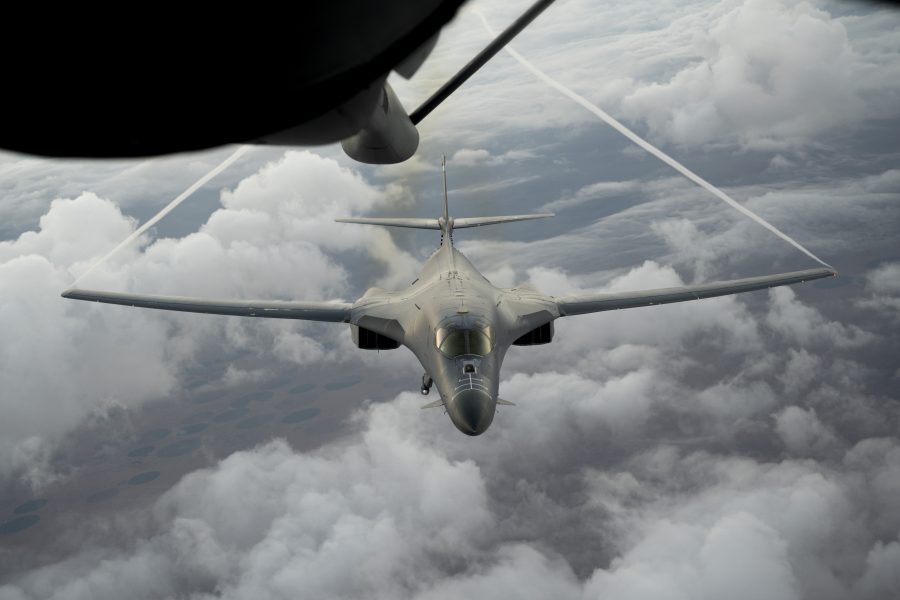
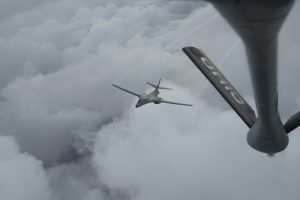
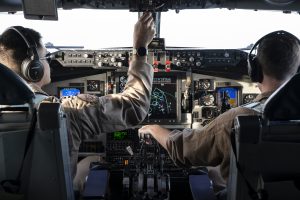
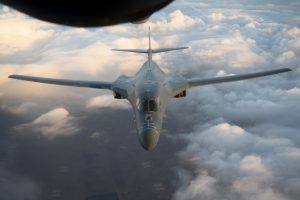
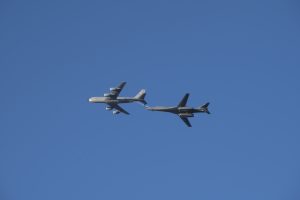
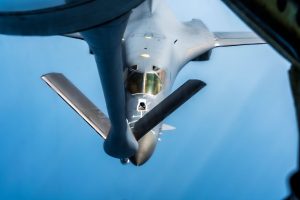
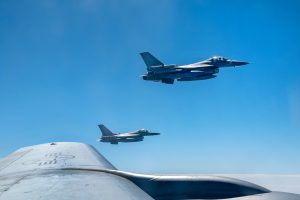
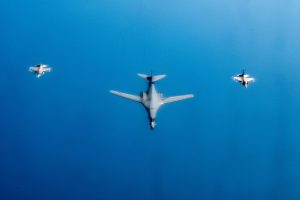
A U.S. Air Force B-1B Lancer approaches a KC-135 Stratotanker as part of a regularly-scheduled Bomber Task Force (BTF) mission in the U.S. Central Command area of responsibility Nov. 13, 2023. BTF missions actively enable bombers to operate with greater operational resilience from various overseas and continental U.S. locations, supporting the National Defense Strategy objectives of building enduring advantages and integrated deterrence in the USCENTCOM AOR. (U.S. Air Force photo by Senior Airman Jacob Cabanero)
Audio of this article is brought to you by the Air & Space Forces Association, honoring and supporting our Airmen, Guardians, and their families. Find out more at afa.org
U.S. Air Force B-1 bombers have flown missions over the Middle East three times in the last week and a half amid U.S. military activity and widespread unrest in the region.
When the first B-1 flight took place Nov. 5, Pentagon Press Secretary Air Force Brig. Gen. Patrick S. Ryder emphasized that it was a “long-planned Bomber Task Force mission” as part of the BTF rotation out of RAF Fairford, United Kingdom, which began Oct. 13.
“It’s important to differentiate the Bomber Task Force mission from the current situation in the Middle East,” Ryder said. at the time. U.S. troops have been attacked more than 50 times in the last month by Iranian-backed militias, as the entire region is on edge in the wake of the Israel-Hamas war.
U.S. Central Command subsequently announced a second B-1 flight took place Nov. 8, with the bomber from Dyess Air Force Base, Texas, escorted by F-16 fighters. Released images showed the fighters as belonging to the 138th Fighter Wing of the Oklahoma Air National Guard. The Tulsa-based Vipers are one of three F-16 squadrons in the region.
On November 8, 2023, and for the second time in three days, a U.S. B-1 Lancer conducted a mission over the U.S. Central Command area of responsibility. U.S. F-16s escorted the bomber. pic.twitter.com/VsXYPyEWsZ
A third flight occurred Nov. 13, with the B-1 getting refueled by a KC-135 Stratotanker from the 121st Air Refueling Wing of the Ohio Air National Guard.
For the third time in eight days, B-1 Lancers conducted missions in the USCENTCOM area of responsibility demonstrating the ability to rapidly project combat power. pic.twitter.com/uRk5qRYVfC
CENTCOM offered few details on the flights, merely stating that the missions showed “the ability to rapidly project combat power” while noting their frequency. No locations were disclosed.
In a social media post, Air Forces Central called the Nov. 13 flight “a regularly scheduled Bomber Task Force mission.”
It is not unusual for bombers deployed to Europe as part of a Bomber Task Force rotation to conduct missions over the Middle East. In June, B-1s from a BTF deploying to Europe conducted live-fire exercises at ranges in Jordan and Saudi Arabia. In March, a B-52 flew alongside fighter escort aircraft from seven different nations during a flight over the region.
However, three announced flights in eight days marks the most by a bomber task force in CENTCOM’s area of responsibility in recent years.
The U.S. has also surged other assets to the region in recent weeks, including additional attack and fighter squadrons, two aircraft carriers—the USS Dwight D. Eisenhower in the Red Sea and the USS Gerald R. Ford in the eastern Mediterranean Sea—and an Ohio-class cruise missile submarine in the Suez Canel.
Audio of this article is brought to you by the Air & Space Forces Association, honoring and supporting our Airmen, Guardians, and their families. Find out more at afa.org
Air Force Special Operations Command recently fired small cruise missiles off an AC-130J gunship for combat operations in Africa, verifying the new weapon for broader operational use.
The Air Force is on track to reach its annual goal of graduating 1,500 new pilots that had proved elusive to this point, one year after the service launched a sweeping overhaul of its undergraduate pilot training program, Air Education and Training Command said Sept. 14.
For years, sustainment challenges and spare parts shortages have hindered the F-35 Joint Strike Fighter’s readiness. But the Air Force’s experience flying F-35s heavily in operations against Iran have showed what the jet can be capable of, if maintainers get all the supplies and support they need.
Ten Airmen received battlefield promotions for their roles in the daring rescue of DUDE 44, the crew of an F-15E Strike Eagle that was shot down over Iran this spring, Air Force Chief of Staff Ken. S. Wilsbach announced Sept. 14. Wilsbach revealed the promotions—a rarity in the Air Force—and…
The Air Force plans to field at least 500 semi-autonomous fighter drones known as Collaborative Combat Aircraft by 2032, and another 500 cheap reconnaissance and strike drones known as Massed Modular Aircraft that same year, Air Force Secretary Troy Meink said Sept. 14.
Lockheed Martin’s proposed autonomous drone, called Vectis, is still on track to fly a prototype by the end of 2027, an official from the company’s Skunk Works division said Sept. 10, and the firm already started work on four more Vectis aircraft.
Operation Epic Fury marked the U.S. military's largest air campaign in a generation, with strikes on 13,000 targets in Iran before the first in a series of shaky ceasefires began in April. Now, even as hostilities continue to flare up, Lt. Gen. Derek C. France sees several clear lessons that…
The Air Force announced Aug. 13 it recently tested prototypes for a portable ground station for commanding and controlling semi-autonomous Collaborative Combat Aircraft, and a spokesperson now says the plan is to award a contract for the effort next summer.