
Air Force Basic Training’s Mock Airfields
By Matthew Cox
Second Air Force officials plan to inject more realism in Basic Military Training this year by building two mock airfields where Airmen will get hands-on training with real combat aircraft.
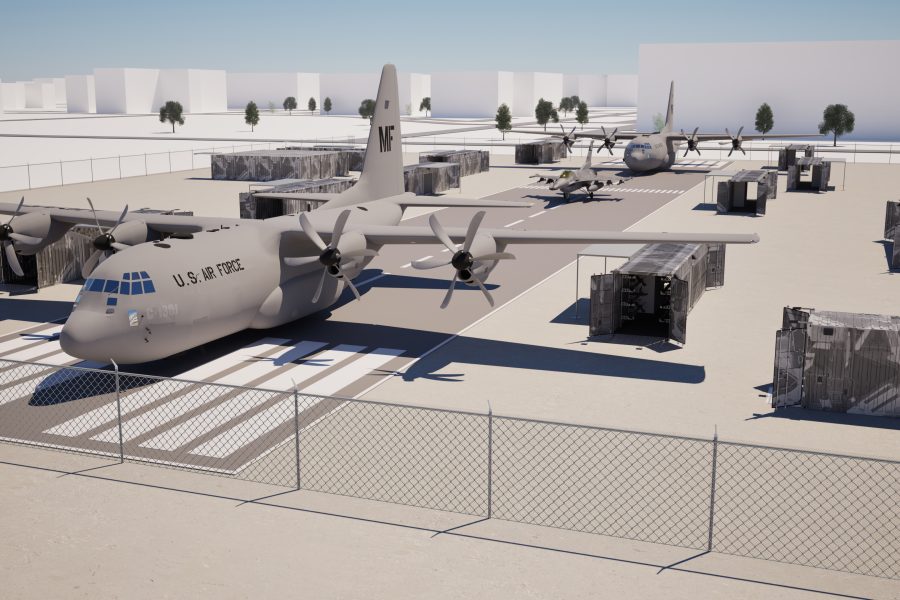
By October, BMT officials at Joint Base San Antonio-Lackland, Texas, hope to complete the first air base training range outfitted with a mock concrete runway, two C-130 Hercules Aircraft, and an F-16 Fighting Falcon aircraft, they told Air & Space Forces Magazine. Trainees will practice basic airfield support skills such as arming and refueling aircraft, repairing bomb-damaged runways, and loading casualties into a cargo aircraft for evacuation.
A second, more expeditionary air base training range that features dirt airstrips and possibly additional aircraft is scheduled to be completed by the end of the year. It will be designed to add a new level of realism for Airmen going through PACER FORGE, the final field exercise introduced in 2022 that simulates operations at makeshift air bases that trainees might experience conducting agile combat employment operations.
The effort is part of the next phase of the 2nd Air Force’s sweeping transformation of basic training. The new phase, known as BMT 3.0, is scheduled to begin in April and follows on the launch of BMT 2.0 last October, which added more physical fitness training and an emphasis on teaching young Airmen how to operate in small teams to keep an air base operational during a war with a peer adversary such as China. BMT 3.0 will add additional training curriculum but mainly will focus on creating a realistic training environment to convert trainees into multicapable Airmen, 2nd Air Force Commander Maj. Gen. Wolfe Davidson told Air & Space Forces Magazine.
“This is about providing that basic context of what it takes to sustain airpower; we call it DOGS—defend, operate, generate, and sustain airpower,” Davidson said. “That is the basic concept of how Airmen fight from an airfield.”
In BMT 2.0, “we started with going to smaller teams, trying to do more practical events, less classroom work,” Davidson added. “Those practical events will only increase with 3.0 … but some of those events, you can’t do until you actually get the training range; you can’t actually put bombs on an airplane unless you have an airplane.”
A large portion of the $30 million investment, spread between the fiscal 2025 and 2026 defense budgets, will go toward building a training range that resembles a permanent air base that’s a little larger than a football field on Lackland located near the drill pads where BMT is conducted, Davidson said. “We are moving really fast to put this thing up, but we have a longer-term plan which would be a military construction effort to formalize that base and make it more permanent, about twice as large and have more training environments,” Davidson said, adding that he doesn’t anticipate the long-term effort “going over $100 million,” a funding request that he hopes to put into a fiscal 2028 request.
The permanent air base training range will be outfitted with an F-16 and two C-130s that were being used to train maintainers at Sheppard Air Force Base, Texas, said Maj. Chris Sweeney, director of logistics, infrastructure, and force protection for the 2nd Air Force. These low-functioning aircraft are on “their third life,” he said.
“Their flying days are over,” Sweeney said. “They’ve been transferred for training purposes for us to use.”
The F-16 will be the first to arrive in April along with two containerized training modules that will be used for familiarizing Airmen with how to arm a fighter aircraft, Sweeney said. “The armament stations and the F-16 are the proof-of-concept for us to get some of the bugs worked out of the curriculum, to get the instructors some repetitions, and then also to get that excitement spread throughout the Air Force that we’re doing something we’ve never done.”
Construction of the short concrete runway, electrical work, and the rest of the tarmac will begin in the May-June time frame before the two C-130s and the rest of the training stations arrive in late summer, Sweeney said.
The plan is to have 16 containerized training stations on the permanent mock air base that train eight key tasks:
- Arming fighter aircraft
- Refueling
- Casualty transfer and evacuation
- Cargo loading
- Post-attack and repair
- Aircraft marshaling
- Aircraft familiarization
- Air base entry control.
“We’ll have two of every station to maximize how many students we can push through,” Sweeney said. “These are meant to be 45-minute familiarization sessions. The point is that we will evaluate them on those soft skills like team-work, interpersonal communication, delegation, feedback, and analysis.”
Trainees will get hands-on experience loading inert AIM-9 missiles on the F-16’s wingtips, Sweeney said, adding that they will also be able to load the “under-wing rocket pods with the individual rockets, and then load the chaff and flare buckets on the sides of the aircraft.”
The fueling stations will feature a weighted hose, so Airmen get the feel of dragging a heavy hose over to the aircraft and attaching it with a universal coupling adapter, Sweeney said.
For the post-attack and repair station, Airmen will assess simulated bomb damage to the runway and go through the steps of patching it.
“Our plan for that is to have mats that roll out over the concrete that have different damage printed on the mats,” Sweeney said. “Then they’ll go back to the container and based on what they assess, they will go with their guidebook of this is what we observed, these are the items we need, and they’ll retrieve those items.”
One option is to have Airmen use Air Force AM2 Matting, a ruggedized Lego-like system that clips together and provides a hard shell over the ground, meant to distribute the weight, Sweeney said.
“If you think in the crawl, walk, run aspect—this is the walk, because they’ve gotten the crawl as a small lecture,” Sweeney said, adding that the run portion will take place at the expeditionary air base training range during PACER FORGE “where it’s a multiday scenario, and … that post-attack repair will involve filling in holes with a mixture and it’ll be far more intensive.”
Currently, the simulated air base at PACER FORGE consists of some hard structures that allow Airmen to practice skills such as perimeter defense. The new expeditionary air base training range will have two dirt assault strips, but 2nd Air Force officials have not decided on the type of aircraft that would be out at the site. Trainees will leave the fixed-air base approach and “they’ll go to a dirt, expeditionary-type environment,” Davidson said.
“We call this going from the drill pad to the airfield, meaning you’ll come into BMT and you start out on the drill pad, just like all the services do, but … then you need to transition to apply them to the Air Force mission of generating airpower,” Davidson said. “We don’t have those training environments yet. That’s what we’re transitioning to as we develop those environments here over the next year.”
Even as Airmen go onto learn their Air Force specialty, the training they receive at these new air base training ranges will instill an “understanding that ‘hey, I’m an Airman, and I am tied to the mission because I know what we do in the Air Force. I know how we defend, operate, generate and sustain airpower, and I accept my role in the execution of that mission.”
New Legislation Aims to Protect Guard, Reserve Benefits
By Matthew Cox
Lawmakers in Congress have introduced legislation aimed at fixing a complex system that has many times prevented Airmen serving on Air National Guard and Reserve duty status from getting the same benefits as their Active-duty counterparts. The bipartisan Duty-Status Reform Act—sponsored by Reps. Gil Cisneros (D-Calif.) and Jack Bergman (R-Mich.)—would streamline the number of Guard and Reserve duty statuses from 30 to just four main categories, a move that former Air National Guard Director Lt. Gen. Michael A. Loh said could be the “game-changer” needed to fix an overly complicated management system that often shortchanges Guard and Reserve members of benefits such as Tricare.
“To finally have the congressional sponsorship of duty-status reform is absolutely awesome,” Loh, now retired, told Air & Space Forces Magazine. “It’s absolutely necessary for our Guard and Reserve.”
Loh has been longtime advocate for streamlining the dozens of duty statuses that Guard and Reserve members are placed on for taskings ranging from drill weekends to disaster-relief missions. On top of that are mobilizations to support real-world missions like Operation Midnight Hammer, the bombing raid on Iran’s nuclear sites, and Operation Absolute Resolve, the recent mission to capture Venezuelan President Nicolás Maduro
“This gets hugely complicated,” Loh said, adding that there have been past attempts to push duty-status reform legislation through Congress, but efforts have never gotten this far.
The 30 separate duty statuses in place currently are the “result of patch fixes done by Congress spanning from World War II to the Global War on Terror,” according to a fact sheet on the legislation. “The current framework is confusing, difficult to administer, and results in unnecessary administrative burdens,” the document states. “Most importantly, it fails to provide equitable benefits and does not align with the needs of our Guard and Reserve units.” The four proposed duty status categories in the act are:
- Category I: Contingency Duty that involves missions such as military operations and national emergencies such as natural disasters. This also covers post-deployment activities.
- Category II: Training and Support activities that include required training, administrative assignments and other support missions.
- Category III: Reserve Component Duty Blocks of time that involve partial-day duty and are dedicated to readiness training and support to prepare individuals and units to be ready for
future use and mobilization. This category would include training periods, flight training, administrative activities, and support activities such as funeral honors. - Category IV: Remote Assignments that involve online learning and individually assigned duties that are completed virtually.
“Efforts to simplify the complex duty status system began over two decades ago. We owe it to our service members to deliver this much-needed change and ensure they are receiving equitable pay and benefits,” Cisneros, a Navy veteran and former Undersecretary of Defense for Personnel and Readiness, said in a news release on the effort. “This was my number one priority returning to Congress. Having worked on this issue during my time at the Pentagon, I learned about the complexity of the current duty status system and how it hurts our readiness and quality of life for service members.”
To Loh, the Guard and Reserve members suffer the “biggest pain point” when they have to change from one status to another on back-to-back assignments such as ordering a Reservist to transition from training to support a real-world operation.
“They changed from one status to another, so it would kick them off in Tricare,” Loh said. “They could be deployed, doing this over in Europe, the Middle East, or somewhere in the Pacific, and the next thing you know they’re getting calls from their family saying ‘Hey, I just got a medical bill, and they said we didn’t have Tricare.”
Bergman said the proposed legislation is a “common sense win” for Guard and Reserve members.
“It cuts through decades of red tape to make sure those who serve get consistent benefits, clear orders, and the support they’ve earned—whether they’re responding to disasters at home or missions abroad,” Bergman, a retired Marine Corps lieutenant general and former commander of Marine Forces Reserve, said in the release.
The bill is endorsed by a number of service associations that support the Guard and Reserve.
Retired Army Maj. Gen. Francis McGinn, president of the National Guard Association, praised the proposed legislation as a “long overdue step forward for our force and the nation.”
Military Officers Association of America Director Jimmy Santos, who has served in the Air Force, the Air National Guard, and now the Air Force Reserve, pointed out that the reform act also “simplifies the Pentagon’s access to the Reserve Forces, helping maintain mission readiness and enhancing force posture.”
Loh made a similar point by saying he has spent “painstaking hours” trying to explain the different duty statuses of the Guard and Reserve to Active-duty commanders to ensure they have the right mix of personnel for a particular mission.
“It would be so confusing, they didn’t understand,” Loh said. To Loh, making it easier to access the Guard and Reserve is critical to maintaining force readiness. “The way you increase readiness is you make a much more simplistic system on how you access approximately 40 percent of the force because we need a Guard member that’s ready to go and that doesn’t have to think about what type of status they’re on or what benefits their family members are going to get,” Loh said. “We need them to focus on the mission.