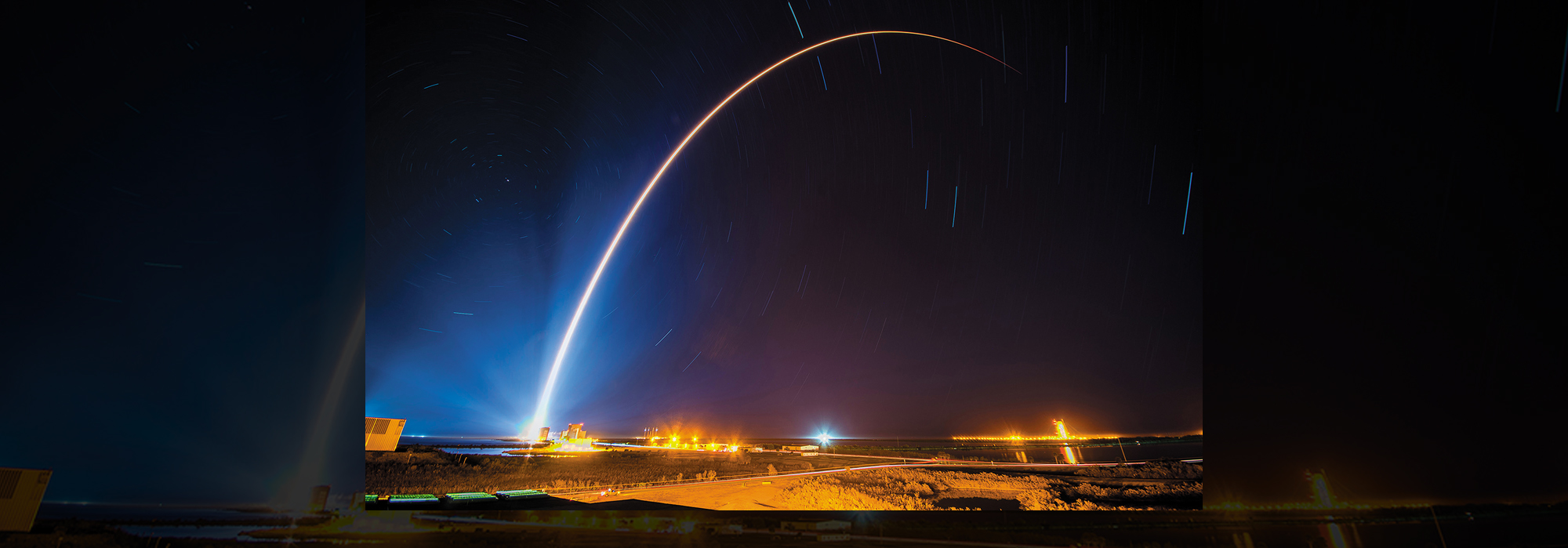
An Atlas V rocket carrying the SBIRS GEO Flight 4 mission for the U.S. Air Force lifts off from Cape Canaveral Air Force Station's Space Launch Complex-41 at 7:48 p.m. ET, Jan. 19, 2018. United Launch Alliance
Audio of this article is brought to you by the Air & Space Forces Association, honoring and supporting our Airmen, Guardians, and their families. Find out more at afa.org
The Air Force makes military space look easy. It is not.
The Air Force’s space launch enterprise has done the seemingly impossible across the last 20 years or so: made rocket science look easy.
United Launch Alliance, the joint rocket venture of Boeing and Lockheed Martin, logged its 125th successful space launch in late January, when it lofted the fourth Space-Based Infrared System (SBIRS) missile warning satellite into geosynchronous orbit. Not all 125 launches were national security launches, and other companies, notably SpaceX, also have successfully orbited satellites and other payloads. But the number of failures—once the stuff of constant headlines—has dwindled while the box score of successes continues to grow.
The string of effective launches belies the fact that getting to orbit is a tough business, and one that continues to evolve.
The latest SBIRS deployment came at a time when USAF’s ability to monitor the world for strategic missile launches was critical. North Korea’s string of long-range missile tests suggested it could soon make good on threats to attack the US directly. “We have a constellation of satellites that detects the IR [infrared] signature of a launch. And they can tell us where the launch is coming from and characterize what kind of rocket it is, based on the launch,” said USAF Gen. Paul J. Selva, vice chairman of the Joint Chiefs of Staff, when describing SBIRS to reporters on Jan. 30.
The Jan. 19 SBIRS launch was made on a ULA Atlas V rocket. Three previous SBIRS satellites were launched on ULA rockets in 2011, 2012, and 2017.
ULA has had a majority of the Air Force’s space launch business in recent years. The Challenger Space Shuttle disaster in 1986 compelled the service to develop alternative ways to orbit. The “Evolved Expendable Launch Vehicle” program led to the modern day Lockheed Martin Atlas and Boeing Delta rockets. At first they competed with one another, but as the need for launch services dipped in the early 2000s, the companies joined forces to create ULA in 2006. Orbital ATK (formerly Orbital Sciences, and now a part of Northrop Grumman), founded in 1982, also lofts lighter payloads to low orbits.
Despite the downturn in space, Amazon founder Jeff Bezos started up Blue Origin in 2000, with the idea of offering lower cost, reliable launch services. Fellow entrepeneur Elon Musk, who founded PayPal and later Tesla, launched SpaceX in 2002, with similar goals. Today Blue Origin offers the Shepard and Glenn rockets, while SpaceX has had a string of successes with the Falcon 9 and, in February, the Falcon Heavy vehicle. SpaceX has demonstrated the ability to soft-land its booster rockets, which it then refurbishes for re-use, significantly reducing its costs.
The Falcon Heavy inaugural launch on Feb. 6 carried one of Musk’s Tesla roadsters into space, where it was boosted into a solar orbit that will take it out to the asteroid belt. Musk was aiming for Mars.
Musk has had a relationship with NASA as far back as 2008, but had to fight in court to win the right to compete for Air Force launch services work. SpaceX won that right in 2015 and began winning USAF launches in May 2017.
Last September, Brig. Gen. Wayne R. Monteith, commander of the 45th Space Wing, commended SpaceX for injecting a culture of speed into the launch enterprise, which allowed USAF to launch more rockets last year than Russia or China.
SpaceX “has forced us to become better at what we do,” Monteith said. “We are adopting commercial business practices, we are becoming more efficient, more effective, more affordable.”
Monteith’s remarks came just a few weeks after SpaceX’s successful launch of the secretive Air Force X-37B. Built by Boeing and managed by the Air Force’s Rapid Capabilities Office, the X-37B is a mini-spaceplane which conducts classified experimental activities in orbit. ULA handled the last X-37B launch in 2015. This was one of two national security launches SpaceX had notched on its belt before 2018; the other was a National Reconnaissance Office payload.
Things don’t always go well. Underscoring the hazards of getting to orbit, something went wrong after a Falcon 9 put a secret payload called Zuma—built by Northrop Grumman—into space on Jan. 7. SpaceX insisted it had fulfilled its part of the job, while Northrop Grumman was silent. Air Force Space and Missile Systems Center commander Lt. Gen. John Thompson said through a spokeswoman that the rocket was an “FAA-licensed, commercially procured launch service,” and that USAF had not identified “any information that would change SpaceX’s Falcon 9 certification status” due to whatever happened to Zuma.
There are other space launch startups in the wings, readying rockets and spacecraft they hope will compete for the next stage of military and civil space access. They, too, may become an indispensible part of USAF’s quest to reach orbit reliably and inexpensively, even as the service becomes evermore dependent on space capabilities.
Audio of this article is brought to you by the Air & Space Forces Association, honoring and supporting our Airmen, Guardians, and their families. Find out more at afa.org
General Stephen Whiting took command of U.S. Space Command in January 2024, and if customary three-year tenures hold, his tour would end in January 2027. The question now before the President and Senate is who should follow him? Whoever they choose, it has to be a Guardian—and so should every successor…
Audio of this article is brought to you by the Air & Space Forces Association, honoring and supporting our Airmen, Guardians, and their families. Find out more at afa.org President Donald Trump and government and military leaders past and present...
The Air Force announced Aug. 13 it recently tested prototypes for a portable ground station for commanding and controlling semi-autonomous Collaborative Combat Aircraft, and a spokesperson now says the plan is to award a contract for the effort next summer.
Under a late summer sun, Air Force basic trainees practice safely rearming a retired F-16 Fighting Falcon at Joint Base San Antonio-Lackland, Texas, with mock AIM-9 Sidewinder missiles. Nearby, a bulldozer levels the ground where the rest of this first new airbase training range will sit.
Audio of this article is brought to you by the Air & Space Forces Association, honoring and supporting our Airmen, Guardians, and their families. Find out more at afa.org General Atomics Aeronautical Systems, Inc. (GA-ASI), the company that introduced the...
Strategic guidance from the command in charge of Air Force training lays out a plan to train all Airmen in artificial intelligence and build “Digital Airmen” across the force’s training and education enterprise.
The Space Force has selected a site in north Texas as the preferred location for the final site of its new Deep Space Advanced Radar Capability, the service announced Sept. 9.
One year into a new campaign to boost readiness rates for the B-1B Lancer and B-52H Stratofortress bombers, Air Force Global Strike Command is claiming some early wins and planning to forge ahead with more improvements.
✓
Thank You!
Check your inbox to verify your email address and finish setting up your AFA account.
★
Welcome Back!
An account with this email already exists. Please log in to continue.
Subscribe to the Air & Space Forces Daily Report
The latest news from Air & Space Forces Magazine, as well as news from other leading publications, delivered right to your inbox every morning!
We’re sorry, there has been an error. Please review your input or try again later.