
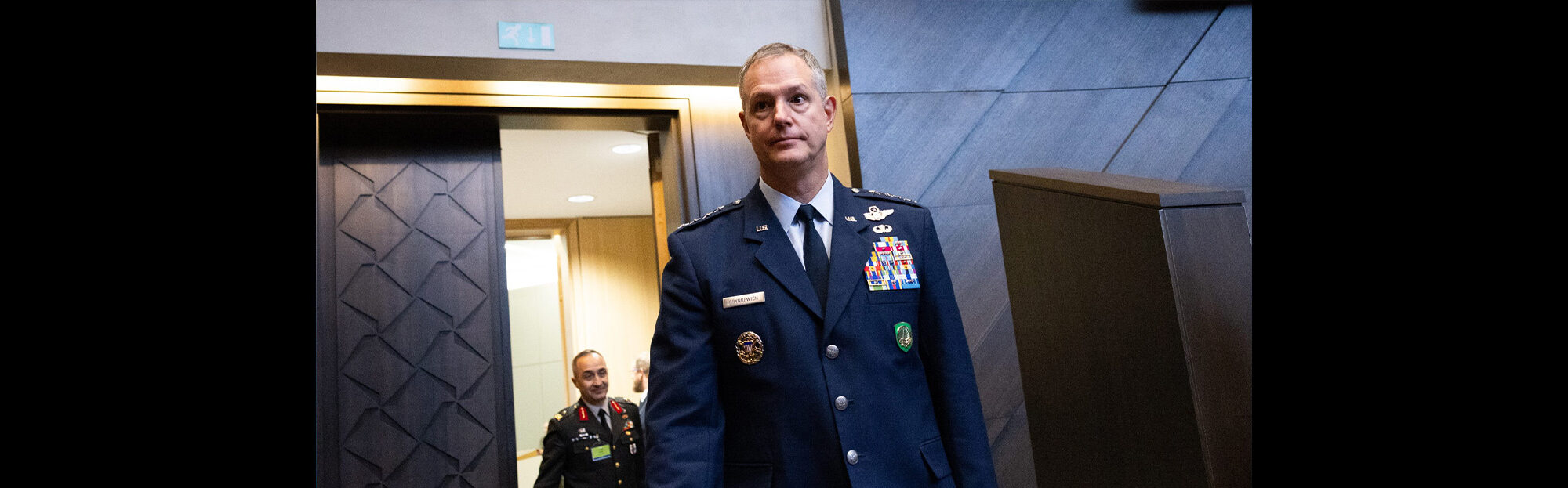
Since U.S. Air Force Gen. Alexus G. Grynkewich became NATO’s top military officer in July 2025, the alliance has contended with Russian drone incursions, hybrid warfare against its members, and Moscow’s continued aggression in Ukraine. Now the Supreme Allied Commander Europe, the career fighter pilot is trying to guide a major transformation of the forces under his command. The NATO Force Model is being adapted as the Trump administration scales back the forces it would offer Europe in a crisis as a means of rebalancing toward Pacific threats. Members of the alliance, meanwhile, are ramping up spending and stepping into greater roles.
Grynkewich, who also heads U.S. European Command, recently joined Air & Space Forces Magazine for an interview in his office at Supreme Headquarters Allied Powers Europe near Mons, Belgium. The text of the interview has been edited for length.
Air & Space Forces Magazine: What are the NATO Force Model cuts and what are their implications?
Grynkewich: I won’t get into specifics about which things have been adjusted in the NATO Force Model, since that is classified, but we have said that it’s air and maritime capabilities, and we’ve said that allies should step forward and fill some of those requirements.
From my perspective as SACEUR, this makes me have a more realistic plan [in case of war]. What the U.S. is doing is accounting for other global contingencies that it might find itself in and not just promising something that it may not be able to give. I now have a signal from the United States on what capabilities they may have to withhold or that might be otherwise engaged. Therefore, allies have a realistic expectation of what they’re going to need to contribute.
The United States has typically said that it would say “everything is available” to the alliance and then decide at the point of need. Other nations have withheld capabilities from the NATO Force Model that they need for their [own] national plans; this is just the first time the United States is doing that, based on other national interests.
Q: Polish and Finnish officials have expressed interest in nuclear sharing, a program in which nations would use dual-capable aircraft to employ U.S. nuclear weapons in a war. What are the implications of expanding the nuclear sharing mission?
A: In general, additional flexibility is never bad for a commander to have, but it is a political decision and there are some strategic implications of it.
Q: President Trump has said additional U.S. troops will be sent to Poland, but no forces have been sent. Do you have clarity on that?
A: All pre-decisional at this point. I’ve been given the order to do some planning and make some proposals and options, and we’ll complete that process and get guidance from the Secretary on how he wants to proceed.
Q: How do you assess the Russian threat?
A: On the Russian air and missile forces, I would say those have not been subject to the same level of attrition and attritional warfare that the Ukrainians have imposed on Russian ground forces. So they do still have the platforms and capabilities, whether it’s bombers or fighters or ballistic missiles, et cetera. They, of course, are expending some munitions in Ukraine, but the platforms are there, and then their production for replacement ballistic missiles and cruise missiles continues. So they have considerable firepower and considerable potential in the [Russian Aerospace Forces] for capabilities. And you pair that with one-way attack drones, et cetera.
This kind of combined aerospace attack, if you will, is something that we’re going to have to be ready to counter. Russia is doing some military modernization as well and building the Su-57 [fifth-generation fighter.] They’ve got their big six weapons programs. That continued modernization maybe hasn’t continued at the pace that it was originally planned because of the war in Ukraine, but it does continue, and we’re watching it very closely.
Q: What are the implications of shifting some long-standing U.S. commanded alliance headquarters to other NATO nations?
A: The big shift here has been that the allies are going to fill two of our four-star commands underneath SHAPE and in Allied Command Operations that traditionally have been filled by American officers. That’s a good sign of Europeans stepping up and taking the lead in some very key positions across the alliance.
We have a combination of joint commands at the four-star level. And then we have domain commands at the three-star level. We have done some work to optimize how those different commands work together, how they’re linked. The near-to-midterm plan is to really test that through our exercise program. Is there something else that we need to adjust in the future? I just don’t know yet as we go through the process.
Q: Are NATO facilities sufficiently hardened to deal with a Russian attack, such as those launched by Iran across the Middle East with missiles and drones?
A: I won’t get into the specifics of what’s hardened and what’s not, but we clearly account for the threat that you’re describing. We think through a range of active and passive measures. Active measures being traditional air defense capabilities and nontraditional electronic warfare against drone attacks, et cetera. We also look at and exercise regularly the full suite of passive hardening—camouflage, dispersion, dispersal—that we’d be able to see to it in the event of a crisis.
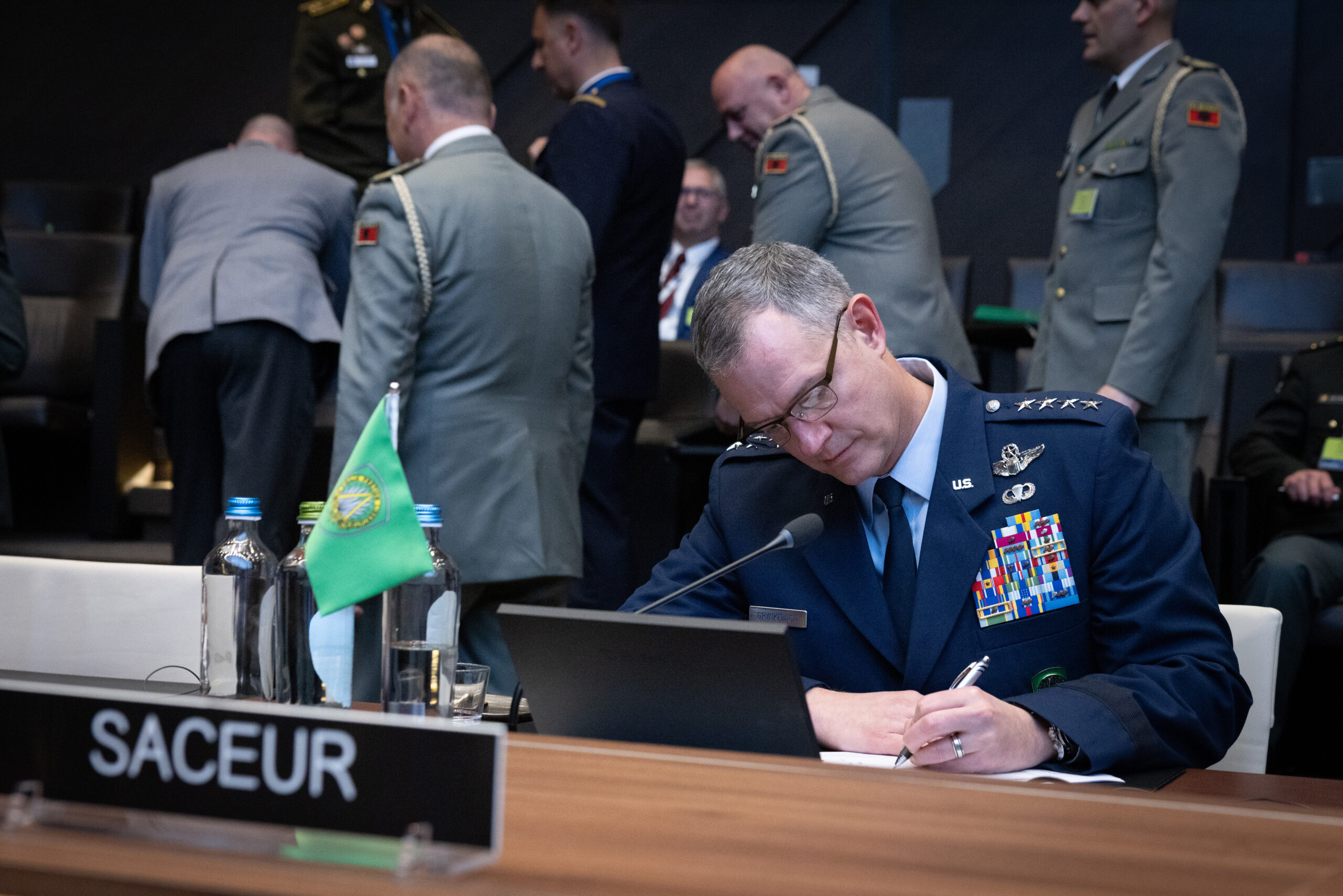
Q: What’s the goal for the Ankara Summit?
A: I think the best way to approach the Summit is to focus on pragmatic and realistic outcomes, hard outcomes that show progress. We ought to, as a team of friends, hold each other to account. Are we meeting our Hague Summit commitments? Are we meeting our capability targets? Do we have the right resilience that we’re building into our force? How are our plans looking? And there will be some things, as we do that—in that honest and open discussion—to celebrate. And there’ll be other things where we need to hold ourselves to account and get everyone to row a little harder. So, I think if we approach it from that perspective, we’ll come out of it much stronger on the backside.
Q: On a high level, what do allies need to do?
A: The Hague spending commitments were not pulled out of thin air. The 3.5 percent is derived from the capability requirements that are resident in our plans, and the things that SACEUR needs to execute those plans. The first thing allies need to do is spend the money and ramp up quickly, so that we can keep pace with the evolving threat. The second is, as allies spend that money and ramp it up quickly, it needs to go toward their capability targets, and those capability targets need to be thought of in the context of the evolution of warfare.
In other words, don’t build me an armored brigade today if you have a target for one that looks like one did in 2021. It needs to account for the evolution of operations, as we’ve seen. So the composition of that unit, the specific capabilities that will be different—and you could say that across any domain and any capability target. We get a lot of help from SACT, the Supreme Allied Commander for Transformation, on this. He’s pulling the lessons learned out of Ukraine, helping to propagate them across the alliance. He runs a series of war games that look at future force structure, so it’s not just SHAPE alone. We’re part of a bigger system that does this, but it all comes back, and it’s all relevant.
The reason our voice matters is that it’s tied to the core task of the alliance, which is to defend every inch of alliance territory. I’m advising the heads of state and government, or their ministers, or their chiefs of defense across 32 nations on what I need them to do to make those plans work. And in a way, I’m holding them to account for that and I’m telling them when they’re not doing enough. So it’s grounded in military reality, but it’s direct feedback to the political level across all the nations of the alliance.
Q: What is your core message?
A: There are a couple things I want to get across. First, it’s incredible to watch how allies are stepping up and taking more of a leadership role in the alliance, not just in fielding capabilities, but in some of the positions we talked about. There is this shift toward a much stronger Europe that will make a much stronger and durable alliance over time, a NATO 3.0.
The gift to me as SACEUR over the last year coming out of The Hague Summit is that we are getting more and more capable every single day, and so that’s message number one. The burden shift is underway. Allies are really stepping up and taking the lead in many ways.
The second big point is we say we’re transitioning to a warfighting headquarters, but we are ready today. We are ready. Will we be more ready after a few more exercises, and after a few more capabilities are about? Absolutely. So we’ll be more ready tomorrow, and we’re ready the day after that. But we are ready today, and it’s serious business, and allies are taking that seriously.
Grynkewich spoke with Air & Space Forces Magazine after the Ankara Summit to discuss the outcome.
Q: What was your assessment of the outcome of the Ankara Summit?
A: President Trump said there was a lot of love in the room at the Summit. I was in the room, and it was an incredible display of unity in response to President Trump’s leadership. Our allies are stepping up on their investments, and fielding and providing additional capabilities to Allied Command Operations. This will ultimately deliver the
capabilities we need to better deter and defend every inch of alliance territory, not just today and tomorrow, but well into the future.