
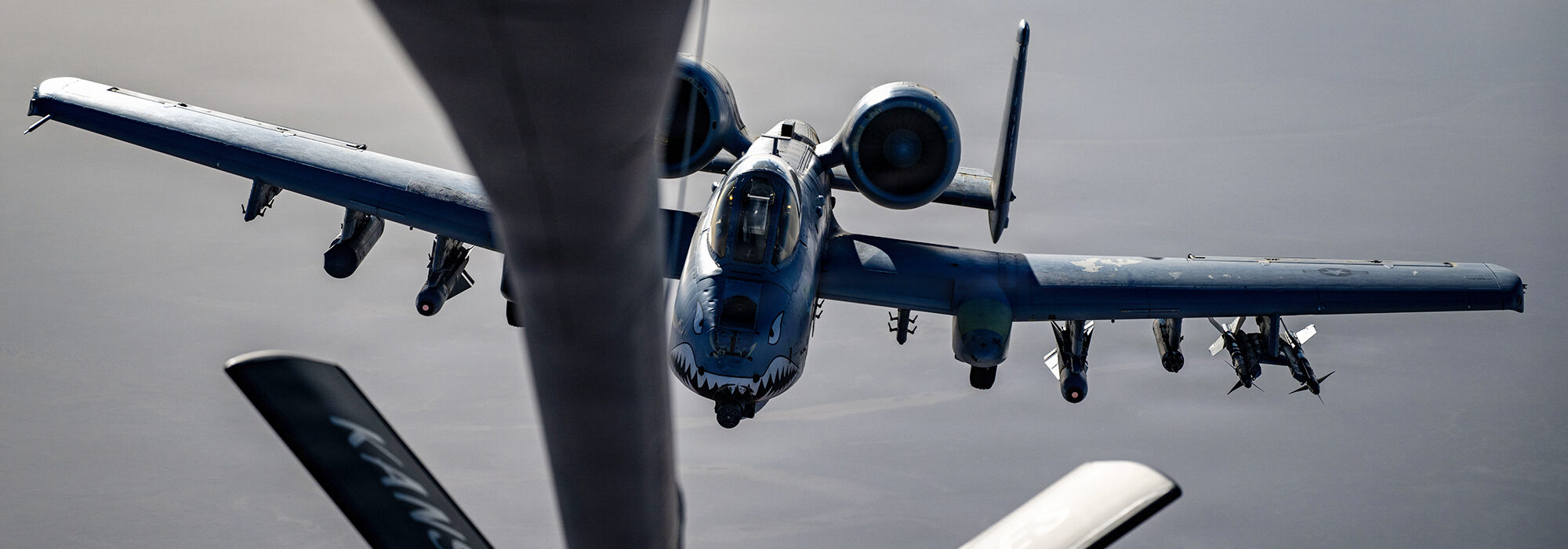
Operation Epic Fury got underway Feb. 28 with the largest assembly of U.S. airpower since 2003: Nearly 300 Air Force, Navy, and Marine Corps fighters, 20 bombers, dozens of tankers, and a fleet of electronic warfare, intelligence and surveillance, command and control, and other manned and unmanned aircraft, positioned globally, coordinated exquisitely. It was an Air Force-led demonstration of U.S. military power at its best.
Epic Fury showed what space and cyber integration can do at the operational level, extending control of the vertical dimension and enabling the accurate delivery of penetrating airpower with minimal collateral damage. Iran lost 90 percent of its ability to strike back in the first week alone—and the U.S. quickly achieved air supremacy.
Clearly, our Air Force can land a powerful punch. The question is, can it last 10 rounds against a fellow heavyweight?
Just a week before the war, readiness was a central focus of conversation at AFA’s Warfare Symposium. The juxtaposition between readiness shortfalls and the exceptional performance of Airmen and Guardians over the past year in Operations Midnight Hammer, Absolute Resolve, and Epic Fury can be hard to square.
On the one hand, Air Force leaders have openly acknowledged maintenance backlogs, parts shortages, and unburned flying training hours. On the other, Airmen demonstrate devastatingly effective performance under pressure: Thousands of combat sorties significantly degraded the enemy, and combat losses were minimal—three F-15s lost to friendly fire, a dozen drones to surface-to-air missiles, and one tragic accident.
But facts are facts: The Air Force suffers both materiel and readiness challenges, as clearly acknowledged by its leadership. Years of inadequate investment in spare parts and supplies and rationalized reductions in maintenance and support personnel—coupled with an aging fleet and too few fifth-generation stealth jets—make it nearly impossible to keep up with the demands of multitheater employment, exercises, and rotational presence.
Airmen prove daily that USAF’s old planes can still operate, flying KC-135s that are past 60 years old and F-15Cs over 40. But it’s not easy. You wouldn’t take a 60-year-old car on a cross-country road trip, but the Air Force flies old planes daily—on long journeys into hostile territory.
No wonder Air Force Chief of Staff Gen. Ken Wilsbach is so focused on fixing as the key to flying and winning. You can’t fly if you don’t fix, and the repair bill goes up with every mission as airplanes age.
Expending over 11,000 munitions in 16 days of combat as the U.S. has done demonstrates the value of stockpiling weapons during peacetime. But according to the Royal United Services Institute (RUSI), an independent British defense research specialist, the U.S. is now within weeks of exhausting stockpiles of several weapons, including THAAD, Patriot, and JASSM-ER missiles.
Clearly, our Air Force can land a powerful punch. The question is, can it last 10 rounds against a fellow heavyweight?
Size and depth are factors that used to figure into U.S. military strategy. In the 1990s, the national defense strategy featured a built-in force-sizing factor: the ability to fight two “major regional contingencies”—or wars—simultaneously.
By the time President Barack Obama took office, the U.S. had effectively been fighting two wars for six years—one in Iraq and the other in Afghanistan. Seeking to pivot toward Asia and to diminish U.S. presence in the Mid-East, then-Defense Secretary Robert Gates openly questioned the two-war strategy.
This is how our Air Force became the oldest and smallest in its history. New aircraft programs were slowed or cut short. Budgets for training, parts, and munitions were gutted. Squadrons were reduced from 24 to 16 airplanes, wings from three to two combat squadrons.
Meanwhile, Russia tests U.S. responses in Alaska and China rattles sabers in the South China Sea; both test our military in space and cyberspace.
Focused on one region, today’s smaller force is inherently less able to deter misbehavior in others.
China is therefore front of mind. Among the most eye-opening discourses at AFA’s Warfare Symposium last month was a startling presentation by retired Navy Cmdr. J. Michael Dahm, a China expert with AFA’s Mitchell Institute for Aerospace Studies. Using open-source commercial satellite images, he demonstrated the growing capacity of China’s air force and military aircraft industry. Reprised in part on p. 38 of this issue, his work exposes China’s unseen military expansion.
The Pentagon closed its eyes to that very reality nearly two decades ago, with persistent attempts to kill the F-22. It became the world’s most capable fighter—ideally suited to the Pacific fight. But USAF bought too few, and the line has long been shut. While America still boasts unparalleled skill and capability as a fighting force—as demonstrated in Epic Fury—it no longer boasts unparalleled scale. China, having already surpassed the U.S. Navy in size, is now within two years of dwarfing U.S. airpower, as well.
In space, China is racing to catch up, and while it hasn’t yet matched U.S. launch capabilities, it has or soon will have more launch capacity than our Space Force.
The coming budget debate in Congress can mitigate the imbalance between resources and requirements, but only if properly directed.
Restoring American supremacy in air and space is going to be expensive, and the Air Force and Space Force must be clear and decisive in setting requirements and defining objectives. Too often in the past, Air Force leadership has vacillated and lost the battle for investment. What’s needed is clarity and a united focus.
The Air Force needs combat capacity, and that means acquiring many more F-35s, F-15EXs, and B-21s and continued development of the next-generation F-47, to replace its now antiquated forces. But it also means more tankers, which are too often the limiting factor in ongoing operations, and new E-7s to manage the battlespace and guard against tragedies like the March loss of a KC-135 over Iraq that killed six Airmen. It needs enhanced, jam-proof command, control and communications; improved logistics, and greater integration.
Off the radar for many is the value of USAF’s MQ-9 fleet. While vulnerable to ground fire—some two dozen have been lost in Iran and Yemen in the recent past—they possess the unique ability to remain on station and provide both sensors and shooters where and when they’re needed. They save lives, and we need more, not less.
Finally, enhancing U.S. space capabilities—both in space and on the ground—is fundamental for ensuring long-term national security. America needs to fully operationalize space, consolidate the essential warfighting assets not yet in the Space Force, and make USSF more operationally agile and responsive to ensure access to space and the ability to rapidly replace capability lost in the event of orbital conflict.
Spending $1.5 trillion for defense is a huge price to pay—but if the alternative is watching the U.S. diminish and China grow, unchecked, to become the world’s new dominant superpower, it’s worth every penny.