
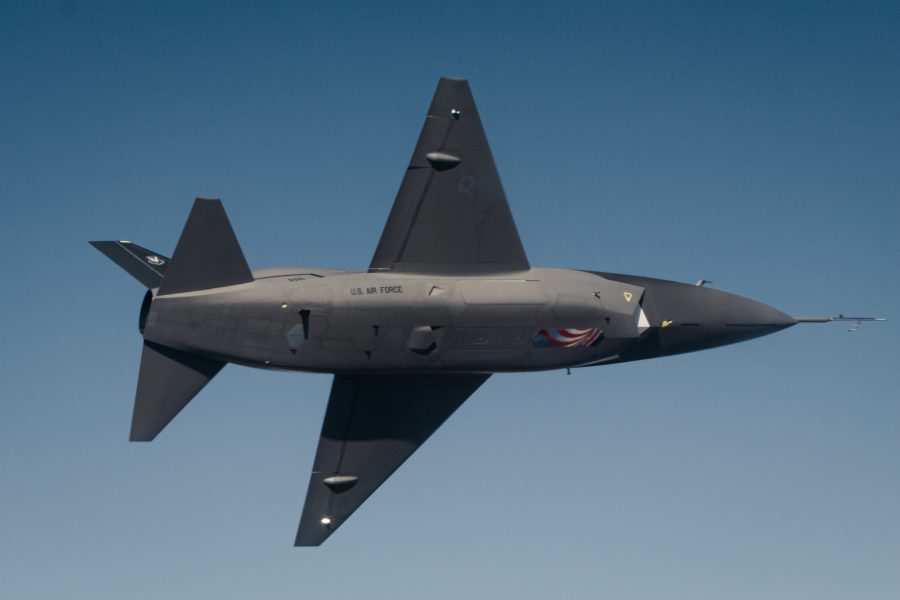
AURORA, Colo.—Anduril Industries flew its YFQ-44A Collaborative Combat Aircraft with two different mission software systems during the same flight Feb. 24, an Air Force official revealed at AFA’s Warfare Symposium.
“What we did was we took we flew one mission autonomy [from] Shield AI, and then in the same flight, without landing, we went and pivoted to a second mission autonomy, same flight,” Col. Timothy Helfrich, portfolio acquisition executive for fighters and advanced aircraft, said during a panel discussion.
Anduril later said the second mission autonomy system was its own Lattice for Mission Autonomy software. The Air Force is not currently considering Lattice for Increment 1 of the CCA program.
“The aircraft took off and autonomously approached a designated point where Shield AI’s mission autonomy software stack, Hivemind, was activated to complete a series of test cards,” Anduril said in a release. “Following completion of Hivemind tests, Anduril was able to seamlessly switch to Anduril’s Lattice for Mission Autonomy stack to complete the same test points, before returning safely to land.”
Mission autonomy software controls how a CCA drone executes complex actions when given basic directions from a pilot in a manned aircraft.
It is “essentially the pilot in the seat,” Lt. Col. Matthew Jensen, commander of the Experimental Operations Unit, said during the symposium panel, responsible for executing the mission assigned. The flight autonomy is the software loaded onto the aircraft to ensure it can execute basic operations and maintain safety.
The CCA program has already had one case of mission autonomy software controlling a drone—General Atomics announced Feb. 12 its YFQ-42A flew with Collins Aerospace’ Sidekick software earlier this month.
Anduril went a little further with the midflight switch from one autonomy software to another—demonstrating a key point of the CCA program, Helfrich argued.
The Air Force has established an Autonomy-Government Reference Architecture—essentially a baseline that separates flight from mission autonomy and gives contractors a common standard so that any mission software can plug and play with any aircraft and its flight software. Doing so allows for frequent updates without worrying about jeopardizing the basic safety and airworthiness of an aircraft.
“The autonomy GRA has proven out that we’re able to make changes very quickly. … So we’re demonstrating through the architectures that we can make these changes,” Helfrich said. “We’re setting up the structure of the program to be able to respond and integrate with the operator every single day. And so what you get on day one, that’s just the first step. You’re going to keep getting better and better.”
The Air Force is planning on making a production decision on both the aircraft and the autonomy mission software for Increment 1 of the CCA program in 2026.