
AURORA, Colo.—The Air Force has awarded multimillion contracts to two industry teams to design small prototype engines for the service’s future Collaborative Combat Aircraft, according to Feb. 23 announcements.
The awards, announced on the first day of AFA’s 2026 Warfare Symposium here, are the result of stiff competition among defense firms of all sizes to develop these new propulsion systems for next-generation CCAs and low-cost missiles.
Kratos Defense & Security Solutions, Inc., which is partnered with GE Aerospace, received a $12.4 million Air Force design contract, according to the firm’s announcement. The initial phase of the program will complete the preliminary design of the GEK1500 engine, which is based partly on the lessons of the firm’s mature GEK800 cruise missile engine. The GEK1500 is a 1,500-pound thrust jet engine that could potentially power unmanned aerial systems, CCAs, and missiles, according to the Kratos announcement.
“Lessons learned from recent GEK800 altitude testing are directly informing GEK1500—improving thrust, power generation, and lifecycle cost—so we can meet CCA requirements without compromising affordability or schedule,” Steve “Doogie” Russell, vice president and general manager of Edison Works at GE Aerospace, said in the Kratos announcement.
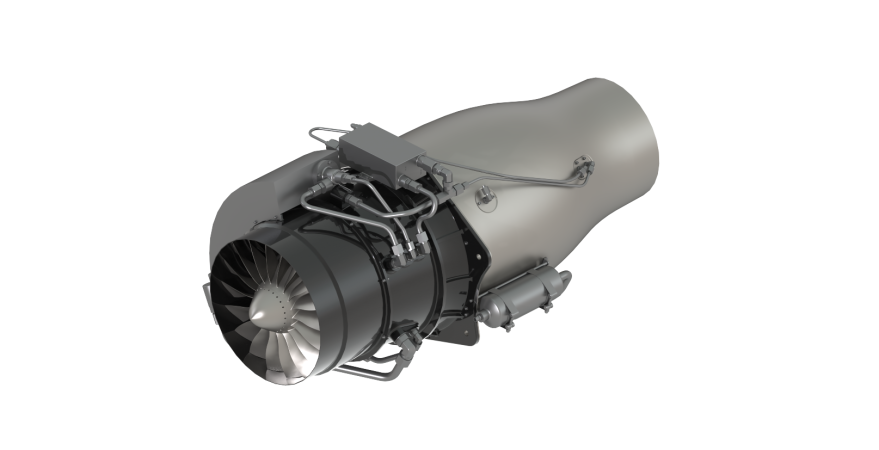
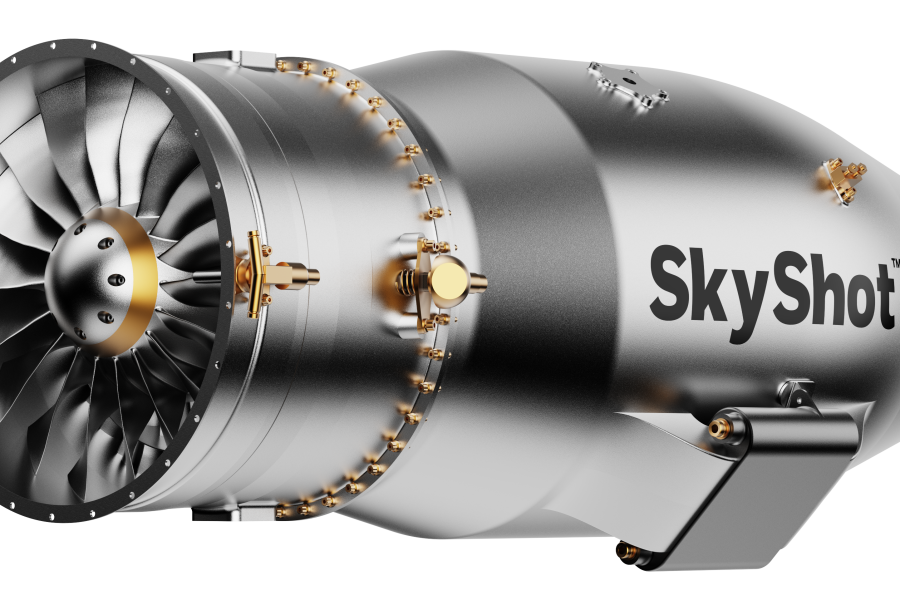
Honeywell also announced the Air Force had awarded the firm a prototype contract to design a CCA engine based on Honeywell’s new small-thrust-class engine: the SkyShot 1600. Honeywell officials would not comment on the amount of their Air Force contract.
The SkyShot 1600 engine can produce thrust levels from 800 to 2,800 pounds and can be configured as either a turbojet or turbofan, with scalability when additional thrust is required, according to the announcement.
The engine, which is based on the HON1600, is capable of operating at 40,000 feet and is designed to meet rigorous G-level performance requirements, enabling it to be effective against maneuvering targets.
“We’ve combined decades of proven technologies with the latest advancements to create an engine that can keep pace with cost, speed, and performance demands of next-generation platforms,” Dave Marinick, president of engines and power systems at Honeywell, said.
So far the Air Force is considering two CCA prototypes under increment 1 of the program—General Atomics’ YFQ-42A and Anduril’s YFQ-44A.
The service also recently announced it awarded nine contracts under Increment 2 of the CCA program but has not provided a clear explanation of how increment 2 differs from Increment 1.
Kratos developed the XQ-58A Valkyrie, which the Air Force used to test its Skyborg autonomy software that served as a forerunner to the CCA program. Kratos officials have said they intend to compete for Increment 2.
Propulsion firms, ranging from small startups to industry giants, have been racing to develop a new class of engines capable of producing 200 to 3,000 pounds of thrust at the low end up to 3,000 pounds-8,000 pounds of thrust at the higher end—which the Air Force has suggested CCAs might require.
Besides CCAs and one-way missiles, propulsion experts said last fall that there is a growing need for these newer small engines to bolster the Pentagon’s existing standoff munitions stockpile.