
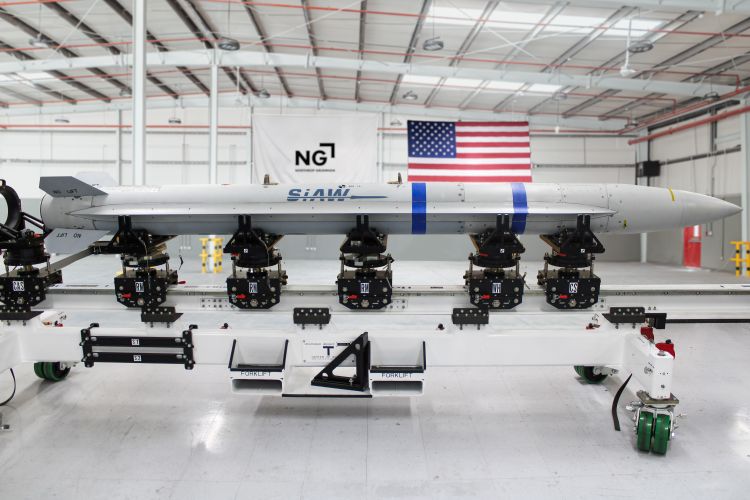
The Air Force wants more companies able to produce its new, multi-use, anti-radar missile that one expert says will prove vital in any future peer conflict and would be in high demand for the war in Iran if stocks were available now.
The service posted a notice March 4 for a missile with “similar or improved capabilities” as the Stand-in Attack Weapon, or SiAW, currently under development by Northrop Grumman.
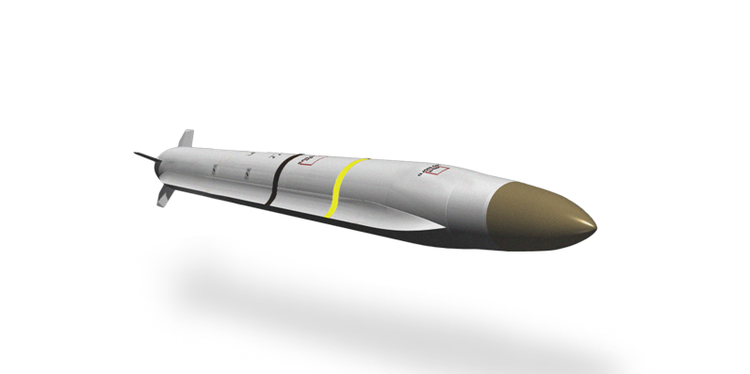
The SiAW is a supersonic air-to-ground missile the Air Force plans to use to defeat enemy air defenses and take out high-value, relocatable targets. The missile is planned to be carried by the F-35, F-16, F-47, and B-21. Northrop based the design of the new missile on its Advanced Anti-Radiation Guided Missile-Extended Range, or AARGM-ER, which in turn is based on the older AGM-88 High-speed Anti-Radiation Missile, or HARM.
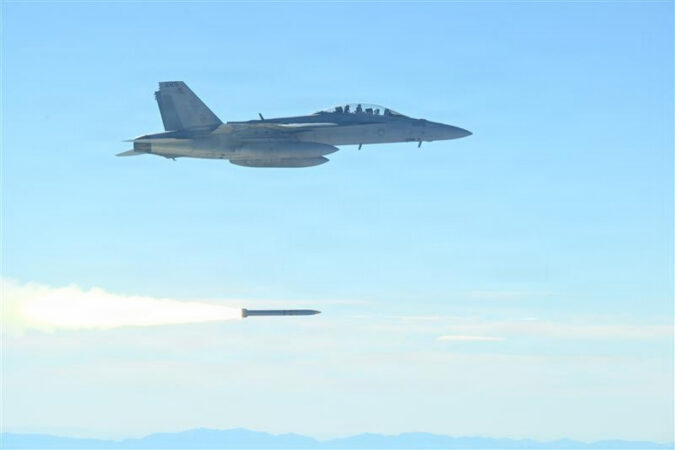
The AARGM-ER is believed to be a Mach 4 missile with a range of 180 miles, Air & Space Forces Magazine previously reported. The SiAW is expected to fly faster than the HARM and possibly the AARGM-ER and strike targets at greater ranges. Northrop has stated that the missile fills “gaps created by 2025+ threats.”
“It’s the kind of weapon that if we had it in quantity would be very valuable in current operations in Iran and definitely in the Pacific,” said retired Col. Mark Gunzinger, director of future concepts and capability assessments at AFA’s Mitchell Institute for Aerospace Studies.
For the past two decades, the Air Force has pursued a strategy against heavily defended targets that uses a mix of single-use stand-off weapons alongside inexpensive, stand-in weapons fired by survivable and stealthy aircraft that can reattack multiple times, Air & Space Forces Magazine has previously reported.
The Air Force started work on SiAW by awarding first-phase contracts to Northrop, L3Harris, and Lockheed Martin in 2022. The service tapped Northrop to build the missile in 2023 with a three-year program valued at $705 million. The firm delivered the first SiAW test missile to the Air Force in November 2024, with plans to field the weapon by 2026.
The program got a boost in last summer’s One Big Beautiful Bill Act: the reconciliation package included $325 million for production capacity improvements for air-launched, anti-radiation missiles. It was not immediately clear if those extra funds led the Air Force to seek more vendors.
The new sources sought notice informs interested vendors that they must deliver key features such as “extended range, advanced targeting, counter-countermeasures, and integration with existing and future platforms.”
Though the SiAW is an anti-radiation missile, like its predecessors, Air Force officials expect the weapon to strike a variety of targets.Those include command-and-control sites, ballistic missile and cruise missile launchers, GPS jamming systems, anti-satellite systems, and other high-value or fleeing targets.
Original notices for the SiAW required companies include notional average unit production prices assuming production quantities of 500, 1,000, and 1,500 units. The recent notice seeks vendors capable of building 600 missiles annually.
Features
Gunzinger, who has authored multiple reports on munitions use and affordability, said the SiAW’s supersonic speeds give it more utility against moving targets because it can reach them in minutes. A subsonic cruise missile, considered a stand-off weapon, fired outside of an enemy’s defensive ranges, can take a half hour or more to reach its target, which will relocate.
Another advantage of the SiAW is its smaller size, which means it can be carried internally on stealth aircraft.
“Designing weapons that can be carried internally and stealthily is a real advantage,” Gunzinger said. “We don’t want to hang weapons outside because you’re no longer stealthy.”
The size also brings another boon—quantity.
“Reduced size can increase the number of weapons per sortie, which equates to more targets per sortie,” Gunzinger said.
Gunzinger said that the Air Force has wanted multiple vendors for the SiAW since its inception. That’s important because it creates competition between companies, which can lower costs.
“Secondly, we need these weapons at scale, not just for operations like we see today in Iran, but definitely for a fight against a peer adversary such as China,” Gunzinger said.
Top Air Force officials have said they plan for the SiAW to be a large-scale acquisition program that will procure thousands of units with regular technology updates. The munition will likely also be available for export.
Northrop announced in December it had completed a separation test of the SiAW from an F-16 at Eglin Air Force Base, Fla., moving it one step closer to service.
Flexibility
Air Force Global Strike Force Command deputy Lt. Gen. Jason R. Armagost said at AFA’s Warfare Symposium last month that the service needs more munitions flexibility across its platforms.
The three-star specifically pointed to spreading the Suppression of Enemy Air Defenses, or SEAD, missions beyond their traditional home with F-16 or F-35 fighters, making SEAD capabilities “native to all the various platforms.”
One piece of hardware that could help with that flexibility is the Universal Armament Interface, mentioned in Air Force budget documents.
If successful, the interface would be used on the B-21 and include weapons such as the SiAW, AARGM-ER, Joint Air-to-Surface Standoff Missile, Joint Direct Attack Munition, Small Diameter Bomb I & II, Long Range Anti-Ship Missile, and the Joint Strike Missile.
Having a greater variety of weapons on an aircraft allows for better “mission flexibility,” Gunzinger said.
“That can really open up options for a commander to use a combat aircraft,” Gunzinger said.