
The Pentagon’s proposed budget for the Air Force in fiscal 2027 would include billions of dollars in additional spending on advanced next-generation fighters, trainer aircraft, hypersonic missiles and more.
But an expert close to Air Force issues—who asked not to be identified to speak more frankly about the budget request—said the service’s asks are paltry compared to the massive $1.5 trillion topline the Pentagon requested and would represent a historic lost opportunity to invest for the long term.
“While any increased funding is obviously appreciated, many defense watchers are extremely puzzled that the Air Force did not choose to boost procurement for most of its key airframes,” the expert said. “The airframe buys really just look like a normal year. … This was a generational opportunity, and there was multiyear ability on the reconciliation money to spread those buys.”
“This was the chance,” the expert said. “If those are the aircraft buys, they blew it. They blew it, and they’re not going to see this [opportunity] again for a long time.”
The Air Force budget would get a roughly 22 percent—or $57 billion—increase, according to documents released by the Department of Defense comptroller, going from about $260 billion between discretionary and mandatory funding in fiscal 2026 to more than $317 billion in 2027.
Those totals include funds for the Active-Duty, Guard, and Reserve, covering costs for personnel, operations and maintenance, procurement, research, development, test, and evaluation, and construction. The big increases are going to O&M, missile procurement, R&D, and military construction.
That proposed increase for the service would be a smaller slice of the pie than others would receive, the expert said, and he pointed to relatively small numbers of proposed fighter and tanker procurements in 2027.
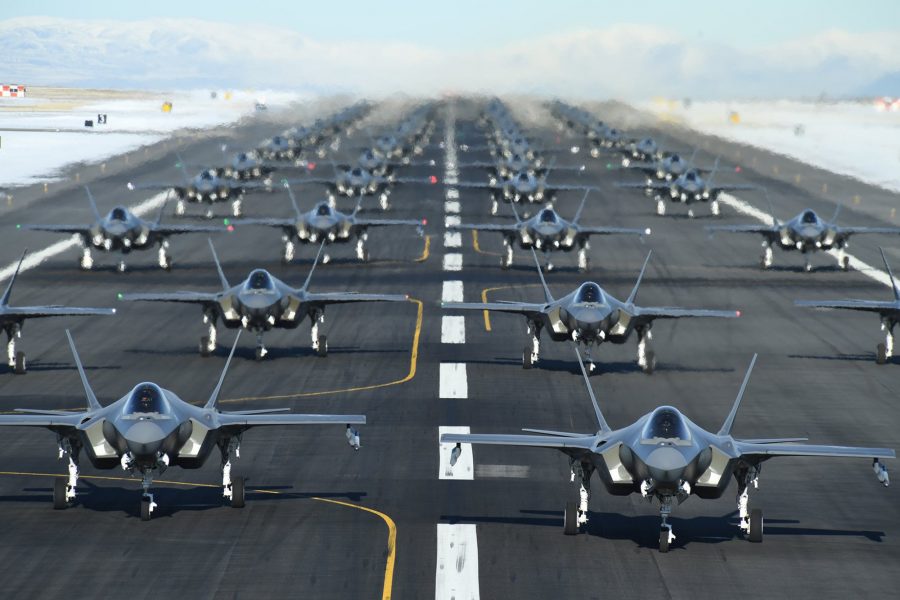
The Air Force said it plans to buy 38 F-35As in 2027, which would be the second-lowest in more than a decade. The only recent year that saw fewer F-35A purchases was 2026, when the Air Force bought 24. The proposed budget would also fund 24 F-15EX Eagle II fighters, only slightly more than the 22 F-15EXs the service bought in 2026. Total, the Air Force would buy 62 new fighters in 2027—less than the 72 new jets the Air Force has long said it needs to buy each year to modernize its fleet and lower the average age of its fighters.
The number of KC-46A Pegasus refueling tankers would remain flat at 15 in 2027.
Boosts for Some Programs
At least some key Air Force programs would get spending boosts under the budget proposal.
The F-47 program, the Air Force’s sixth-generation fighter now being built by Boeing, would receive $5 billion in 2027, according to the comptroller documents. That is up from nearly $3.5 billion passed by Congress in 2026, and more than twice the amount spent on the program in fiscal 2025.
The Air Force’s Collaborative Combat Aircraft program would get nearly $1 billion in procurement funds in 2027 to start buying the semi-autonomous drones, as well as almost $1.4 billion to continue research, development, test and evaluation on them. That is up from the $827 million in RDT&E funds Congress approved for CCA in 2026.
The T-7 Red Hawk advanced trainer would receive $529 million in procurement funding in 2027 to buy 23 jets, as well as another nearly $70 million in advance procurement spending for 2028. That is up from the $362 million the Air Force received to buy 14 T-7s in 2026.
But with the T-38 Talon fleet growing increasingly creaky and further past its life span, the expert said buying just nine more T-7s in 2027 won’t be enough.
The Air Force’s two main hypersonic missile programs would receive nearly $1.7 billion in funding in 2027, a major increase from the $1.2 billion in spending approved the year before.
The AGM-183A program—also known as the Air-Launched Rapid Response Weapon, or ARRW—would receive $452 million in missile procurement funding in 2027, up from the $362 million approved in 2026. ARRW at one point was on the chopping block after a string of test failures but has since been revived.
The Hypersonic Attack Cruise Missile, or HACM, would receive nearly $404 million in missile procurement funds in 2027, as well as another $806 million in research and development funding. HACM did not receive procurement funds in 2026, but had $828 million in its RDT&E budget that year.
The Air Force’s Survivable Airborne Operations Center, or SAOC, would receive $2.2 billion in RDT&E funds in 2027, up from the $1.9 billion or so it received in 2026.
Nuclear Drops
Two key programs necessary to modernize the Air Force legs of the nuclear triad that got healthy boosts from last year’s One Big Beautiful Bill Act are not slated to receive any reconciliation funding in 2027—and would see their overall budget drop.
The B-21 Raider stealth bomber would receive $2.2 billion in procurement funds in 2027. That is slightly higher than the nearly $2 billion the Raider program received in the base budget in 2026.
But if this spending plan were approved as-is, the Raider’s overall funding in 2027 would decline. The Raider received another $4.5 billion in 2026 funding as part of the reconciliation bill to accelerate its procurement—resulting in total spending of nearly $6.5 billion—but the 2027 budget does not now include additional funds to continue the accelerated procurement. The Air Force did not immediately reply to a query on the B-21’s funding in 2027.
Similarly, the LGM-35A Sentinel program—the nuclear intercontinental ballistic missile that is intended to replace the Cold War-era Minuteman III ICBM—would receive $4.5 billion in its base budget for RDT&E in 2027.
That is a slight drop from the $4.8 billion Sentinel received in total approved RDT&E spending in 2026, which included a base budget of $2.6 billion and another $2.2 billion in reconciliation spending.
Sentinel’s procurement spending would also drop from $176 million in 2026 to nearly $108 million in 2027.
The expert said Sentinel and the B-21 are too crucial to see their budgets effectively go down.
He believes the Air Force will come to regret not taking the chance to shoot for more.
“You either get on the train and buy the reset you can when it becomes available, and then you ride it for decades, or you get left out,” the expert said. “It will be very hard for them to make the case that they’ve really got to grow, when literally they were offered a blank check and they didn’t cash it.”
