
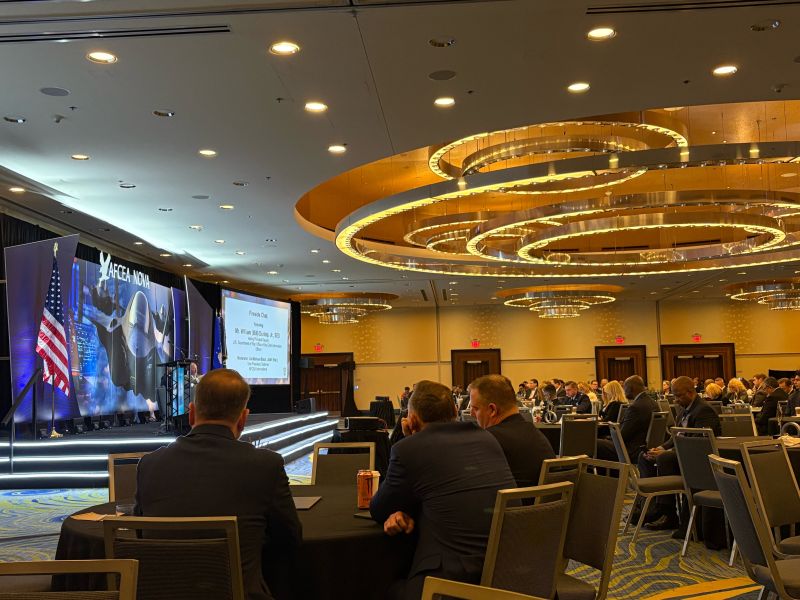
The Department of the Air Force is embracing the new commercial-first approach to IT ordered by Defense Secretary Pete Hegseth, outsourcing networks and other infrastructure and reducing the amount of customization required from vendors, say the chief information officers for several DAF organizations.
The aim is to minimize customization, said George Forbes, the director of the Digital Operations Directorate at Headquarters Air Force A3X, speaking at an AFCEA Northern Virginia event Dec 12.
“Our target is 95 percent out of the box,” he said. “Our philosophy is speed to market … to get products into the hands of Airmen right away.”
A memo and strategy document unveiled by Hegseth in November during his address to defense contractors, ordered military acquisition offices to adopt a “commercial first” approach and focus on “speed to capability.”
His objective is to stop hiring contractors to build proprietary software solutions, and instead to leverage commercial solutions as much as possible, Forbes said. Commercial software-as-a-service, platform-as-a-service, and data-as-a-service models can often answer government needs with only a little tweaking.
“We don’t have a lot of time for you to customize stuff that we will have to own and perpetuate and propagate and then edit and fix in the future,” said Forbes. “We’re going to give you a little bit of room to get what we need. But we value speed to market more than we value customization. The 85 percent [solution] is often good enough for us.”
The Air Force A3 is focused on “executing the flying mission, not owning a lot of [IT] infrastructure,” Forbes said, “So we like to outsource that as much as possible. … I don’t want to own any infrastructure related to building my apps, because that’s also outside of my lane.”
Elwood “Eddie” Lewis III, chief information officer for the Department of the Air Force comptroller, agreed that customization adds delays and creates sustainment problems, because updates to the underlying commercial product can break customizations. “It slows down our agile acquisition delivery process,” Lewis said. “It’s extremely expensive and then sustaining it is very difficult, and it also impedes interoperability tremendously.”
The fight against custom solutions is a perpetual battle, Lewis acknowledged.
“For the last 20 years, we’ve tried to change that, but we’re still not there,” he said. “We haven’t convinced ourselves that there’s a lot of our business processes that are just the same, whether you’re sitting here within a DOD or Department of War setting, within the executive branch or in commercial industry.”
The biggest challenges are managing data and integration, Lewis said.
“Between interfaces and APIs, we’re spending a lot of time here trying to get our data accurate,” he said. “On our interface side, what we’re really doing is partnering to make sure that we’re putting in place a control environment so that we fully understand the data coming in and that the format is actually what we think it is.”
Forbes said his office wants to data to converge, and the integrations to be tight. “I’m not interested in having a lot of technical debt to figure out how to connect it all up.”
Francisco Salguero, chief information officer for the Air Force Chief of Personnel (A1), echoed the call for using commercial Platform-as-a-Service offerings with minimal customization. “You can actually plug in together, make them work together,” he said. Salguero, Forbes and Lewis all participated in a a panel discussion on digital transformation moderated by retired William “Bill” Marion, a former Air Force deputy chief information officer and now an independent consultant. Platform-as-a-service offerings provide a proven foundation, Marion told Air & Space Forces Magazine after the panel.
“The reason platforms are big is, platforms give you the bottom half of the stack,” Marion said. “When you go to a Salesforce or Service Now, or Palantir, you’re getting stuff we used to build. We would spend five years building what industry can deliver, literally [at the] flip [of] a switch.”