New approaches to acquisition, faster testing, and lessons from combat are shrinking the Air Force’s timelines for fielding low-cost munitions from years to months.
That’s what a top Air Force weapons official told the Senate Armed Services Committee on March 24 as he answered questions about ramping up production of affordable missiles and bombs for the U.S. military.
Air Force Brig. Gen. Robert P. Lyons III, portfolio acquisition executive for weapons, touted three examples of what he called a “new class of affordable, low-cost munitions”: the Extended Range Attack Munition, or ERAM, and two variants of the Family of Affordable Mass Munition.
“These cruise missiles represent a new speed of acquisition,” Lyons said: the programs went from conception to first contract in four months, and from contracts to flying prototypes in four to seven months. The ERAM entered production just 14 months after the first contract was awarded.
The ERAM is an air-launched cruise missile designed to strike high-value fixed targets from standoff ranges with precision guidance at low cost. The program was developed in part to supply Ukraine in its war against Russia. The Air Force awarded contracts to produce the ERAM to Zone 5 Technologies and CoAspire in late 2024.
The FAMM program first emerged in the Air Force’s fiscal 2026 budget request. Prototyping activities include “integration and flight demonstrations of affordable and highly manufacturable small turbine engines, seekers/sensors, networked datalinks, collaborative autonomy behaviors, and ordnance (warhead/fuse),” according to budget documents. Its origins date back further, though, to the goal of developing a low-cost, palletized, air-to-surface munition through the Air Force’s Enterprise Test Vehicle, or ETV, program.
The idea has expanded over time, and now the service has $656.3 million through the One Big Beautiful Bill Act reconciliation package to acquire 3,010 weapons for FAMM.
Both programs are moving fast thanks to streamlined acquisition processes and accelerated testing, Lyons said. Those two approaches have featured prominently in the Pentagon’s overall strategy to bolster U.S. munitions production lines and its industrial base.
“Through these programs, we will be able to expand production, build up munition inventories, and more rapidly replenish munitions stockpiles,” Lyons said. “Most importantly, we will provide more munitions options to combatant commanders.”
The need for affordable munitions options is getting more attention in the shadow of Operation Epic Fury. The U.S. military has hit more than 9,000 targets in its air campaign against Iran in less than four weeks, using a variety of weapons and raising concern among experts that the conflict may strain weapons stockpiles.
Sen. Roger Wicker (R-Miss.) asked Lyons and fellow weapons managers from across the services what percentage of their munitions budget should be spent on low-cost options. Wicker noted that in November, the Munitions Acceleration Council reported 97 percent of the munitions budget was being spent on “exquisite” expensive weapons.
None of the service representatives would provide a percentage breakdown, but they offered that through testing and development, the slice of the pie going to cheaper weapons would grow over time.
Sen. Ted Budd (R-N.C.) asked Lyons how the Pentagon could scale production of the WGU-59 A/B Advanced Precision Kill Weapon System rocket, or APKWS guidance kit, that has been successful in taking down enemy drones.
“That example begins with having profound insight about operations on the battlefield,” Lyons said.
The one-star said that a team traveled to Europe in 2024 and got feedback from the U.S. Air Forces in Europe commander on threats in the theater and using an air-to-air weapon to defeat them.
The APKWS was originally used as an air-to-ground weapon on the F-15 Strike Eagle. But the Air Force demonstrated its use against aerial targets with the F-16 Fighting Falcon in 2019.
The guidance kit converts a standard rocket into a guided weapon. The rockets are launched from multi-round, reusable pods.
The weapon has been used to down Houthi missiles and drones in the Red Sea.
The Air Force awarded a $322 million order, under a contract worth up to $1.7 billion, to BAE Systems to produce the kits in December. The order will result in the production of “tens of thousands” of munitions over a five-year period.
The APKWS costs less than $40,000, with a per-shot cost of $24,900, far cheaper than AIM-9 air-to-air missiles, which run more than $500,000 each.
Budd also asked Lyons about progress on the Air Force’s development of low-cost palletized munitions, an idea the service explored through its “Rapid Dragon” initiative but has yet to move forward on. Lyons said the service expects to reach the next step in design and testing, with demonstrated capability, this spring.
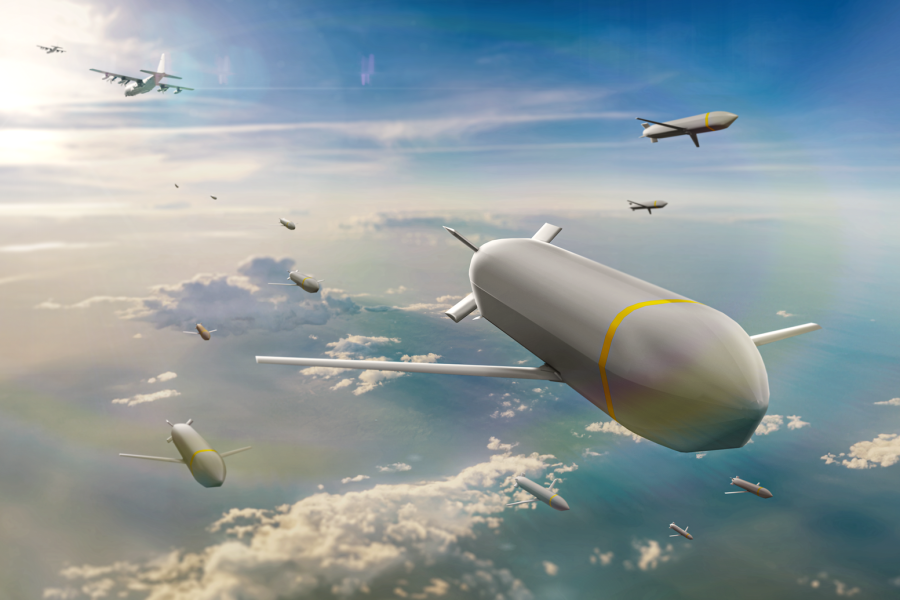
As the Air Force looks to buy more low-cost muntions, industry players have raced to develop options, including palletized munitions.
Leidos is developing a Small Cruise Missile, called Black Arrow, and designated AGM-190A by the Air Force in February, that is a low-cost munition capable of being launched by a pallet.
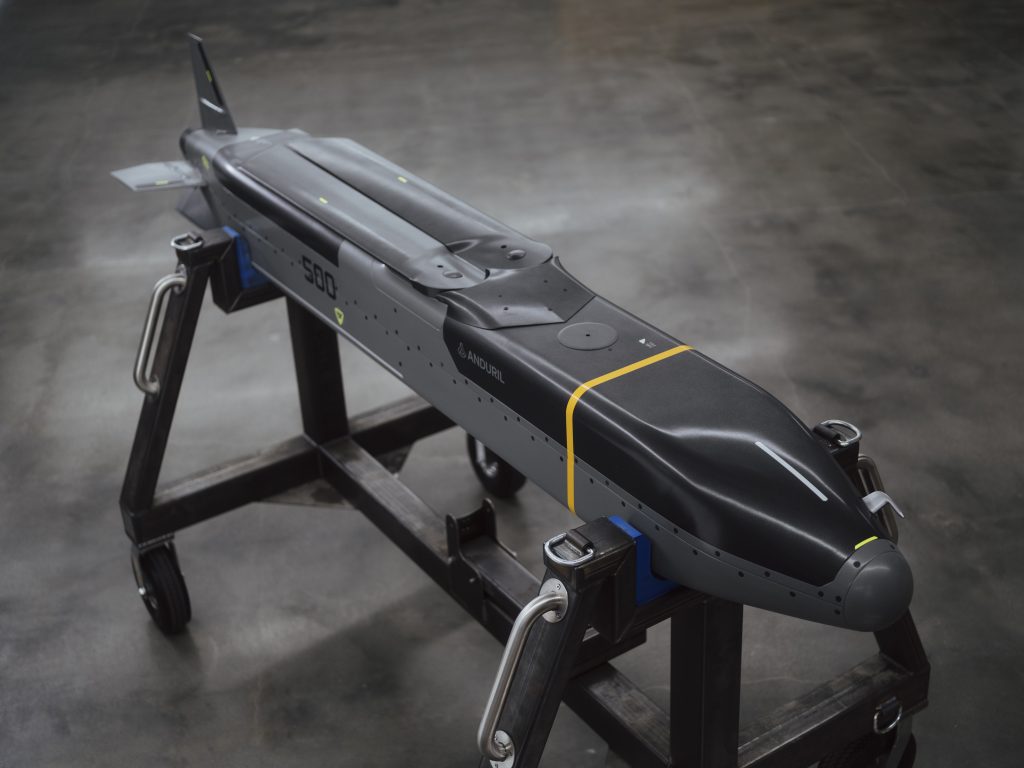
Anduril’s Barracuda-500 is designed for cargo-launched, palletized use.
Lockheed Martin has built two versions of its Common Multi-Mission Truck system, or CMMT. The CMMT-D is an unpowered glide vehicle, and the smaller CMMT-X has a motor. In testing, the CMMT-D was dropped vertically from a pallet, as it would with a cargo aircraft such as the C-17. The CMMT-D is expected to cost $150,000.