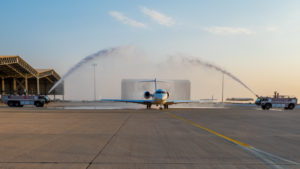
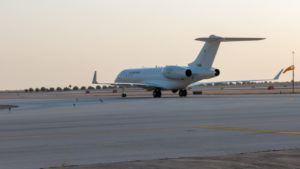
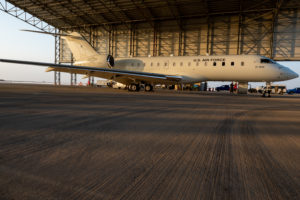
A U.S. Air Force E-11A BACN aircraft lands at Prince Sultan Air Base, Kingdom of Saudi Arabia, Dec. 16, 2022. U.S. Air Force photo by Staff Sgt. Shannon Bowman
Audio of this article is brought to you by the Air & Space Forces Association, honoring and supporting our Airmen, Guardians, and their families. Find out more at afa.org
The Air Force deployed a brand new version of one of its prized communications aircraft to Saudi Arabia, the service said in a Jan. 2 news release. An E-11A equipped with a Battlefield Airborne Communication Node, or BACN, arrived at Prince Sultan Air Base in the middle of last month, according to the service.
The E-11A is a high-demand, low-inventory asset. Previously the Air Force had just three E-11A aircraft, which operate in the U.S. Central Command area of responsibility. The new E-11A, serial number 21-9045, was transferred to the Air Force by airframe manufacturer Bombardier in September and arrived in Saudi Arabia on Dec. 16.
The BACN payload, made by Northrop Grumman, is able to relay and translate information from air assets and ground troops. It allows aircraft with different data links to work together and provides a way to transmit information over mountainous terrain, a feature that proved useful in supporting U.S. operations in Afghanistan. Air Force officials have often described BACN in simple terms as “Wi-Fi in the sky.”
While the U.S. war in Afghanistan is over, CENTCOM still requires plenty of communication among its forces. U.S. troops are on the ground in Syria helping combat the remnants of ISIS, while Air Forces Central aircraft fly combat air patrols, conduct air strikes, and practice counter-drone exercises.
“We supply communication coverage to ground and air forces in active combat zones, who require consistent, clear communications to higher levels of leadership and other command and control assets,” Lt. Col. Todd Arthur, the commander of the 430th Expeditionary Electronic Communications Squadron, said in a statement. The 430th EECS is the only unit in the Air Force to operate the E-11A, which is a modified Bombardier Global business jet that is used for the niche BACN payload. As a result, all of the Air Force E-11A pilots are volunteers who moved over from other aircraft.
Tragically, one of the Air Force’s E-11As crashed in Afghanistan in 2020, killing the two pilots.
“The Air Force and U.S. Congress have recognized what the E-11A platform brings to the fight,” Arthur said.
Audio of this article is brought to you by the Air & Space Forces Association, honoring and supporting our Airmen, Guardians, and their families. Find out more at afa.org
Roughly two of every five fighters in the Air Force fleet could be F-35As by 2035, according to a new fighter force structure report the service submitted to Congress on Oct. 16. Lt. Gen. David Tabor, deputy chief of staff for plans and programs, revealed the new estimate during an…
The Air Force Life Cycle Management Center is moving forward with a program to upgrade a quarter-century-old computing system for some F-16 fighter jets.
The U.S. Navy on Oct. 15 accepted a C-130J-30 Super Hercules plane that it will modify to become the first of its new nuclear command, control, and communications aircraft—a route the Air Force is considering for a similar NC3 mission under congressional direction.
More than 40 years after the original YF-117 operational prototype flew test runs from a Lockheed Martin Skunk Works facility, an F-117 returned for a $1 million refurbishment to look its best when it assumes its place in history alongside other iconic aircraft on permanent exhibit at the National Air…
A U.S. Air Force F-22 pilot controlled a YFQ-44A Fury Collaborative Combat Aircraft this month while both aircraft were in flight, according to an Oct. 16 release, another milestone in the service’s ambitious CCA efforts.
The Marine Corps recently conducted its first-ever “ripple” release of eight Small Diameter Bomb IIs from an F-35B, a key early step in proving out the capability for all F-35 variants.
The Air Force will field operational prototypes for an autonomous drone to replace its MQ-9 Reaper in 2028, Secretary of the Air Force Troy Meink said Oct. 14.
One of the Air Force’s critical B-2 Spirit stealth bombers has returned to Whiteman Air Force Base, Mo., after an extensive course of maintenance to restore its stealth coating and preserve its structural integrity.
BAE Systems has received a contract from Lockheed Martin to install an upgraded Block 4 electronic warfare system into new F-35 Joint Strike Fighters, as well as to retrofit some older jets.
✓
Thank You!
Check your inbox to verify your email address and finish setting up your AFA account.
★
Welcome Back!
An account with this email already exists. Please log in to continue.
Subscribe to the Air & Space Forces Daily Report
The latest news from Air & Space Forces Magazine, as well as news from other leading publications, delivered right to your inbox every morning!
We’re sorry, there has been an error. Please review your input or try again later.