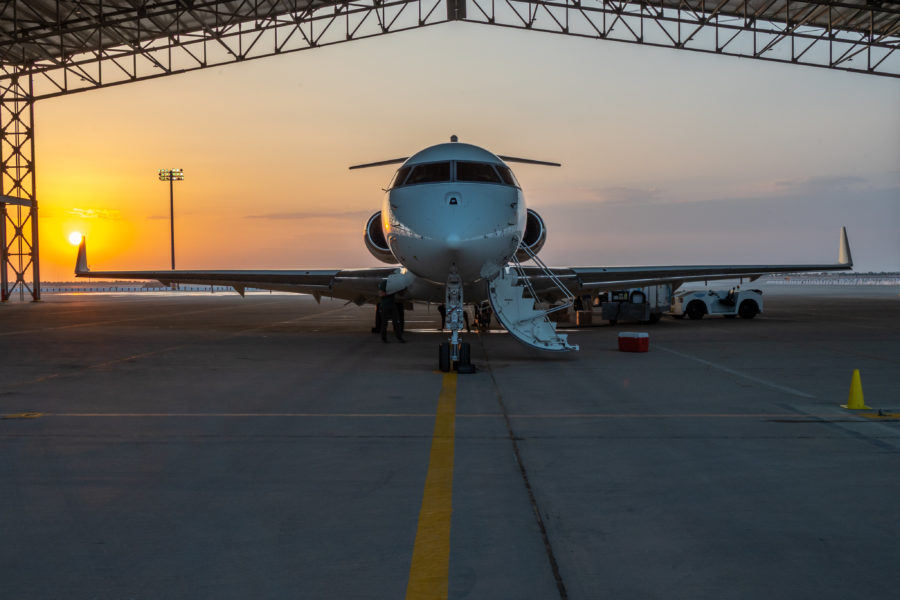
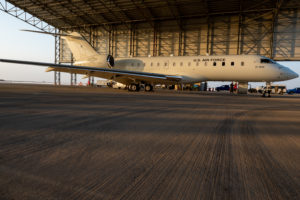
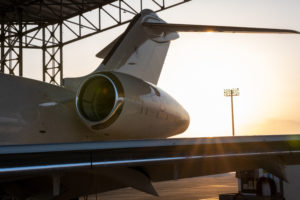
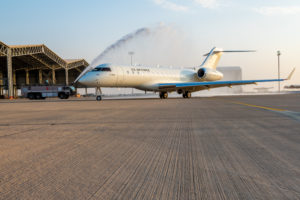
A U.S. Air Force E-11A BACN aircraft lands at Prince Sultan Air Base, Kingdom of Saudi Arabia, Dec. 16, 2022. U.S. Air Force photo by Staff Sgt. Shannon Bowman
Audio of this article is brought to you by the Air & Space Forces Association, honoring and supporting our Airmen, Guardians, and their families. Find out more at afa.org
The Air Force deployed a brand new version of one of its prized communications aircraft to Saudi Arabia, the service said in a Jan. 2 news release. An E-11A equipped with a Battlefield Airborne Communication Node, or BACN, arrived at Prince Sultan Air Base in the middle of last month, according to the service.
The E-11A is a high-demand, low-inventory asset. Previously the Air Force had just three E-11A aircraft, which operate in the U.S. Central Command area of responsibility. The new E-11A, serial number 21-9045, was transferred to the Air Force by airframe manufacturer Bombardier in September and arrived in Saudi Arabia on Dec. 16.
The BACN payload, made by Northrop Grumman, is able to relay and translate information from air assets and ground troops. It allows aircraft with different data links to work together and provides a way to transmit information over mountainous terrain, a feature that proved useful in supporting U.S. operations in Afghanistan. Air Force officials have often described BACN in simple terms as “Wi-Fi in the sky.”
While the U.S. war in Afghanistan is over, CENTCOM still requires plenty of communication among its forces. U.S. troops are on the ground in Syria helping combat the remnants of ISIS, while Air Forces Central aircraft fly combat air patrols, conduct air strikes, and practice counter-drone exercises.
“We supply communication coverage to ground and air forces in active combat zones, who require consistent, clear communications to higher levels of leadership and other command and control assets,” Lt. Col. Todd Arthur, the commander of the 430th Expeditionary Electronic Communications Squadron, said in a statement. The 430th EECS is the only unit in the Air Force to operate the E-11A, which is a modified Bombardier Global business jet that is used for the niche BACN payload. As a result, all of the Air Force E-11A pilots are volunteers who moved over from other aircraft.
Tragically, one of the Air Force’s E-11As crashed in Afghanistan in 2020, killing the two pilots.
“The Air Force and U.S. Congress have recognized what the E-11A platform brings to the fight,” Arthur said.
Audio of this article is brought to you by the Air & Space Forces Association, honoring and supporting our Airmen, Guardians, and their families. Find out more at afa.org
One year into a new campaign to boost readiness rates for the B-1B Lancer and B-52H Stratofortress bombers, Air Force Global Strike Command is claiming some early wins and planning to forge ahead with more improvements.
Over the past few months and peaking in August, crews with the 910th Airlift Wing out of Youngstown Air Reserve Station, Ohio, have been running nighttime, low-flying missions to kill a ubiquitous and deadly adversary that’s plagued Americans for centuries—mosquitoes.
An Iranian ballistic missile attack on a key U.S. air base in Jordan damaged multiple U.S. warplanes, people familiar with the matter confirmed to Air & Space Forces Magazine.
General Atomics has unveiled the first renderings of its Wildfire drone, which it plans to pitch for the Air Force’s hunt for a new, low-cost Massed Modular Aircraft.
In the small world of Air Force weather specialists, combat weather specialists are a niche unto themselves, deploying with Army ground units to provide forecasts and, if need be, fight alongside those Soldiers. For Staff Sgt. Francisco Estrada, the hardest part of the job isn’t the possibility of ground combat,…
Startups Anduril Industries and Heremus have agreed to integrate Anduril’s autonomy software onto Hermeus’ hypersonic demonstrator aircraft “Quarterhorse”—uniting two technologies that have drawn keen interest and investment from the Air Force.
In a dramatic flare-up in the hostilities between the U.S. and Iran, American forces struck and destroyed five Iranian oil tankers Sept. 8, U.S. Central Command said. Iran retaliated by lobbing ballistic missiles toward a major U.S. base in Jordan.
After months of delays, the first F-15EX fighter jet the U.S. Air Force will permanently base overseas left Boeing’s facilities in St. Louis on Aug. 28. Eventually, the aircraft will fly to Kadena Air Base in Japan and join the 18th Wing there, but for now it is going to…