
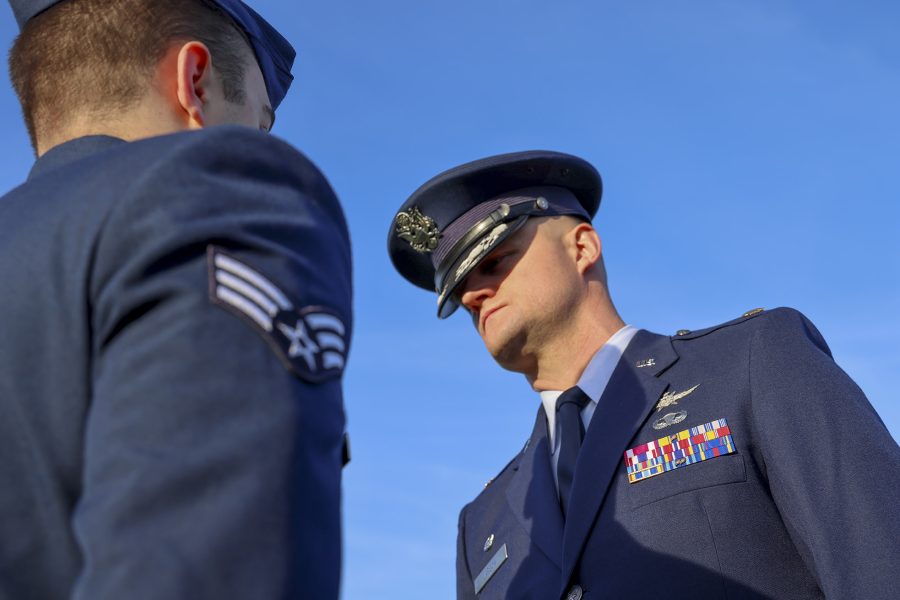
Air Force senior leaders are dialing back a forcewide requirement for commanders to hold quarterly “standards and readiness reviews” of their Airmen to once per year.
Acting Air Force Vice Chief of Staff Lt. Gen. Scott L. Pleus notified all major commands of the change in a Dec. 17 message, leaked to the unofficial Air Force amn/nco/snco Facebook page. An Air Force spokesperson confirmed the message’s authenticity Dec. 18 to Air & Space Forces Magazine.
Pleus directed unit commanders to conduct annual, unitwide SRRs to ensure adherence to standards and to “identify and address factors inhibiting mission readiness and execution,” the message states.
That’s a major change from February, when Pleus had directed unit commanders to conduct SSRs four times a year, beginning March 31, as part of a push for stricter enforcement of standards.
That directive prompted “a lot of feedback from the field that there wasn’t a lot of trust in noncommissioned officers” to make sure their Airmen are maintaining standards, according to a senior Air Force official.
Chief Master Sergeant of the Air Force David R. Wolfe said as much in a Dec. 18 social media post.
“We’ve heard your feedback from the field, and we listened,” Wolfe wrote. “Standards and Readiness Reviews (SRRs) are now required only ONCE a year. This change reflects confidence in our leaders to know their Airmen, manage readiness, and address issues on the daily, not just during a scheduled review.
“Trust is foundational to our Air Force. We trust our NCOs and SNCOs to uphold standards and maintain readiness every day,” Wolfe added. “Annual reviews will balance the time and energy we spend to focus on what matters most: the mission and our people.”
Ordering commanders to hold inspections is nothing new. Before taking over as the new Air Force Chief of Staff, Gen. Kenneth S. Wilsbach ordered similar inspections for Airmen during his time as head of Air Combat Command. His June 10, 2024 memo to ACC noted that a “discernible decline in the commitment to, and enforcement of, military standards in the Air Force.”
The reduced number of required inspections, however, doesn’t mean senior leaders are no longer concerned about enforcing standards across the force.
“We must embrace building our warrior culture on standards—technical excellence, accountability, and our pride in our profession,” Pleus wrote. “If adherence to standards erodes, our competitive advantage evaporates. We know lapses in disciplined execution and enforcement of standards contribute to preventable incidents, to include fatal accidents. This must change.”
Pleus, who has acted as Vice Chief of Staff for the past nine months, may soon relinquish the post to Gen. John D. Lamontagne. President Donald Trump recently nominated Lamontagne as the next Vice Chief, and the Senate must consider his nomination.
Commanders are required to begin annual SRRs after Jan. 1 and to focus on inspecting the overall readiness of their Airmen.
“The SRR is more than a mere dress and appearance inspection; it emphasizes holistic readiness, ensuring personnel are equipped to perform their assigned missions while fostering a culture of warfighters focused on readiness, resilience and excellence,” Pleus wrote.
SRRs should include records reviews to assess deployment readiness, training performance, physical fitness test scores and overall resilience, he wrote. Commanders or their delegated representatives should ensure Airmen are up to date on virtual Record of Emergency Data, family care plans, and Servicemembers Group Life Insurance.
Individuals’ uniform, conduct, and professional appearance will also be graded during an SSR, the message states. It’s up to the individual commander to select the SSR uniform.
Proper dress and personal appearance standards consist of five elements—neatness, cleanliness, safety, uniformity, and military image, Pleus wrote.
“It is critical that commanders ensure their Airmen present a professional image during the SSR,” he wrote.
Airmen with medical waivers or religious accommodations for dress and appearance “will be required to produce the appropriate documentation at all SSRs,” Pleus wrote. He directed commanders to coordinate with legal offices to establish appropriate procedures to protect Airmen’s privacy, medical and religious rights during SSRs.
The Air Force is working on new policies to ensure it is compliant with Defense Secretary Pete Hegseth’s crackdown on grooming standards. The service is limiting medical shaving profiles to a maximum of six months and will soon require Airmen and Guardians with profiles to undergo medical reevaluation for profile renewal. The Air Force is also working on an implementation plan for new standards for Airmen and Guardians who have religious accommodations to wear beards.
Following SRRs, commanders will “appropriately document discrepancies and ensure corrective action is accomplished consistent with applicable law and policy,” the message states. Pleus added that commanders have a range of options to hold Airmen accountable to standards, including actions under the Uniform Code of Miliary Justice.
Reporting SSR results to higher headquarters is not required, but unit commanders should consider reporting trends to the Inspector General Evaluation Management System when appropriate, the message states.
Commanders can either hold a command-wide SSR or multiple SSRs for individual units to allow flexibility to training schedules, leave policies, and official travel, the message states. Commanders should minimize reinspecting Airmen multiple times a year unless it is “necessary to follow up an unsatisfactory earlier inspection,” the message states.
“Every Airman contributes to our shared purpose to fly and fix [aircraft] so we are ready to fight and win,” Pleus wrote. “We must embrace building our warrior culture on standards—technical excellence, accountability, and our pride in our profession.”