
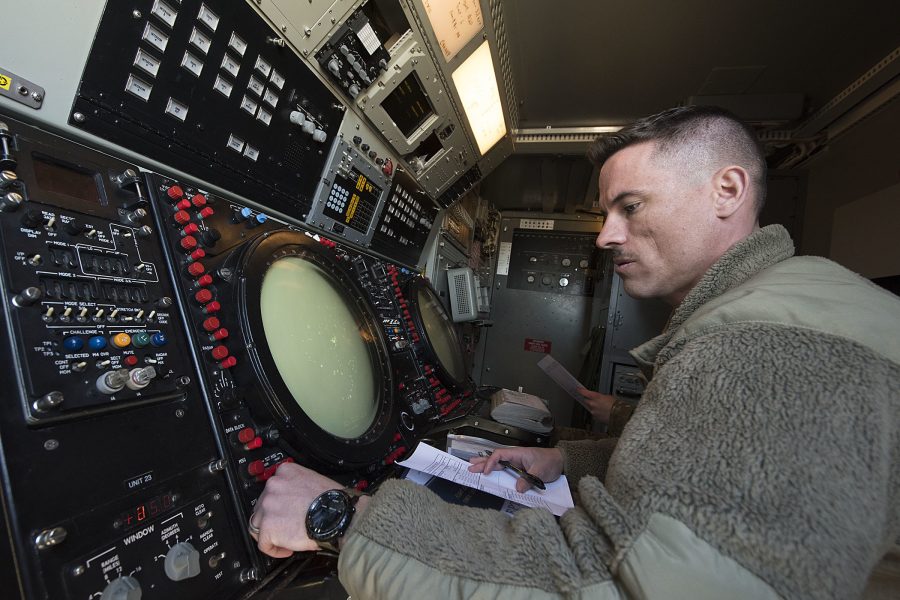
The Air National Guard will deactivate an air control squadron in Georgia and dozens of similar billets in Iowa, converting the unit and positions to do cyber operations.
In separate announcements made Feb. 20, the Air Force said the changes would eliminate 83 jobs beteen the two states, while opening up new roles for cyber.
Fort Gordon, Ga., will get new cyber squadrons, according to the release, while the 177th Air Control Squadron at Hunter Army Airfield in Savannah, Ga., will be inactivated. The state will see a net loss of four full-time and 39 part-time personnel.
Meanwhile, the Iowa Air National Guard will lose seven full-time and 33 part-time personnel authorizations as jobs are reassigned to the existing 132nd Wing in Des Moines, Iowa. The Iowa Guard previously had the 133rd Test Squadron, responsible for evaluating command-and-control capabilities, but that unit deactivated in March 2025.
Cyber units at both locations are expected to reach full operational capability by 2030.
The decison to cut half of the Air National Guard’s Tactical Air Control Party and Control and Reporting Center missions dates to last year’s budget, which noted the impact of technological advancements on manpower requirements on the units, which do threat warning, battle management, theater missile defense, weapons control, combat identification, along with strategic communications.
The legacy Control and Reporting Center combines the AN/TPS-75 radar, AN/TYQ-23 operations module, communications terminals, and additional gear, a substantial package that takes six C-17s to deploy. By contrast, the new Tactical Operations Center-Light (TOC-L) packs into 35 cases on a single 4,500-pound pallet, small enough to load into a single C-130.
The TOC-L fuses data from 750 radar feeds into a single interface, with artificial intelligence built in to help battle managers prioritize targets and determine actions.
The Air Force accepted 16 prototypes in 2023 and ordered 40 new TOC-L kits from contractor Booz Allen a year ago.
TOC-L is among the components that will ultimately come together in the Department of the Air Force Battle Network. Lt. Gen. Luke C.G. Cropsey, who led the project for the past several years, has called TOC-L the “basic building block” for future command and control infrastructure.
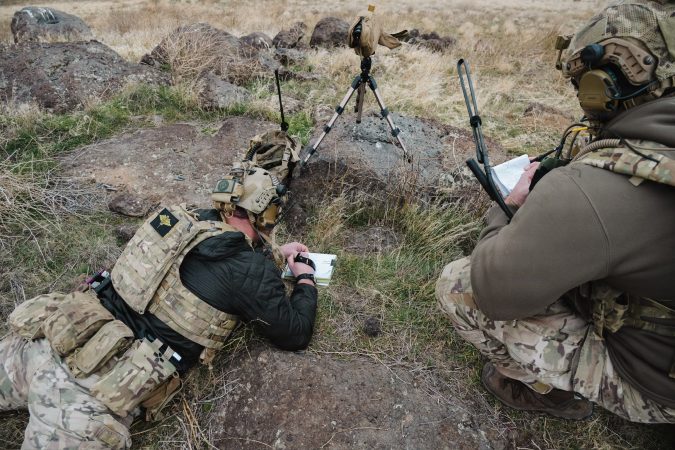
TACPs deploy with special operations units and work as liaisons between forces on the ground and in the air for a variety of close support missions. Their close air support role will be less relevant in a fight with the Chinese military, Air Force leaders say, while demand for cyber capabilities continues to rise.
The service first announced plans to cut the TACP community nearly in half in 2023, and those cuts were codified in the 2025 defense budget. At the time, officials planned to cut the total TACP workforce—enlisted, officers, and civilians—from 3,700 to 2,130, or 44 percent.
An Air Force spokesman, Maj. Patrick Gargan, said at the time that around 80 percent of TACP jobs were filled, and the service would begin its cuts with those vacant positions.
Most Active-Duty TACPs work as part of air support operations squadrons under the 93rd Air Ground Operations Wing at Moody Air Force Base, Georgia, and the 435th AGOW at Ramstein Air Base, Germany.
The cuts to TACP personnel dovetail with the Air Force’s retirement of certain aircraft, such as the A-10 Thunderbolt II, a close support jet. Air & Space Forces Magazine recently reported that the last A-10 is slated to leave depot maintenance at Hill Air Force Base, Utah, at the end of February.
Maintenance personnel for the A-10 will be reassigned to lines working on the F-35, F-16, and C-130, the Air Force announced. In recent budget documents, Air Force officials have aimed to fully divest from the aircraft by 2028.