
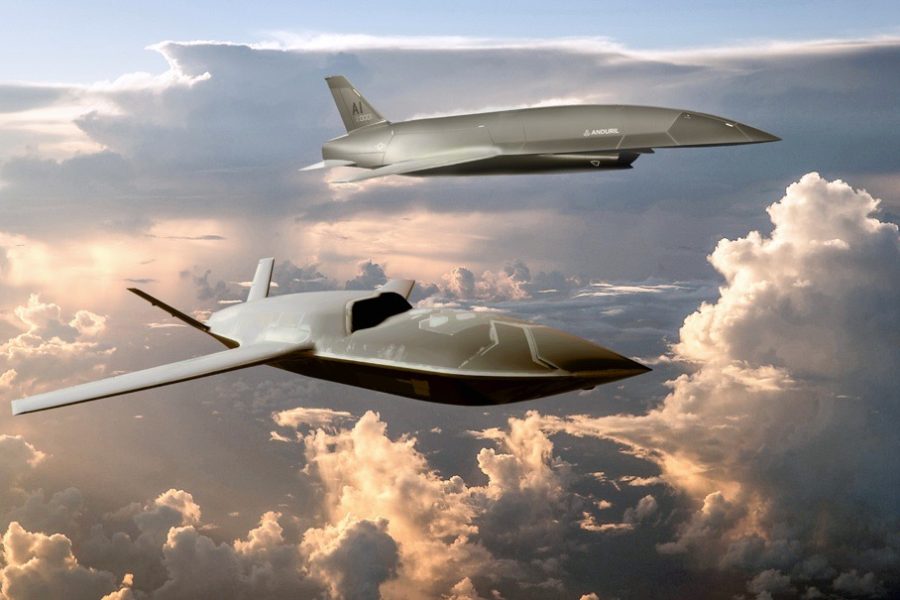
The Air Force is working with Collins Aerospace and Shield AI to develop the software Collaborative Combat Aircraft will use to fly missions alongside manned fighters, the service revealed Feb. 12—and drone-maker General Atomics was quick to announce it has already flown its YFQ-42A aircraft with Collins’ system.
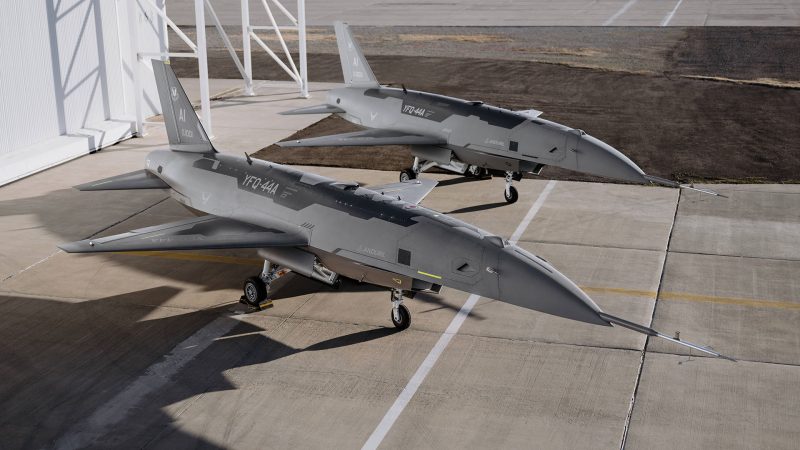
Shield AI, meanwhile, said Feb. 13 it expects to start flight testing its software on Anduril Industries’ YFQ-44A drone “in the coming months.”
The two companies are developing “mission” autonomy software, which will allow CCAs to take complex action when given basic directions from a pilot in a manned aircraft. Shield AI, for example, noted in a release that its system allows aircraft to “reroute around no-fly zones, avoid or engage obstacles, respond to unexpected conditions, and complete missions safely and effectively without human intervention.”
That’s separate from but related to the flight autonomy software responsible for executing basic or preplanned operations, like taking off, sticking to a flight path, or landing.
Anduril and General Atomics have been publicly competing to build the first aircraft for the CCA program since April 2024, and the Air Force has announced milestones like first flights and designations.
By comparison, the competition to build the software that will enable the drones to operate semi-autonomously had been kept largely secret until now. Back in July 2024, officials revealed that five companies were working on the “mission” software side of the program but declined to name them citing security concerns. Then, in September 2025, Aviation Week reported that Collins and Shield had been selected to move forward, but no official announcement followed.
Now, nearly six months later, the Air Force has confirmed the two firms’ selection. The service release touted the integration of both into the Autonomy Government Reference Architecture—the open, universal standard the government has set for mission autonomy software that all contractors must build their systems to comply with.
“Verifying A-GRA across multiple partners is critical to our acquisition strategy,” Col. Timothy Helfrich, portfolio acquisition executive for fighters and advanced aircraft, said in a statement. “It proves that we are not locked into a single solution or a single vendor. We are instead building a competitive ecosystem where the best algorithms can be deployed rapidly to the warfighter on any A-GRA compliant platform, regardless of the vendor providing the algorithm.”
Collins is paired with General Atomics, while Shield AI is working with Anduril—feeding into the dynamic of “established Pentagon supplier vs. Silicon Valley startup” that has defined the GA-Anduril competition. Collins has gone through various mergers and acquisitions but traces its roots back decades, while Shield AI was founded in 2015 and quickly expanded with backing from venture capital firms.
Shortly after the Air Force made its announcement, General Atomics published its own release with additional details on how it has already started flight testing Collins’ software on the YFQ-42A.
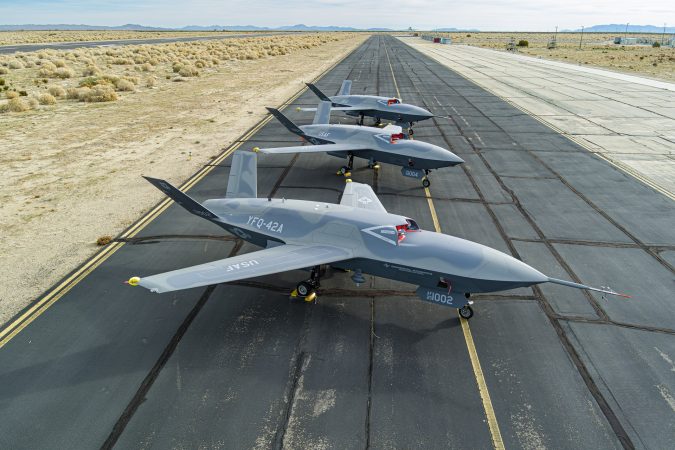
Testing began earlier this month, GA’s release states, and Collins’ software, dubbed “Sidekick,” controlled the drone for more than four hours. During that time, a human operator on the ground provided “various commands” to the drone and the software interpreted those commands and directed the aircraft to execute them “with high accuracy,” the release states.
GA’s release also notes that since the YFQ-42A made its first flight in August 2025, the company has built and flown “multiple” aircraft, including instances of “push-button autonomous takeoffs and landings”—using flight autonomy software separate from the mission software. An image accompanying the release shows three YFQ-42s on a flightline.
Ryan Bunge, vice president and general manager for strategic defense solutions at Collins, said in a statement that “the rapid integration of Sidekick onto this platform to perform various combat-relevant tasks highlight the strength and adaptability of Collins’ open systems approach. The autonomy capabilities showcased in this flight highlight nearly a decade of dedicated investment and close collaboration with our customers to advance collaborative mission autonomy.”
Anduril and Shield AI, meanwhile, released their own statements promising flight tests with Shield’s “Hivemind” autonomy software in the near future—Shield’s release states that flight demonstrations are expected “in the coming months,” while Anduril’s says the firm is looking forward to a first flight “very soon.”
Shield noted in its release that Hivemind has already operated on multiple other aircraft, including General Atomics’ MQ-20 Avenger drone, the U.S. Navy’s BQM-177 target drone, and Airbus’ H145 helicopter.
“Shield AI is proud to be named a mission autonomy provider supporting the Collaborative Combat Aircraft program,” Gary Steele, the firm’s CEO, said in a statement. “The Air Force is moving with urgency to explore how autonomy can reshape air combat, and we have spent years preparing for this—building, testing, and flying mission autonomy in the real world. We will work relentlessly to deliver and to help advance the next era of airpower alongside the Air Force and its industry partners.”
Anduril, meanwhile, emphasized the YFQ-44A’s modularity.
“The aircraft’s simple design, external weapons stores, and open hardware and software architectures ensure that the aircraft can easily be configured with a range of mission systems, software suites, and payloads to support a wide variety of missions,” Jason Levin, senior vice president of engineering, said.