
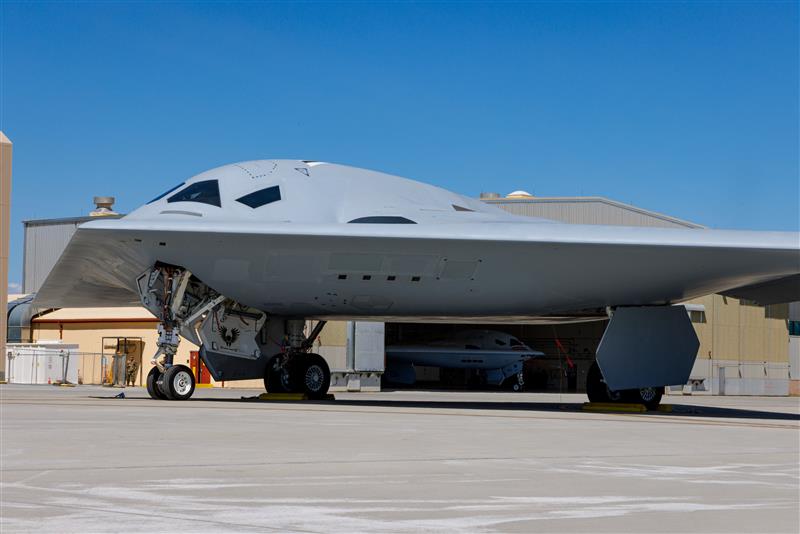
AURORA, Colo.—The Air Force and Northrop Grumman have struck a $4.5 billion deal to speed up production of B-21 bombers by 25 percent.
Secretary of the Air Force Troy E. Meink announced the deal during his Feb. 23 keynote address to open AFA’s Warfare Symposium, and the service provided more details in a statement.
Among those details, the Air Force release states that the B-21 remains on schedule to be “on the ramp” at its first operational base, Ellsworth Air Force Base, S.D., in 2027. Previously, officials had said only that they expected the B-21 to enter service in the “mid-2020s.”
The new production deal has been in the works for months, since Congress earmarked $4.5 billion specifically to accelerate B-21 production as part of its reconciliation package—officially called the One Big Beautiful Bill Act—last summer.
Northrop CEO Kathy Warden said last month she expected to strike a deal by the end of March, and Meink confirmed it was done with a single line in his speech: “B-21 is doing well, and we’ve recently reached an agreement to increase production capacity.”
In a statement, Meink added that “accelerating production capacity now ensures we deliver operational capability to combatant commanders faster—strengthening our ability to outpace, deter, and, if necessary, defeat emerging threats.”
In its release, the Air Force confirmed the deal uses all of the $4.5 billion provided by Congress.
“This agreement accelerates the approved acquisition profile by increasing annual production capacity by 25 percent, compressing delivery timelines while preserving cost and performance discipline,” according to the statement.
The exact production rate for the B-21 remains classified, though sources previously suggested it would be about seven per year. So an increase of 25 percent could equate to as many as two more bombers per year, once full production is reached. Right now, the program is in low-rate initial production, which is expected to cover 21 aircraft over five lots.
The agreement does not appear to increase the total number of B-21s the Air Force is buying. The current requirement is for a minimum of 100 aircraft, and while current and former leaders at U.S. Strategic Command and Air Force Global Strike Command have argued in favor of 145 bombers or more, officials continue to say the program of record has not changed.
Northrop and the Air Force have described the B-21 as the world’s first sixth-generation aircraft. It is intended to replace both the B-1B and B-2 in USAF’s bomber fleet and serve as the bedrock of the service’s long-range strike capability.